Owner Operator Detention Pay: How Much You Really Collect
KEY TAKEAWAYS
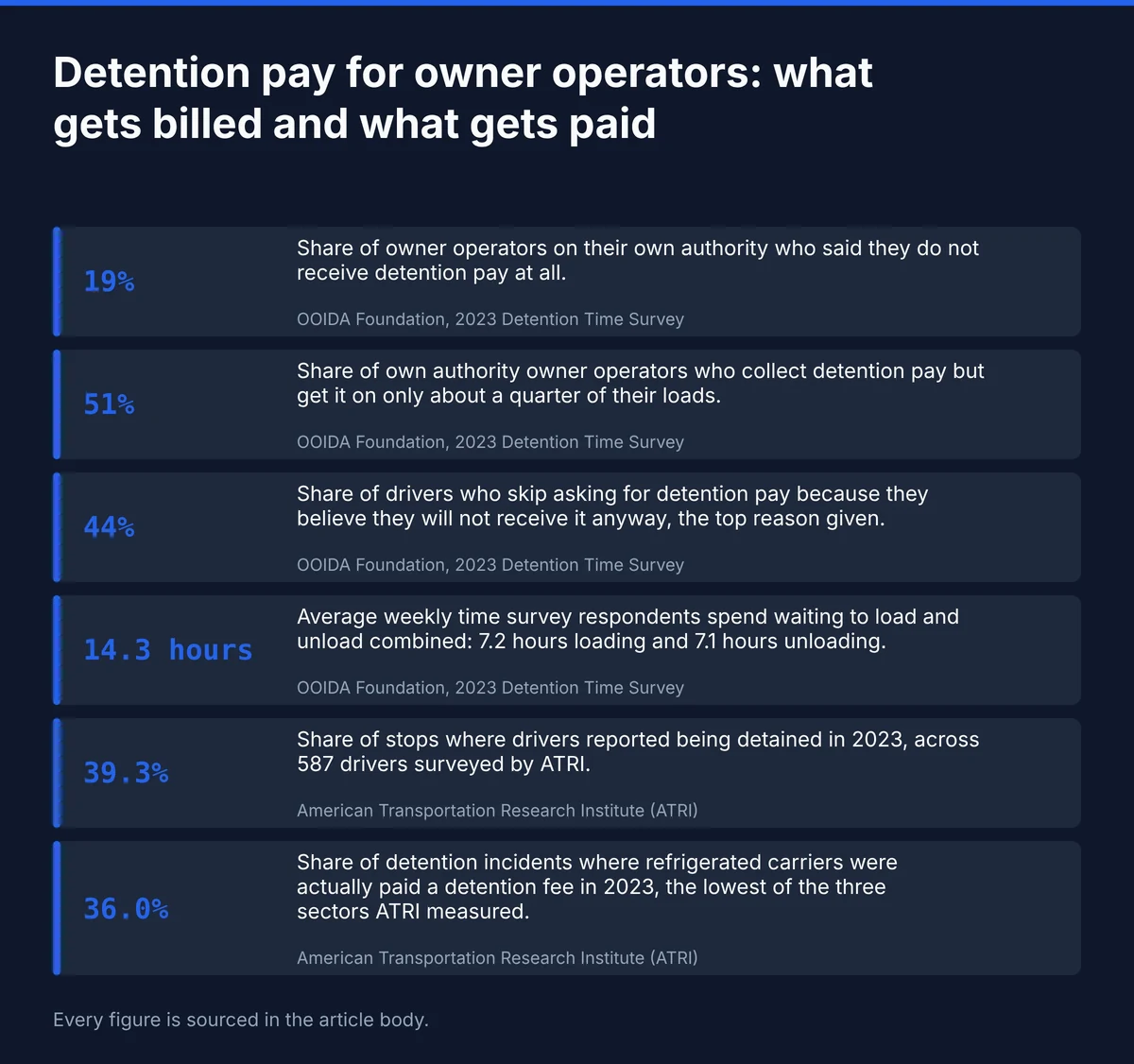
- → 19% Share of owner operators on their own authority who said they do not receive detention pay at all. (OOIDA Foundation, 2023 Detention Time Survey, 2023)
- → 51% Share of own authority owner operators who collect detention pay but get it on only about a quarter of their loads. (OOIDA Foundation, 2023 Detention Time Survey, 2023)
- → 44% Share of respondents who skip asking for detention pay because they believe they will not receive it anyway, the top reason given among those who do not always ask. (OOIDA Foundation, 2023 Detention Time Survey, 2023)
- → 14.3 hours Average weekly time survey respondents spend waiting to load and unload combined: 7.2 hours loading and 7.1 hours unloading. (OOIDA Foundation, 2023 Detention Time Survey, 2023)
- → 39.3% Share of stops where drivers reported being detained in 2023, across 587 drivers surveyed by ATRI. (ATRI 2024 detention study)
- → 36.0% Share of detention incidents where refrigerated carriers were actually paid a detention fee in 2023, the lowest of the three sectors ATRI measured. (American Transportation Research Institute (ATRI), 2023)
- → $50 Median detention fee per hour charged by truckload carriers in ATRI's carrier survey; $60 for refrigerated and $80 for specialized. (American Transportation Research Institute (ATRI), 2023)

Among own authority owner operators who collect detention pay, only 35% say they get it on all of their loads. (OOIDA Foundation, 2023 Detention Time Survey, 2023) Another 51% of those collectors get it on about a quarter of their loads, and separately 19% of all own authority respondents collect nothing at all.
The carrier numbers are not much better. In 2023, truckload carriers billed detention on 79.0% of incidents and collected 55.0% of what they billed, so fees were paid on 43.5% of incidents. (American Transportation Research Institute (ATRI), 2023) Refrigerated carriers did worse, with fees paid on 36.0% of incidents.
I found no public survey that compares the dollars an owner operator bills with the dollars that arrive. This page puts the two best data sets side by side, works out what an hour of waiting is worth, and says where the numbers stop. If you run under your own trucking authority, read the first two sections first.
1 How Much Detention Pay Do Owner Operators Really Collect?
Among own authority owner operators who collect detention at all, 35% get paid on all loads, 51% on about a quarter of loads and 12% on about half. Separately, 19% of all own authority respondents receive no detention pay. The OOIDA Foundation surveyed its members in late 2023. (OOIDA Foundation, 2023 Detention Time Survey, 2023)
| METRIC | VALUE | SOURCE |
|---|---|---|
| Collectors paid on all loads | 35% | OOIDA Foundation, 2023 Detention Time Survey |
| Collectors paid on about a quarter of loads | 51% | OOIDA Foundation, 2023 Detention Time Survey |
| Collectors paid on about half of loads | 12% | OOIDA Foundation, 2023 Detention Time Survey |
| Own authority respondents who receive no detention pay (share of all) | 19% | OOIDA Foundation, 2023 Detention Time Survey |
| Median detention pay received per hour | $50 | OOIDA Foundation, 2023 Detention Time Survey |
| Median hourly rate respondents call fair | $75 | OOIDA Foundation, 2023 Detention Time Survey |
Here is a rough way to read those answers together. Score each answer as the share of loads it names, so all loads counts as 100%, three quarters as 75%, half as 50% and a quarter as 25%. Owner operators who collect then get paid on about 56% of loads. Count the 19% who collect nothing as zero, and the average across all own authority owner operators falls to about 45%. That is my arithmetic on the survey's answer groups, not a figure the OOIDA Foundation publishes, and it treats the 19% and the collectors as two separate groups. It lands in the same range as ATRI's carrier figure for truckload freight. The survey covers 253 members who chose to answer out of 18,788 who were emailed, so it describes members and not every owner operator, and it measures how often pay arrives, not the dollars. ATRI summarizes the same survey as payment on about 25% of detained loads, but the survey's own table shows about half of collectors answering a quarter of loads, so I use the table.
Where you collect matters too. 70% of own authority respondents named the broker as the way they collect, so your pay depends on the broker passing along what the customer owes. Brokers also take a cut of every load, as what freight brokers keep explains, and the time to settle detention terms is before you book, as we cover in getting better rates from freight brokers. If you are leased on, 65% collect through the carrier instead, so the line to check is your settlement. Our guide to lease on carrier terms shows that a lease should say who pays for detention, and what to look for on a settlement.
2 Do Owner Operators Even Ask for Detention Pay?
Only 49% of own authority owner operators always ask for detention pay. 15% usually ask, 25% ask occasionally and 11% never do. Among respondents who do not always ask, the top reason was expecting not to be paid anyway, named by 44%. (OOIDA Foundation, 2023 Detention Time Survey, 2023)
| METRIC | VALUE | SOURCE |
|---|---|---|
| Always ask for detention pay | 49% | OOIDA Foundation, 2023 Detention Time Survey |
| Usually ask | 15% | OOIDA Foundation, 2023 Detention Time Survey |
| Occasionally ask | 25% | OOIDA Foundation, 2023 Detention Time Survey |
| Never ask | 11% | OOIDA Foundation, 2023 Detention Time Survey |
| Top reason for not asking: expect no payment (share of those who skip) | 44% | OOIDA Foundation, 2023 Detention Time Survey |
| Always ask but receive nothing (share of those who always ask) | 9% | OOIDA Foundation, 2023 Detention Time Survey |
Skipping the request is an understandable reaction to a bad record, but a customer that never receives a detention bill has little reason to change how it handles the wait. ATRI also found that carriers sometimes avoid pressing an important account for detention fees, and that this concern may weigh more on small carriers. 100% of surveyed fleets with more than 50 trucks reported charging detention, against 92% of fleets with 50 or fewer trucks. (American Transportation Research Institute (ATRI), 2023)
The same report says owner operators and small fleets shared that it can be hard to report detention quickly when the delay has already put them behind schedule. My advice is to send the notice from the dock while the clock runs, and to write down your arrival, check in and release times at the same moment. Those times are your proof when you bill.
Before you book, ask three questions. When does detention start, what does it pay per hour, and who submits the paperwork? Get the answers in writing on the rate confirmation. ATRI found that 67% of fleets start the clock at the 2 hour mark, yet 90% of OOIDA Foundation respondents want the traditional definition of detention eliminated, so do not assume the customer's rules match yours.
3 How Often Do Carriers Get Paid What They Bill?
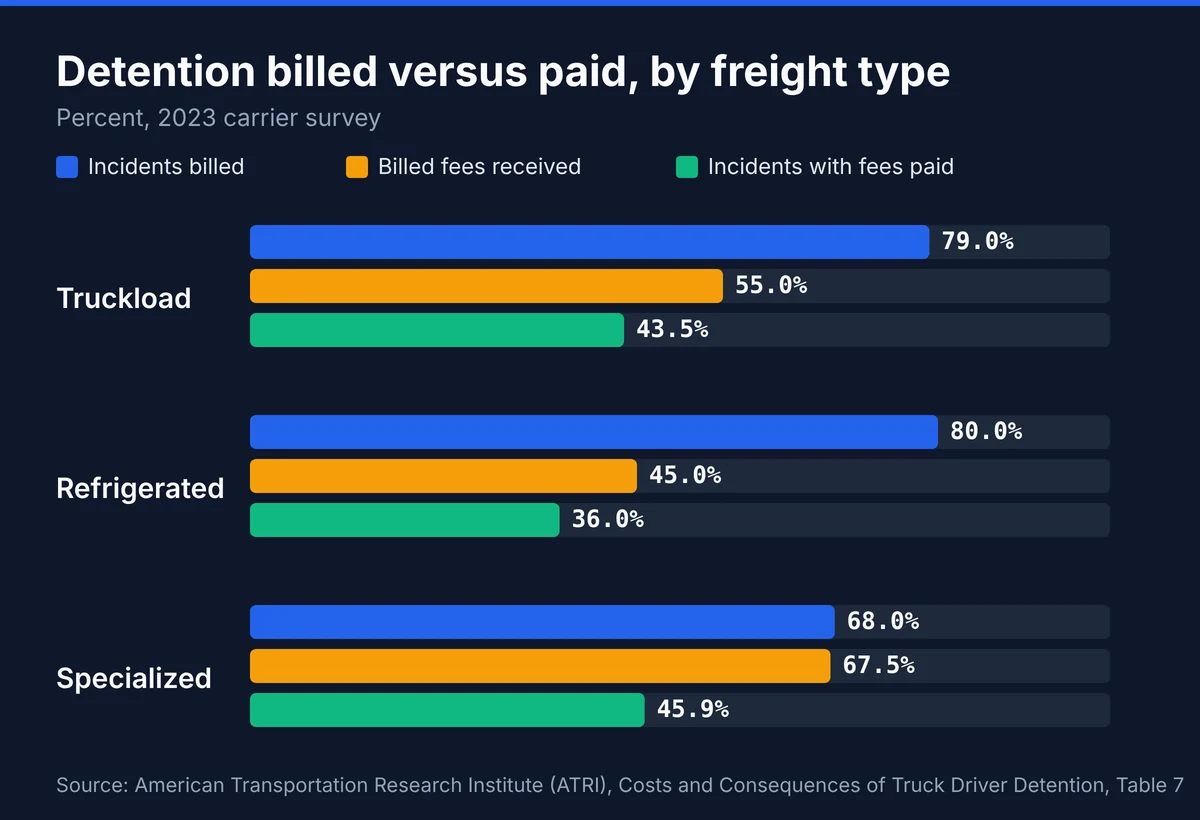
Carriers are paid on fewer than half of detention incidents. In ATRI's 2023 survey, truckload carriers billed 79.0% of incidents and collected 55.0% of the fees billed, so fees were paid on 43.5% of incidents. Refrigerated carriers collected on only 36.0%. (American Transportation Research Institute (ATRI), 2023)
| METRIC | VALUE | SOURCE |
|---|---|---|
| Truckload: incidents billed | 79.0% | American Transportation Research Institute (ATRI) |
| Truckload: billed fees received | 55.0% | American Transportation Research Institute (ATRI) |
| Truckload: incidents with fees paid | 43.5% | American Transportation Research Institute (ATRI) |
| Refrigerated: incidents billed | 80.0% | American Transportation Research Institute (ATRI) |
| Refrigerated: billed fees received | 45.0% | American Transportation Research Institute (ATRI) |
| Refrigerated: incidents with fees paid | 36.0% | American Transportation Research Institute (ATRI) |
| Specialized: incidents billed | 68.0% | American Transportation Research Institute (ATRI) |
| Specialized: billed fees received | 67.5% | American Transportation Research Institute (ATRI) |
| Specialized: incidents with fees paid | 45.9% | American Transportation Research Institute (ATRI) |
| Fleets that charge detention at least sometimes | 94.5% | American Transportation Research Institute (ATRI) |
Two leaks sit in those numbers. The first is billing: a carrier may skip the bill because the wait was under a billable interval, because the driver arrived late, or because it expects the customer will refuse. The second is collection, where the customer refuses or shorts the invoice. ATRI notes that a carrier may be unable to bill when the driver arrived late, even if the wait ran far longer than the lateness.
ATRI left owner operators out of its cost math, so treat these carrier figures as a benchmark and not as your number. Detention fees are also moving slowly. Detention clocks mostly start at the 2 hour mark, since 67% of fleets use it, and the fees attached to them have barely moved, as the next section shows. To see what a load really pays before you accept it, start with loads and rates.
4 What Is One Hour of Detention Worth?
ATRI's carrier survey found median detention fees of $50 per hour for truckload, $60 for refrigerated and $80 for specialized freight. Own authority owner operators who collect report a median of $50, while survey respondents call about $75 fair. (American Transportation Research Institute (ATRI), 2023)
| METRIC | VALUE | SOURCE |
|---|---|---|
| Median detention fee, truckload | $50 | American Transportation Research Institute (ATRI) |
| Median detention fee, refrigerated | $60 | American Transportation Research Institute (ATRI) |
| Median detention fee, specialized | $80 | American Transportation Research Institute (ATRI) |
| Median detention pay received, own authority owner operators | $50 | OOIDA Foundation, 2023 Detention Time Survey |
| Carrier revenue per hour excluding fuel, truckload | $99.54 | American Transportation Research Institute (ATRI) |
| Increase in detention fees, 2018 to 2023 | 3% | American Transportation Research Institute (ATRI) |
| Increase in hourly cost of trucking, 2018 to 2023 | 21.4% | American Transportation Research Institute (ATRI) |
| Yearly income lost to detention per truckload driver (carrier drivers, owner operators excluded) | $889.22 | American Transportation Research Institute (ATRI) |
Run the numbers on one load. Say you wait 4 hours past the free time on a refrigerated load. At the $60 median that is $240 on paper. If you are paid on about 45% of detained loads, as the rough average above suggests, that is closer to $108 per detained load. The same wait at the truckload median of $50 is $200 on paper. ATRI puts truckload carrier revenue at about $99.54 per hour excluding fuel, so even a paid detention hour earns well under what a moving hour does.
Price that risk into your numbers before you book. Add your expected waiting time to the other costs line in the cost per mile calculator, and run the load through the load profit calculator with accessorials set to zero, so the load has to work without any detention pay. If the load still works, take it.
5 How Often Does Detention Happen, and Who Gets Hit Hardest?
Drivers reported detention at 39.3% of stops in 2023. Refrigerated stops were hit hardest at 56.2%, ahead of dry van at 32.6% and flatbed at 26.2%. In the carrier survey, spot freight was detained at 42.5% of stops against 33.8% for contract freight. (American Transportation Research Institute (ATRI), 2023)
| METRIC | VALUE | SOURCE |
|---|---|---|
| Stops with detention, all drivers | 39.3% | American Transportation Research Institute (ATRI) |
| Stops with detention, refrigerated | 56.2% | American Transportation Research Institute (ATRI) |
| Stops with detention, dry van | 32.6% | American Transportation Research Institute (ATRI) |
| Stops with detention, flatbed | 26.2% | American Transportation Research Institute (ATRI) |
| Stops with detention, spot freight (carrier survey) | 42.5% | American Transportation Research Institute (ATRI) |
| Stops with detention, contract freight (carrier survey) | 33.8% | American Transportation Research Institute (ATRI) |
| Annual detention hours per driver, refrigerated | 209.4 | American Transportation Research Institute (ATRI) |
| Annual detention hours per driver, truckload | 173.0 | American Transportation Research Institute (ATRI) |
| Annual detention hours per driver, specialized | 117.5 | American Transportation Research Institute (ATRI) |
| Weekly wait to load plus unload, OOIDA respondents | 14.3 hours | OOIDA Foundation, 2023 Detention Time Survey |
| Drivers losing 1 to 2 loads per week to detention | 50% | OOIDA Foundation, 2023 Detention Time Survey |
ATRI says contract versus spot freight appears to have a greater impact on detention, and likely explains why detention was more common for owner operators, who tend to rely more on the spot market. That makes the rate you accept on a spot load a detention decision as well. Our look at load board rate accuracy explains why load board benchmarks from different sources disagree, so check what a posted rate includes before you count on it. Our guide to profit per mile by trailer type shows what each trailer type keeps per mile after costs, which is the margin a long wait eats into.
The OOIDA Foundation's respondents averaged 14.3 hours a week waiting to load and unload, and half said detention costs them one to two loads a week. (OOIDA Foundation, 2023 Detention Time Survey, 2023) Our guide to owner operator miles per year makes a related point: detention and slow loading can cost you about as many miles as empty runs do.
6 What Does Detention Cost the Industry, and Is Anyone Measuring It?
ATRI puts direct unreimbursed detention costs at $3.6 billion a year and lost revenue at up to $11.5 billion. The 2018 DOT Inspector General study, as FMCSA summarizes it, found detention cuts truckload driver earnings by more than $1 billion a year, and each 15 minute rise in average dwell time lifts the expected crash rate by 6.2%. (American Transportation Research Institute (ATRI), 2023)
| METRIC | VALUE | SOURCE |
|---|---|---|
| Direct unreimbursed detention costs, ATRI estimate | $3.6 billion | American Transportation Research Institute (ATRI) |
| Lost revenue from detention, ATRI upper estimate | $11.5 billion | American Transportation Research Institute (ATRI) |
| Truckload driver earnings lost, DOT Inspector General (2018 study) | more than $1 billion | FMCSA detention research page |
| Crash rate rise per 15 minutes of added dwell time | 6.2% | Federal Motor Carrier Safety Administration |
| Stops with detention in FMCSA's 2014 study | 1 in every 10 | Federal Motor Carrier Safety Administration |
| Drivers who left a job over excessive or undercompensated detention | 34.6% | American Transportation Research Institute (ATRI) |
FMCSA lists a detention research project with three goals: collect representative data, assess technology that can measure detention, and produce a report on ways to cut it. (Federal Motor Carrier Safety Administration, 2014) The page was last updated on October 3, 2025 and gives no completion date, so I found no federal figure yet for what an owner operator collects. The Inspector General study dates to 2018, which is why the 2023 surveys above carry more weight.
These sources do not measure the same thing. ATRI counts incidents and fees at carriers, the OOIDA Foundation counts how often members are paid, and FMCSA's 2014 study found detention at 1 in every 10 stops while drivers surveyed by ATRI reported 39.3%. FMCSA's page does not say how that study measured detention, so the gap may come from method as much as from time. Use the figures as a range and not as a single answer.
Until that study lands, your best data is your own. Track every wait, bill every wait, and count the unpaid ones as a cost, the way hidden owner operator expenses treats them. Then set that total against the take home figures in owner operator salary after expenses.
Explore every figure in this article
Frequently Asked Questions
How much detention pay do owner operators actually collect?
The OOIDA Foundation's 2023 survey is the closest public answer. Among own authority owner operators who collect detention pay, 35% get it on all loads and 51% get it on about a quarter of loads. Separately, 19% of own authority respondents collect nothing. I found no public survey that measures the dollars collected against the dollars billed. (OOIDA Foundation, 2023 Detention Time Survey, 2023)
How often do carriers get paid the detention fees they bill?
ATRI's 2023 carrier survey found truckload carriers received 55.0% of the detention fees they billed. Refrigerated carriers received 45.0% and specialized carriers received 67.5%. Because carriers also skip billing on some incidents, fees were paid on 43.5% of truckload detention incidents. (American Transportation Research Institute (ATRI), 2023)
Why do owner operators skip asking for detention pay?
The top reason in the OOIDA Foundation's 2023 survey was a belief they would not be paid anyway, named by 44% of respondents who do not always ask. Another 20% said they do not have much waiting time, and 8% feared losing business with the customer. (OOIDA Foundation, 2023 Detention Time Survey, 2023)
When does detention start?
It depends on the customer, but the 2 hour mark is the most common start. In ATRI's carrier survey, 67% of fleets start the detention clock at 2 hours, 12% start at 1 hour and 6% start at 3 hours. Your rate confirmation or carrier agreement is what actually controls it, so read it before you book. (American Transportation Research Institute (ATRI), 2023)
What is a typical detention rate per hour?
ATRI's carrier survey found median detention fees of $50 per hour for truckload, $60 for refrigerated and $80 for specialized freight in 2023. Individual rates vary by customer and by what your rate confirmation says, so treat these as medians rather than a price list. (American Transportation Research Institute (ATRI), 2023)
Which freight gets detained the most?
Refrigerated freight, by a wide margin. Drivers reported detention at 56.2% of refrigerated stops in 2023, compared with 32.6% for truckload dry van and 26.2% for flatbed. In ATRI's carrier survey, spot market stops were detained more often than contract stops, 42.5% to 33.8%. (American Transportation Research Institute (ATRI), 2023)
Is anyone fixing the detention data gap?
FMCSA lists a detention research project with three goals: collect representative detention data, assess technology that can measure it, and produce a report with strategies to reduce it. The agency page was last updated on October 3, 2025 and gives no completion date. (Federal Motor Carrier Safety Administration, 2025)
Sources & References
- American Transportation Research Institute (ATRI). "Costs and Consequences of Truck Driver Detention: A Comprehensive Analysis." truckingresearch.org. Accessed 2026-11-23.
- OOIDA Foundation. "2023 Detention Time Survey." ooida.com. Accessed 2026-11-23.
- Federal Motor Carrier Safety Administration. "Impact of Driver Detention Time on Safety and Operations." fmcsa.dot.gov. Accessed 2026-11-23.
Last updated:
Want more RigDigest in your Google results? Add us as a preferred source, then check the box next to rigdigest.com.
Make me a preferred source on Google