Get Started
Every step from company driver to your own truck, in the right order.
Cost per mile, factoring, fuel, per diem and taxes, so you keep more of every load.

As an owner operator, you keep what is left after every cost, and the IRS taxes that profit. Three things run the money side of your truck: your cost per mile, the share of each load you set aside for tax, and a short list of due dates. Get those three right and the rest is paperwork.
By Emeka Ogbonna, 11+ years OTR. Updated November 3, 2026.
I leased my truck to Landstar Ranger for 3 years, and every fuel stop and repair bill came out of my settlement. Today I run my own authority, so the filings are mine too. This page puts the money side in one place: what you spend, what you can deduct and when you pay. Each section points to the full guide.
The American Transportation Research Institute (ATRI) put the average cost to run a truck at $2.336 per mile in 2025. That is up 3.4% from 2024 and the highest in the report's history. Without fuel, the average was $1.854 per mile, up 4.2%.
Tolls rose the fastest, up 13.2%. Repair and maintenance rose 8.6%, driver benefits 6.6% and tires 6.4%.
That average includes $1.028 per mile for driver wages and benefits. You are your own driver, so take that out. About $1.31 per mile is left for fuel, the truck, insurance, repairs and the rest. That subtraction is my own math, and ATRI averages many carriers. Your real number comes from your own bills.
To find it, add up a year of fuel, truck payment, insurance, repairs, tires, tolls, permits and fees. Divide by every mile you drove, loaded and empty. A load that pays less than that number costs you money to haul. The Cost Per Mile calculator does the math, and how to calculate rate per mile shows you how to test one load.
The costs that blindside drivers are rarely the ones in the budget. Repairs, days parked for parts, unpaid detention and empty miles do the damage. My first truck taught me to plan for repairs before the payment, and my hidden owner operator expenses guide shows the math. To see what drivers keep after the big bills, read owner operator salary after expenses.
You report your trucking income and costs on Schedule C. The IRS lets you deduct ordinary and necessary business costs. Ordinary means common in your trade. Necessary means helpful and appropriate for your business. Both definitions come from IRS Publication 463. Here is how the main ones work.
| Cost | How it works |
|---|---|
| Fuel, repairs, tires, tolls and scales | Deduct what you spend in the year. |
| Insurance, permits and licenses | Deduct what you pay, including UCR and your IRP plates. |
| The truck | The loan payment is not a deduction by itself. The interest on the loan is, and so is depreciation. Lease payments count too. A tax pro can tell you which method fits your truck. |
| Tools to run the business | The business share of your ELD fees, load board, phone and accounting software. |
| Meals on the road | Per diem or actual receipts. Drivers under DOT hours of service limits deduct 80%. See the next section. |
| Health insurance for you | The IRS allows a deduction for self employed health insurance. |
| Half of your self employment tax | You deduct it when you figure income tax. More on that below. |
IRS Notice 2026-11 says a permanent 100% first year depreciation deduction applies to qualified property acquired after January 19, 2025. Ask a tax pro whether your truck qualifies and whether you want it. A big first year deduction can leave less to deduct in later years, so decide before you buy, not after.
The IRS sets one special meals rate for transportation workers: $80 a day inside the continental U.S. and $86 outside it. Notice 2026-60 sets it for travel starting October 1, 2026, and it did not change from last year.
Drivers under DOT hours of service limits deduct 80% of meal costs, not the usual 50%. On the $80 rate, that is $64 a day.
You have to be away from your tax home long enough to need sleep or rest. A run that ends back at your terminal the same day does not count. The day you leave and the day you return count at three quarters of the rate, or $60, under the method Publication 463 shows. If you use the special rate on any trip, use it on every trip that year.
The special rate covers meals and small extras only. There is no standard amount for lodging, so you deduct your actual lodging cost and keep the receipts. Also keep proof of the time, place and business purpose of each trip. Your ELD logs show where you were.
Here is the math. Say you spend 200 full days away from home. At $80 a day, that is $16,000. At 80%, you deduct $12,800. That is my own example, not an IRS table. Run your days through the per diem calculator. If your software already applies the 80%, do not apply it a second time.
Nobody withholds tax from an owner operator's settlement. You pay it yourself, in four payments a year.
Self employment tax is 15.3%: 12.4% for Social Security and 2.9% for Medicare. For 2026, the Social Security part applies to the first $184,500 of your combined wages and net earnings. You figure the tax on 92.35% of your net profit, and you deduct half of it when you figure income tax. The IRS covers the rate and the 2026 limit on its self employment tax page, and the 92.35% and the half deduction in Topic 554. Income tax comes on top.
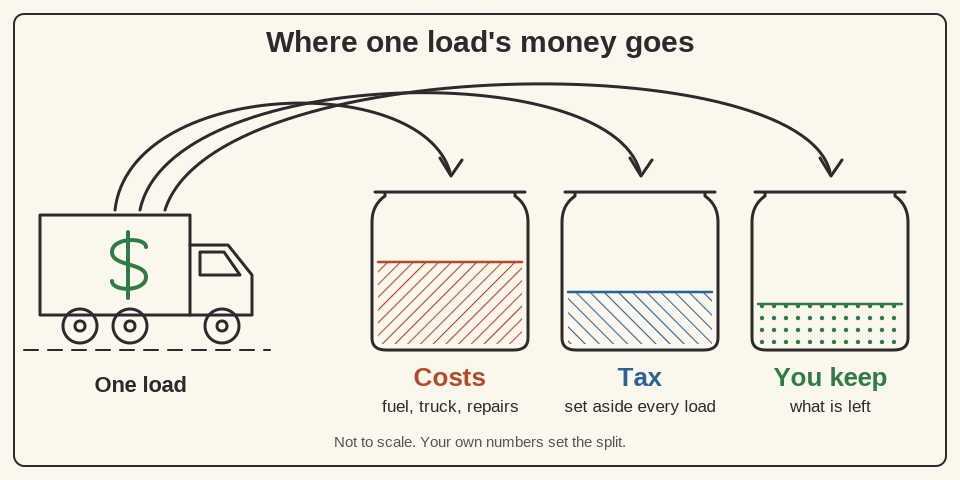
Set aside 20% to 25% of each load's net profit for federal tax, and keep it in a separate account. My quarterly estimated taxes guide works the numbers. A single filer with $80,000 in net profit owes about 20.8% in federal income and self employment tax for 2026, using the standard deduction and the qualified business income deduction. Your number will differ. If your state taxes income, add state payments. State dates and rules can differ, so check yours.
The IRS expects estimated payments if you will owe $1,000 or more when you file. To avoid a penalty, pay at least the smaller of 90% of this year's tax or 100% of last year's. The 100% becomes 110% if your adjusted gross income last year was over $150,000, per Publication 505. You can pay more often than four times a year, as long as enough has reached the IRS by each due date.
| What | When it is due | Next date |
|---|---|---|
| Estimated federal tax | April 15, June 15, September 15 and January 15 | January 15, 2027 |
| IFTA fuel tax return | April 30, July 31, October 31 and January 31. A weekend or holiday moves it to the next business day. | February 1, 2027, for October to December |
| Form 2290 heavy vehicle tax | The last day of the month after the truck's first use. The tax period is July 1, 2026 to June 30, 2027. | November 30, 2026, for a truck first used in October |
| UCR registration | Every year, before January 1 of the registration year | December 31, 2026, for 2027. The fee is $55 for 1 or 2 trucks. |
Dates checked November 3, 2026.
IFTA. The International Fuel Tax Agreement covers the 48 contiguous states and 10 Canadian provinces. You need an IFTA license if your truck runs in two or more member jurisdictions and has two axles with a weight over 26,000 pounds, or three or more axles at any weight. You file one return a quarter with your base state. IFTA, Inc. says a return is generally required even if you did not operate that quarter. Keep your miles by state and your fuel receipts for at least 4 years from the return's due date or filing date, whichever is later. The IFTA calculator estimates what you will owe.
Form 2290. You file this if your truck's taxable gross weight is 55,000 pounds or more. An 80,000 pound truck owes $550 for the full year, the amount in the IRS's own example. If you expect to drive 5,000 miles or less in the year, you still file, but the tax is suspended. If you go over, the tax is due. You need an EIN to file, not your Social Security number. The stamped Schedule 1 is your proof of payment when you register the truck. The IRS Trucking Tax Center has the filing steps.
UCR. The Unified Carrier Registration fee for 2027 is $55 for 1 or 2 trucks, up from $46, the Federal Register shows. Registration for 2027 opened October 1, 2026, and payment is due before January 1, 2027. My 2027 UCR guide covers who files and how.
Factoring means you sell a freight invoice for cash now, minus a fee. A 3% fee on a $2,000 load is $60, and add ons and chargebacks push the real cost higher. My freight factoring guide shows how to find your effective rate before you sign. The Factoring Fee calculator runs it on your own loads.
ATRI's two cost figures put fuel at about 48 cents of every mile, so where you fill up matters. My guide to Love's vs TA vs Pilot compares fuel rewards, parking and showers. The Fuel Cost calculator runs your own truck.
Ordinary and necessary business costs. That includes fuel, repairs, tires, tolls, insurance, permits and fees, interest and depreciation on the truck, business tools and 80% of meal costs. A tax pro who works with truckers can confirm what fits your return.
Set aside 20% to 25% of each load's net profit for federal tax. Add your state's tax if it has one. The rate rises as your profit rises, so adjust it each quarter.
April 15, June 15, September 15 and January 15. For 2026, the last payment is due January 15, 2027.
The special transportation rate is $80 a day in the continental U.S. and $86 outside it. It did not change for travel starting October 1, 2026. Drivers under DOT hours of service limits deduct 80% of it.
Yes. You file, and the tax is suspended. If the truck goes over 5,000 miles in the tax period, the tax becomes due.
A return is generally required every quarter, even if you did not operate. Ask your base state how to report a quarter with no miles.
This is general information, not tax advice. Rules and rates change, so confirm them with the IRS or a tax pro who works with truckers before you act.

I am Emeka Ogbonna, the founder and chief writer of RigDigest. I have 11+ years as an OTR professional truck driver and hold a CDL with Hazmat and Tanker Endorsements.
I have run freight as a company driver, a leased owner operator and under my own authority. I write these guides to help you know your numbers, keep more of every load and stay compliant.
View my certificates and full credentials at emekaogbonna.com
Every step from company driver to your own truck, in the right order.
New or used, what to inspect, how to finance it, and the lease purchase traps.
Load boards, brokers, rate confirmations and freight that actually pays.