2027 UCR registration: real owner operator costs and how to file
How much is 2027 UCR registration for an owner operator? One truck costs $55 for the year, up from $46 in 2026. You file online at ucr.gov and pay before January 1, 2027.
The fee table, who has to file, how to count your trucks and the filing steps. Each line is tied to the rule behind it.
Key takeaways
- $55 is the 2027 UCR fee for 1 truck, up from $46 in 2026. (Federal Register, 2026)
- 20% is the average fee increase, from $9 more for 0 to 2 trucks to $9,329 more for the largest fleets. (Federal Register, 2026)
- $0 extra for more states or more miles, because the fee follows your truck count only. (UCR Plan, 2026)
- Jan. 1, 2027 is the date payment must be done by, and fees are not prorated. (UCR Handbook)
- 392.2 is the roadside violation code for failure to pay UCR fees, and each state sets its own penalties. (UCR Plan, 2026)
- 9 states do not take part in UCR, but a truck that crosses state lines still needs to file. (UCR Plan, 2026)

What does 2027 UCR registration cost an owner operator?
A one truck owner operator pays $55 for 2027 UCR registration. UCR stands for Unified Carrier Registration, a yearly fee program for carriers that cross state lines. One truck falls in the first bracket, which covers 0 to 2 commercial motor vehicles.
The Federal Motor Carrier Safety Administration (FMCSA) published the new schedule in the Federal Register on Sept. 1, 2026. The rule takes effect October 1, 2026.
| Bracket | Commercial motor vehicles | 2026 fee | 2027 fee | Increase |
|---|---|---|---|---|
| B1 | 0 to 2 | $46 | $55 | $9 |
| B2 | 3 to 5 | $138 | $167 | $29 |
| B3 | 6 to 20 | $276 | $333 | $57 |
| B4 | 21 to 100 | $963 | $1,163 | $200 |
| B5 | 101 to 1,000 | $4,592 | $5,548 | $956 |
| B6 | 1,001 and above | $44,836 | $54,165 | $9,329 |
Source: Federal Register, final rule 2026-17893. The increase column is the difference between the two published fees. Brokers and leasing companies that run no trucks pay the first bracket.
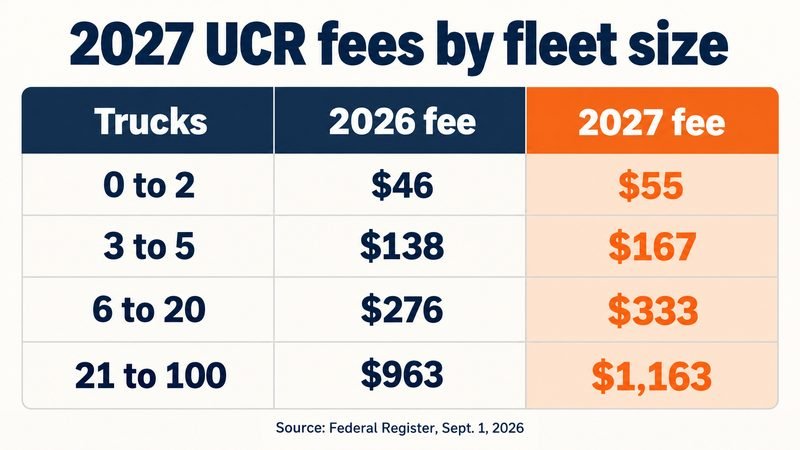
The average jump is about 20 percent, and the rule sets no further yearly increases beyond this one. The final rule also notes the 2027 fees are still lower than the ones in force for registration years 2019 through 2022.
Run the math on one truck
- 2027 fee for 1 truck: $55
- Per month: $55 divided by 12 is about $4.58
- Per day: $55 divided by 365 is about $0.15
- Industry average cost to run a truck: $2.336 per mile, from ATRI's 2026 report on 2025 data
- At 100,000 miles a year (my example, use your own miles): $233,600 in operating costs
- UCR as a share of that: $55 divided by $233,600 is about 0.02 percent
The fee itself is small, and the real costs sit around it. A third truck moves you from bracket 1 to bracket 2 and adds $112 a year, the first jump a growing fleet hits. A filing service can add its own charge, and the program does not control that charge. A wrong truck count can turn into an audit adjustment. I cover each of these below.
If you are still pricing out the whole business, the owner operator startup cost calculator puts UCR next to every other first year bill. Insurance is a separate big bill, and semi truck insurance cost breaks that down.
Who has to file UCR registration, and who can skip it?
You must file if you move property or passengers across state or national borders. The program's own questionnaire says this includes the legs before pickup and after delivery. Motor carriers, private carriers, freight forwarders, brokers and leasing companies are all covered.
According to the UCR Handbook and the program's questionnaire, these groups can skip it:
- Carriers that stay inside one state (intrastate only)
- Carriers that operate solely within Hawaii, except household goods movers for individual shippers
- Government vehicles, since all levels of government are exempt
- Utilities and other businesses whose vehicles cross state lines only to answer a request for emergency assistance
- Private carriers of passengers, such as a church or school moving its own people
Hauling your own freight does not exempt you, and neither does running only light vehicles, though a light vehicle can lower your fee.
What about leased on drivers?
The UCR Handbook counts a truck toward a carrier's fleet when it runs under a lease of 30 days or more. It also says each entity holding DOT authority registers on its own. So a driver running on a carrier's authority is normally counted in that carrier's filing.
The handbook does not say whether a carrier charges that cost back to the driver. Ask before you sign, and read the settlement terms in lease on carrier terms. If you run your own authority, the filing is yours. The trucking authority guide and the MC number guide cover that setup.
How many trucks do you count for UCR registration?
You count commercial motor vehicles, and only power units are countable. The handbook says a trailer is "never to be counted separately as a UCR fleet vehicle." A vehicle counts if it meets any one of these tests:
- Gross vehicle weight rating or actual weight of at least 10,001 pounds
- It carries placarded amounts of hazardous materials, at any weight
- It is built to carry more than 10 passengers, including the driver
Hotshot drivers need to read one more line. The program says a light truck pulling a trailer in interstate commerce counts as a commercial motor vehicle when the combined weight is 10,001 pounds or more.
A truck counts when it is registered in your name or runs under a lease of 30 days or more. A short term lease does not count. If you add a truck mid year, you do not file again. The program says fleet changes are not reported until the following year.
How do you file UCR registration, step by step?
Filing is one page of information, a signature and a payment. The handbook says the large majority of carriers file online through the national registration system. Paper forms to your base state also work.
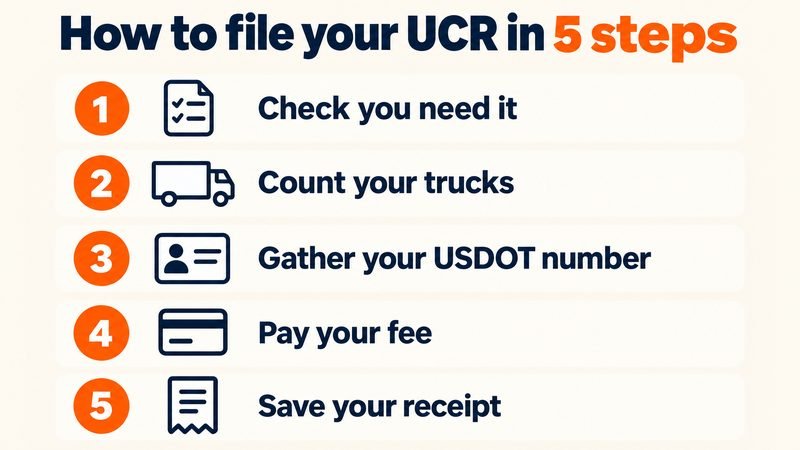
- Check you need it. Take the questionnaire on plan.ucr.gov, and know that if any trip crosses a state line the answer is yes.
- Count your trucks. Use the counting rules above, because one power unit puts you in bracket 1 with a $55 fee.
- Gather your USDOT number and details. The form asks for your legal name, address, USDOT number and fleet size. Copy them from your USDOT record so nothing differs. If you do not have a number yet, start with the one truck startup guide.
- Pay your fee. Go to ucr.gov, where the Indiana Department of Revenue recommends Google Chrome. An authorized representative signs the form, and the fee goes in with it.
- Save your receipt. You do not need a credential in the cab, and you are not required to carry proof. The program says you may carry the receipt if you choose. Keep a copy anyway, because it is your proof if a payment is ever questioned.
Your base state is the state of your principal place of business if it takes part. If it does not, use a participating state where you have an office or facility. Your base state does not change your fee.
When is UCR registration due, and what happens if you miss it?
Registration for the 2027 year opens October 1, 2026. The UCR Handbook says payment must be done before January 1 of the registration year. That makes your deadline December 31, 2026 for the 2027 year, unless the UCR Board postpones the due date for that year, so check ucr.gov to confirm your state has opened filing.
The fee is due when you mark interstate commerce on your USDOT profile or register in the national system. It is not prorated. If you start hauling interstate late in the year, you still owe the full annual fee. Confirm which registration year the system asks you to pay when you file.
Enforcement happens at roadside and through audits:
- Inspectors check UCR through the CVIEW and SAFER data systems and ucr.gov. Failure to pay is written up as 392.2, failure to pay UCR fees.
- The handbook says each participating state sets the penalties it sees fit and that many of them are significant. It lists no single national fine.
- States may withhold vehicle or commercial registration from a carrier that has not paid.
- A carrier that underpays is treated as if it never registered.
For the 2026 year, roadside enforcement began January 1, 2026. Check the program site for the 2027 date, because it was not posted when I last updated this page. Keep your receipt handy, and plan the cost next to your IFTA and quarterly tax dates so the bills do not stack up.
Which states take part in UCR registration?
41 states take part, and 9 do not. The participating states page lists Alabama, Alaska, Arkansas, California, Colorado, Connecticut, Delaware, Georgia, Idaho, Illinois, Indiana, Iowa, Kansas, Kentucky, Louisiana, Maine, Massachusetts, Michigan, Minnesota, Mississippi, Missouri, Montana, Nebraska, New Hampshire, New Mexico, New York, North Carolina, North Dakota, Ohio, Oklahoma, Pennsylvania, Rhode Island, South Carolina, South Dakota, Tennessee, Texas, Utah, Virginia, Washington, West Virginia and Wisconsin.
The states left out are Arizona, Florida, Hawaii, Maryland, Nevada, New Jersey, Oregon, Vermont and Wyoming. Confirm the current list on the program site before you file.
A non participating state does not let you off. If your truck crosses a state line, you still file through a participating base state.
Should you file yourself or pay a filing service?
File it yourself on ucr.gov if you run one or two trucks and your USDOT record is clean. The handbook allows third party filers, and it says the program does not regulate what they charge. For a $55 fee, any added charge is a large share of the total.
This verdict comes from the program rules and the numbers, not from a test of any service. It fits a driver who can spend a few minutes on a form. It does not fit a driver who runs several entities, has a USDOT record that does not match the legal name, or wants someone else to own the deadline.
What would change my call: a service that shows its total price before you start, and handles more than one entity. Get that total in writing. Do not pick a site because it ranks first in a search.
What goes wrong with UCR filings?
- Wrong truck count. An audit can force a one time fee adjustment, and under the handbook an underpayment is treated as no registration.
- Paying twice or paying when exempt. Refunds are limited to duplicate payments, overpayments and registering when not required. You apply through the national registration system portal.
- Wrong entity. Each entity with its own DOT authority registers on its own. If you move from leasing on to your own authority, your own authority needs its own filing.
- Waiting for roadside to tell you. Failure to pay is a written violation, and states may withhold vehicle or commercial registration.
- Treating a light truck as exempt. A pickup with a heavy trailer can count as a commercial motor vehicle.
Drivers who lease on also ask about coverage between dispatches. The non trucking liability insurance guide explains it. Then price a real load in the load profit calculator, and read the owner operator requirements for the rest of the paperwork.
Frequently asked questions
How much is UCR for one truck in 2027?
One truck pays $55 for 2027, up from $46 in 2026. That is the first bracket, which covers 0 to 2 commercial motor vehicles. (Federal Register)
When does 2027 UCR registration open?
It opens October 1, 2026, and payment must be done before January 1, 2027. Confirm on ucr.gov that your state is accepting filings before you start. (Indiana DOR)
Do I need UCR if I only run in one state?
No, a carrier that stays inside one state is not required to register. If any trip crosses a state line, including the legs before pickup and after delivery, you must file. (UCR Plan)
Do I need to carry proof of UCR in the truck?
No. The program says no credential is required in the vehicle. You may carry the payment receipt if you choose, and inspectors can check your status online. (UCR Plan)
Does my fee change if I run in more states?
No. The program says fees do not depend on the extent of a carrier's operations, so your truck count alone sets the bracket. (UCR Plan)
Can I get a refund on a UCR payment?
Only in limited cases: a duplicate payment, an overpayment, or registering when you were not required to. You apply through the national registration system portal. (UCR Handbook)
What if I add a truck in the middle of the year?
You do not need to file again. The program does not require an amended filing, and fleet changes are not reported until the following year. (UCR Plan)
Do leased on owner operators pay UCR?
A truck under a lease of 30 days or more counts in the carrier's fleet, and the carrier files. Ask your carrier whether any part of the cost reaches your settlement. (UCR Handbook)
How this was checked
On October 16, 2026, I read the 2027 fee rule in the Federal Register and the UCR Handbook. I also read the UCR Plan pages on who must register, fees, participating states and enforcement.
The cost per mile comes from ATRI's 2026 report on 2025 data. The Chrome filing tip comes from the Indiana Department of Revenue.
This topic affects money and compliance, so I left out forum posts and anecdotes. I did not test any filing service, and the 100,000 mile example is my own assumption for the math, so swap in your own miles.
This is general information, not legal or tax advice. Confirm details with the UCR program, your base state or a qualified professional.
Evidence label: researched from the Federal Register rule, the UCR Handbook and program pages. Update schedule: when the program posts new dates or fees.
Sources
- Fees for the Unified Carrier Registration Plan and Agreement, September 1, 2026. Federal Register. Accessed October 16, 2026.
- Final rule 2026-17893, UCR fees. FMCSA. Accessed October 16, 2026.
- Fee brackets. UCR Plan. Accessed October 16, 2026.
- Do I need to register. UCR Plan. Accessed October 16, 2026.
- Frequently asked questions. UCR Plan. Accessed October 16, 2026.
- Participating states. UCR Plan. Accessed October 16, 2026.
- Awareness initiative and enforcement. UCR Plan. Accessed October 16, 2026.
- UCR Handbook. Unified Carrier Registration Plan. Accessed October 16, 2026.
- USDOT and UCR. Indiana Department of Revenue. Accessed October 16, 2026.
- Analysis of the Operational Costs of Trucking: 2026 Update. American Transportation Research Institute. Accessed October 16, 2026.