How to Start a Trucking Company (Without Getting Burned)
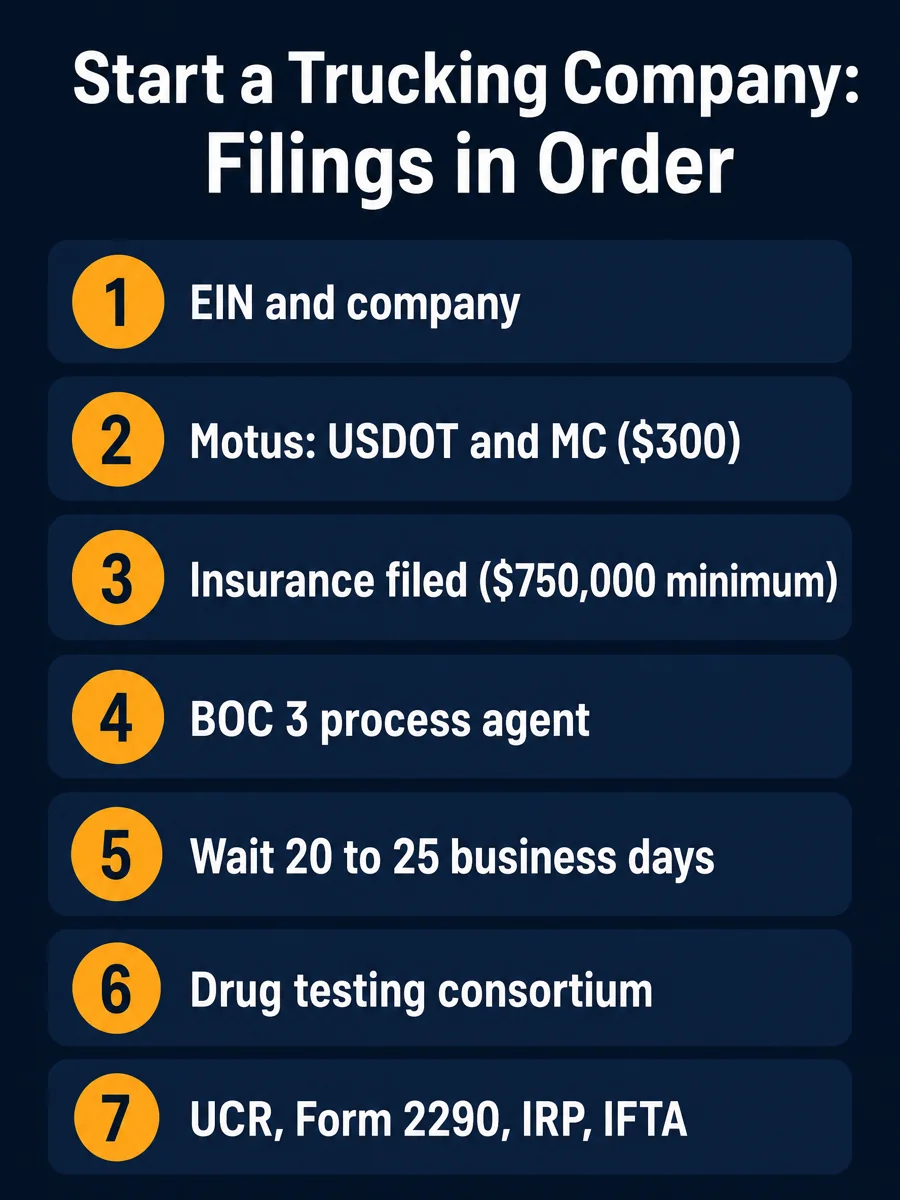
To start a trucking company, you apply for a USDOT number and MC authority in FMCSA's Motus system, pay a $300 filing fee, get at least $750,000 in liability insurance filed, and have a process agent file your BOC 3. FMCSA says a new application takes 20 to 25 business days. That's the paperwork, and it's the easy part.

The money gets lost somewhere else. My first truck was a financed buy in Houston, and I paid a mechanic $500 to inspect it before I signed. He missed what was wrong. Eight months later the engine failed and the truck needed a short engine rebuild. Three months after that the turbo and the radiator went too, and I let the truck go.
Everything below is for a US carrier hauling general freight across state lines with one truck. Fees and rules are as of November 2026.
How to start a trucking company: the filings, in order
- Form the company and get an EIN. The IRS gives EINs away free online, and sites that charge for one aren't the IRS. Get it first, because Form 2290 needs an EIN and won't accept a Social Security number.
- Apply in Motus, FMCSA's registration system, for a USDOT number and operating authority. The fee is $300 for each authority type, and FMCSA doesn't refund it, even for a mistaken application. Pick only the types you need, because the type sets your insurance level.
- Get your insurance filed. For general freight in a truck over 10,000 pounds, the federal minimum is $750,000 in liability. Your insurer files the proof with FMCSA, and FMCSA won't grant authority until it's on file.
- Have a process agent file your BOC 3. It names a legal agent in each state where you run, so a court can serve papers on you there.
- Wait for the grant. Twenty to twenty five business days is normal for a clean application, and FMCSA says further review can add 8 weeks or longer.
- Set up drug and alcohol testing. A one truck owner operator who isn't leased to another carrier must belong to a consortium for random testing. You also register in the FMCSA Drug and Alcohol Clearinghouse as an employer and name that consortium as your third party administrator.
- Handle plates and taxes before the truck moves. UCR, the Unified Carrier Registration fee, is $55 a year for 0 to 2 vehicles in the 2027 registration year. Form 2290, the federal highway use tax, runs up to $550 for a full year, and it's due by the last day of the month after the truck's first use. For a truck in the $550 category first used in October 2026, the IRS partial period rule puts the bill at $412.50, due November 30. IRP plates and the IFTA fuel tax license come from your base state, and they're two different programs.
You may have read that MC numbers are going away. As of this writing they still exist, and FMCSA's own operating authority page still uses them. Our trucking authority guide and MC number guide track any change.
Where new carriers get burned
The truck
A used Class 8 truck averaged $64,367 in August 2026. Say you finance that amount at 12% over 60 months. The payment is about $1,432 a month, and it starts the day you sign. It keeps coming whether the truck is earning or sitting in a shop.
My $500 inspection didn't protect me, because it wasn't the right inspection. Now I'd pay a shop that works on that engine brand, ask for the maintenance records, and pull the full ECM report. Before you sign, work out what one engine job would cost you in cash and in parked days. Plan for repairs before you plan for the payment, because the payment is the number you already know.
The wait
Authority takes about 25 business days, which is close to 1.15 months. If you buy the truck first, you pay roughly $1,650 in payments on a truck that can't haul for hire yet, so buy it when the grant is close or accept that you're paying for a parked truck.
When FMCSA grants authority, the paper usually shows up 3 to 4 business days later. If 10 business days pass with nothing, call 800 832 5660.
The insurance quote
Owner operators who recently got their own authority report quotes that range from $8,000 to $20,000 or more a year. A new business looks risky to an insurer no matter how clean your record is. That's a bigger bill than most first time buyers expect.
The $750,000 applies to general freight only. Oil and listed hazmat loads need $1,000,000, and certain bulk hazmat loads need $5,000,000. Federal rules set no cargo insurance minimum for general freight. Brokers and shippers often set their own, so get their cargo limits before you ask for quotes. Our semi truck insurance cost guide breaks down each policy.
The audit nobody warns you about
FMCSA treats you as a new entrant for 18 months. A safety audit usually comes within 12 months of when you start.
Some things fail the audit automatically, and having no random drug and alcohol testing program is one. So is running a truck that was put out of service before it's repaired, or failing to correct defects your driver vehicle inspection reports list. If you fail, you have 60 days to send an acceptable fix, or 45 days if you carry hazmat that needs placards. If you miss that window, FMCSA revokes your registration.
Join the consortium before the first load, and keep your inspection and repair records in one folder from day one.
What year one costs before you buy a truck
| Item | Amount | How often |
|---|---|---|
| Operating authority | $300 | Once, no refunds |
| UCR | $55 | Yearly, 0 to 2 vehicles |
| Form 2290 | Up to $550 | Yearly, prorated after July |
| Insurance | $8,000 to $20,000 or more | First year on your own authority |
| IRP plates | Set by your base state | Yearly |
Add plates, an ELD, the consortium and the small fees, and our trucking authority guide totals the first year at $10,925 to $23,555. That leaves out the truck and your cash reserve.
The reserve is the number most new carriers skip, so run it with real figures. Say the truck payment is $1,432, insurance is $1,000 a month, and the ELD is $40. Fixed bills come to about $2,470 a month before fuel, tires and repairs. Hold at least two months of that in cash before the first load, which is about $4,940.
Own authority or lease on first?
If you've never run your own numbers, lease on first, because a carrier handles the authority and filings and the insurance usually costs less. Our guide puts it at $3,000 to $5,000 a year leased on against $8,000 to $12,500 on your own authority. The trade is that the carrier controls your freight and takes a cut. Read the lease on terms before you sign anything.
That's the path I took. I drove as a company driver, then leased on as a BCO with Landstar Ranger and ran on Landstar's authority. Now I run on my own authority.
Your own authority makes sense once you can cover two months of bills in cash and name where your first loads come from. It also makes sense if a customer will only contract with carriers that hold their own authority, because then leasing on closes that door. Run both options in the owner operator vs company driver calculator with real quotes, not guesses.
Do most new trucking companies fail?
The best public number comes from the Bureau of Labor Statistics. Of transportation and warehousing establishments that opened in March 2013, 79.4% were still operating after 1 year, 50.1% after 5 years, and 34.0% after 10. The whole private sector was 79.6%, 50.6% and 34.7%.
That count covers every business in the sector, not only carriers. Still, it puts trucking close to the average for all businesses, so treat any claim that most new carriers fail in year one with suspicion.
The BLS also can't see what ends a small carrier, which is usually one bad truck or one slow quarter of cash. No count tells you whether your truck will survive. Your cost per mile does.
Before you pay the $300
Open the owner operator startup cost calculator and enter your real quotes for the truck, insurance and plates. Then ask one question: could you pay two months of fixed bills with zero revenue? If the answer is no, lease on first and file later.
This is general information, not legal or tax advice. Confirm current rules with FMCSA, the IRS and your state before you file.
Want more RigDigest in your Google results? Add us as a preferred source, then check the box next to rigdigest.com.
Make me a preferred source on Google