Lease on pay for owner operators
How lease on pay works
Leasing on means your truck runs under a carrier's authority and the carrier pays you for each load you haul. You supply the truck, and the carrier supplies the DOT authority, the freight and the public liability insurance. Your take home depends on 3 things in the lease: how you are paid, what gets deducted and what you pay up front.
The carrier reviews below will use the same pay checklist.
What the carrier gets when you lease on
Under the federal truth in leasing rules, the carrier gets exclusive possession, control and use of your truck for the length of the lease. It also takes complete responsibility for operating the truck. The carrier has to identify the truck as being in its service, so its name and DOT number go on the truck.
The lease must be in writing, and both sides must sign it. The pay terms must be on the lease or on an attached addendum, and you must have them before your first trip.
The rule text in 49 CFR 376.12 was last amended in 2018.
3 ways carriers pay you
- Percentage of gross revenue. You get a set share of what the carrier bills for the load. Overdrive calls percentage the most common pay structure for leased owner operators, with as many as 8 in 10 in its audience paid that way.
- Per mile rate. You get a fixed rate for each mile. The rate can differ for empty miles, trips home, certain regions or load length, so ask for every version of it.
- Other methods. The rule also allows a rate that varies by direction or by commodity, or any other method both sides agree on and write down.
Percentage pay: you are paid on the carrier's number
With percentage pay, the carrier has to give you a copy of the rated freight bill before or at settlement. That bill is how you check the revenue figure your percentage was applied to.
Whatever your pay method, the lease must let you examine the carrier's tariff or the documents its rates come from. The carrier can black out shipper and consignee names.
Ask what the percentage applies to: linehaul only, or linehaul plus fuel surcharge and accessorials. OOIDA says good carriers usually pass through 100% of the fuel surcharge, so check what your lease says.
Overdrive says percentage pay gives you a raise without extra miles when rates climb. It also leaves you with no safety net when rates drop.
To see what 9 carriers say they keep, read what lease on carriers keep.
Per mile pay: ask which miles count
With per mile pay, you can check the math against your own trip miles. Ask whether the rate covers loaded miles only or all miles, and what you get for empty miles and trips home.
Overdrive says per mile pay can work as a safety net in a weak market, as long as the freight lasts.
Chargebacks and deductions
A chargeback is an expense the carrier pays first and then takes out of your settlement. Section 376.12(h) requires the lease to list every one and explain how each amount is figured. You get copies of the documents you need to check each charge.
The people Land Line interviewed name missing documentation and missed overcharges as the biggest chargeback problem. Their examples are fuel, cash advances and insurance.
The carrier cannot make you buy or rent anything from it as a condition of the lease. If you do sign a purchase or rental deal with the carrier, the lease must spell out the terms, including any right to deduct payments from your pay.
Cargo or property damage deductions need conditions written into the lease. The carrier must give you an itemized written explanation before it takes the money.
Escrow
Some leases require escrow. When yours does, the lease must state the amount, whether it goes to the carrier or a third party, and what it can be used for. You get an accounting on your settlement sheets or in a separate monthly statement, and you can demand one at any time.
While the carrier holds the money, it must pay you interest at least quarterly. The rate must be at least the average yield on 91 day Treasury bills, set on the first day of each interest period. After the lease ends, the escrow comes back within 45 days, with a final accounting of any deductions.
Insurance
The lease must state the carrier's legal duty to carry public liability insurance. It must also say who pays for other coverage, such as bobtail, and the amount of any chargeback for it.
If you buy insurance through the carrier, you can ask for a copy of each policy, and the carrier must give you a certificate for each one. The certificate shows the insurer, policy number, dates, coverage, your cost and your deductible.
The Trucker reports that most carriers expect you to carry your own bobtail and occupational accident or workers' compensation coverage. Ask who pays for tags and permits, and whether you get the unused part back if you leave.
When you get paid
The lease must say payment comes within 15 days after you turn in the necessary delivery documents. Those documents are your logs and whatever the carrier needs to collect from the shipper.
The carrier can ask for more paperwork, but not as a condition of payment. It cannot hold your pay for a clean bill of lading or set its own deadline for your paperwork.
Land Line says the 15 days applies whether or not the carrier has collected on the load yet. At the end of the lease, the carrier can hold final payment until you return its identification devices.
A worked example
These are example numbers, not a quote from any carrier. Say you haul 2,400 miles in a week and the carrier bills customers $6,000, which is $2.50 per mile billed.
At 80%, your gross is $4,800, or $2.00 per mile. Your costs for the week add up to $3,090, which leaves $1,710 before taxes. That is about $0.71 per mile, or 28.5% of what the carrier billed.
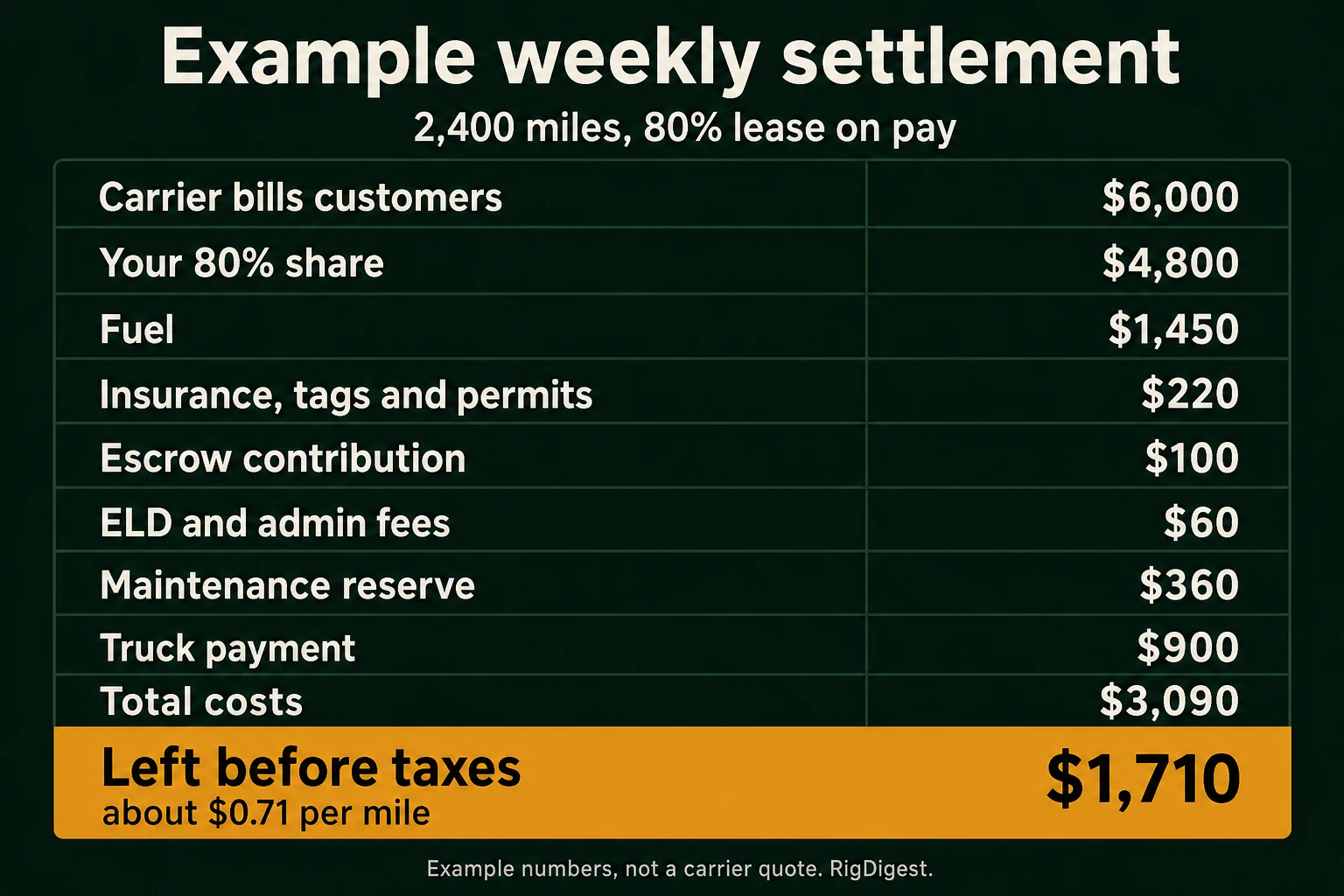
Now look at the percentage. 1 point on $6,000 a week is $60, or about $3,000 over 50 weeks. The gap between a 75% lease and an 80% lease is $300 a week, or $15,000 over 50 weeks.
Lease on or run your own authority
Leasing on is the quicker start. The carrier handles billing and the authority filings, and the rule caps your wait for pay at 15 days after your paperwork. In return you give up a share of every load and some control over which freight you take.
Running your own authority means you keep the full load revenue before your own costs, and you carry the weight yourself. Federal law sets the minimum liability coverage for a for hire carrier hauling general freight in interstate commerce at $750,000 for a truck over 10,000 pounds, and brokers and shippers often ask for more. You also handle billing, bookkeeping, IFTA, permits and compliance, and you wait for customers to pay.
The get started guide lays out every step in order.
Lease on vs lease purchase
A lease purchase is a different deal. You pay off a truck through the carrier, with payments taken from your settlements.
Overdrive reports that only about 5% of owner operators run a truck bought through a carrier program. In its poll of owner operators who entered those programs, more than half never finished the lease to full purchase and about a third did.
The FMCSA Truck Leasing Task Force reported to Congress in January 2025. It found that carriers set pay, truck payments and most other terms on a take it or leave it basis, and that many drivers are left with little or nothing after deductions. It estimated that fewer than 1 in 100 participants end up owning the truck, and it recommended that Congress ban lease purchase agreements.
A Congressional Research Service report dated September 2026 shows no ban enacted yet. A House bill, the BUILD America 250 Act, would direct DOT to write rules prohibiting predatory lease purchase programs within 2 years. The House Transportation and Infrastructure Committee ordered it reported in May 2026.
Ask any carrier for its completion rate in writing. Read the lease purchase traps in the buying a truck guide before you sign anything with a payment schedule.
Questions to ask before you sign
- Can I haul freight from other sources, and what happens if I refuse a load?
- Who pays for insurance, tags and permits, and what happens to them if I leave?
- How is pay figured for empty miles, trips home and different regions?
- How is the fuel surcharge handled, and is 100% passed through?
- What do I get for detention, layover and labor such as tarping?
- Are there trailer rental fees, and which maintenance items are charged to me?
- What am I liable for if cargo is damaged?
- Can I see the full lease and every amendment before orientation?
Have a trucking attorney read the lease before you sign it. OOIDA's business services team can also help its members.
If a settlement looks wrong
Keep every settlement sheet, the signed lease and your messages with the carrier. Dispute problems in writing.
You can file a complaint in FMCSA's National Consumer Complaint Database. Land Line also notes you can take a carrier to court under the private right of action in the leasing rules.
I ran as a Landstar BCO on its authority before getting my own, so I have read these leases from the signing side. This is general information, not legal, tax or financial advice.
Before you sign with any carrier, run your own numbers in the trucking cost per mile calculator and compare what each offer leaves you per mile.
Sources
- 49 CFR 376.12, eCFR
- 49 CFR 376.11, eCFR
- 49 CFR 387.9, eCFR
- Land Line, Your rights and regs (June 2019)
- Overdrive, Pay package reality v. preference
- Overdrive, Lease purchase agreements with a motor carrier
- The Trucker, Ask these questions before leasing to a carrier
- FMCSA Truck Leasing Task Force, report to Congress (January 2025)
- Congressional Research Service, Surface Transportation Reauthorization (September 2026)
Carrier reviews
Carrier reviews are on the way.
The first review is Landstar, written from inside as a BCO.
Send us your settlement numbers
Next stop
- Trucking cost per mile calculatorCalculator
- How to become an owner operatorAnother guide
- Start here: pick where you are on the roadExplore
- Free trucking calculatorsExplore