What Percent Do Freight Brokers Keep on a Load? Public Broker Margin Data (2026)
KEY TAKEAWAYS
- → 14.4% RXO's brokerage gross margin in the second quarter of 2025, the year earlier comparison for the 10.7% in 2026. (RXO second quarter 2026 results, 2025)
- → 25.5% Rise in C.H. Robinson's average truckload linehaul rate per mile, excluding fuel surcharges, in the second quarter of 2026 versus a year earlier. (C.H. Robinson second quarter 2026 results, 2026)
- → 2.0% Rise in C.H. Robinson's truckload adjusted gross profit per mile over the same period, so the dollars it kept per mile barely moved while the bill grew. (C.H. Robinson second quarter 2026 results, 2026)
- → 14.7% Broker awarded margin in Tabi's August 2026 spot freight report, down from 16.5% the month before. The report as published does not define the measure. (Tabi Connect, Tabi Pricing Pressure Index, 2026)
- → 5% to 8% The net margin per load that six carriers allege was typical before 2021, versus the 15% to 20% they allege brokers have increased their margins to. These are allegations in a lawsuit, not findings. (Stevens Trucking Co. et al. v. C.H. Robinson Company, Inc. et al., complaint, 2026)
- → 48 hours How fast a broker would have to hand over its record of a load under FMCSA's 2024 transparency proposal, which is still not a final rule. (Federal Register, FMCSA proposed rule, 89 FR 91648, 2024)
- → $5.8 billion Implied value of C.H. Robinson's announced deal to buy RXO, announced October 5, 2026, with regulatory approval still required. (C.H. Robinson press release, 2026)
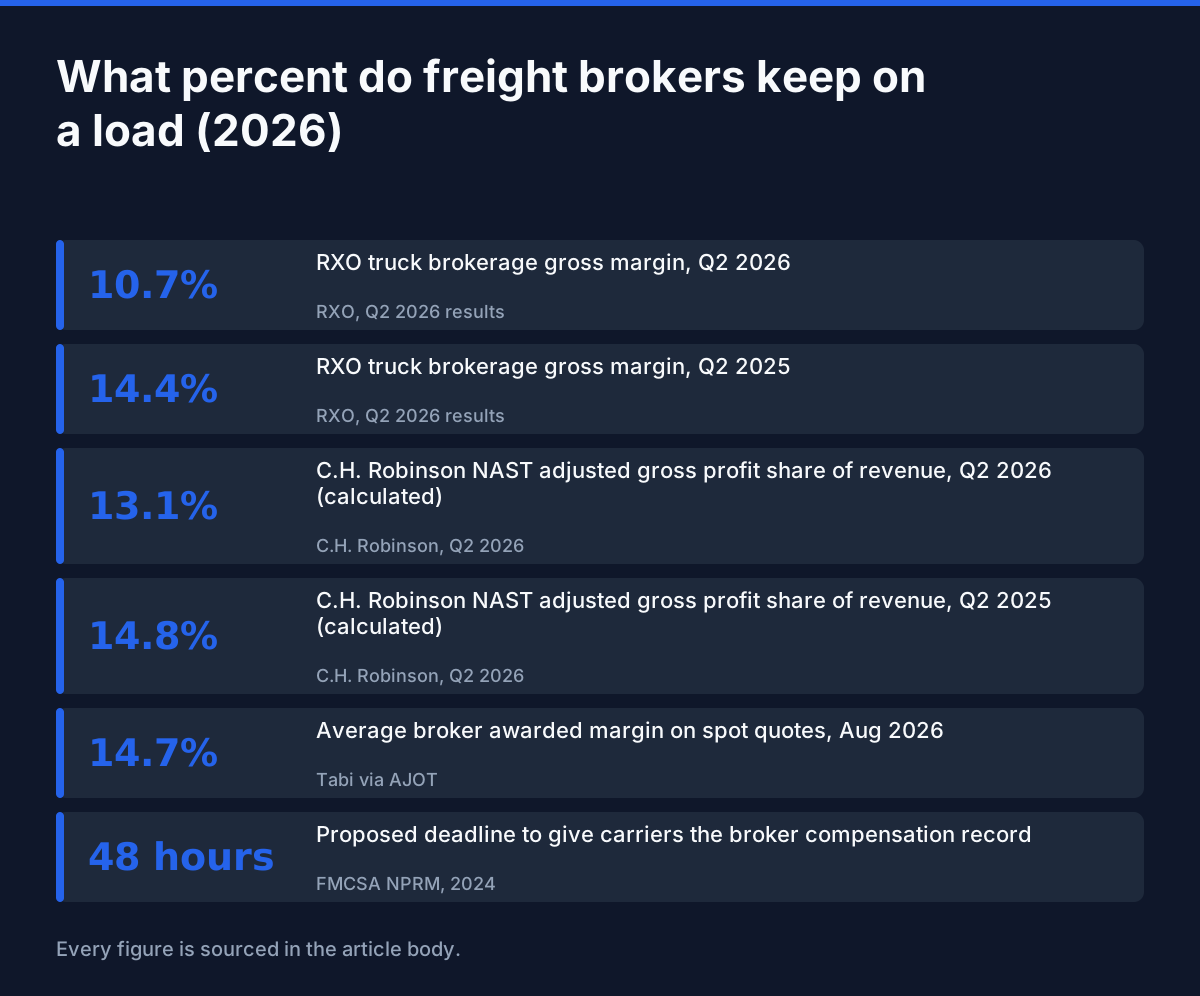
Freight brokers keep roughly ten to fifteen cents of every dollar a shipper pays on a truckload, and the share has been shrinking. In the second quarter, RXO reported a truck brokerage gross margin of 10.7%, down from 14.4% a year earlier (RXO second quarter 2026 results, 2026). That is the cleanest public answer to the question of what percent brokers keep on a load, and it comes with caveats worth knowing before you use it in a negotiation.
No single number fits every load. A broker's margin is the gap between what the shipper pays and what the carrier receives, and public companies measure it differently. RXO reports gross margin on truck brokerage alone. C.H. Robinson reports adjusted gross profit for its whole North American Surface Transportation segment, which includes less than truckload freight, so the share we calculated from its filing, 13.1% this quarter against 14.8% a year ago, is a close relative of a brokerage margin and not an exact match. If you want to compare either figure with what loads are actually paying, keep that difference in mind.
This page works through five questions: what the largest brokers keep, why the percentage fell while freight rates rose, what spot market data and carrier lawsuits claim, whether you can see your own broker's cut, and what a pending merger changes. Every figure links to the filing or document it came from. When you have a specific load in front of you, the load profit calculator turns the numbers into what you take home.
What Share of Each Load Do the Biggest Brokers Keep?
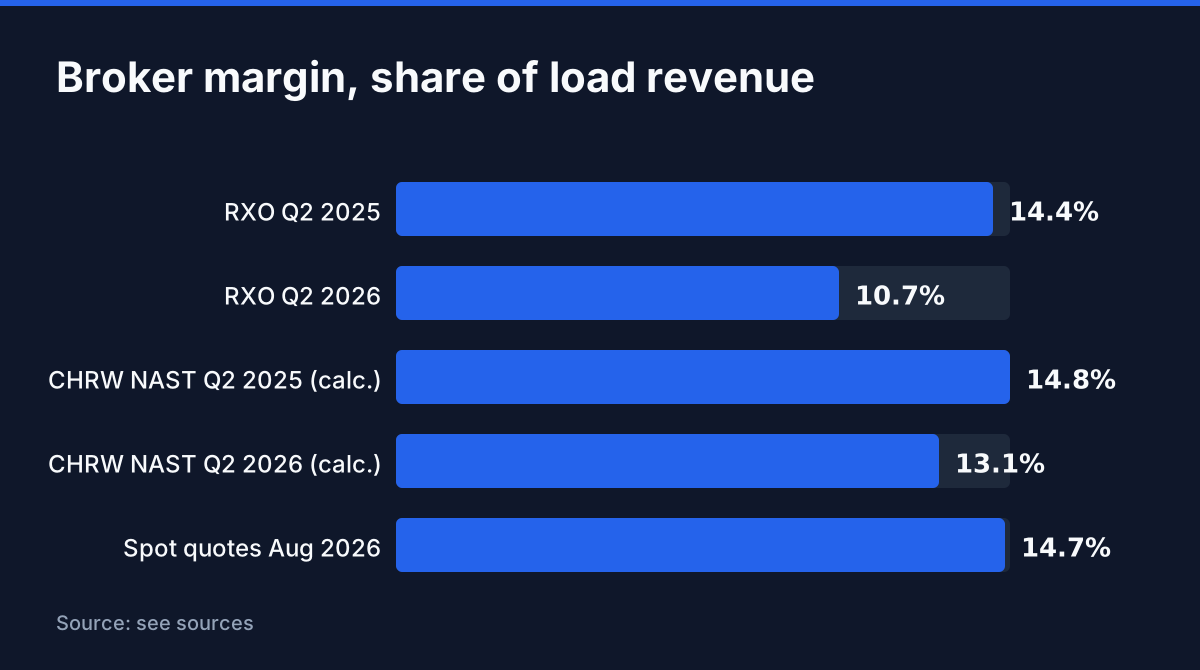
Public filings put the share between 10.7% at RXO and 13.1% at C.H. Robinson in the second quarter. Both are lower than a year earlier, when RXO kept 14.4% and C.H. Robinson's calculated share was 14.8%. The two companies define margin differently, so compare each one against its own history.
| METRIC | VALUE | SOURCE |
|---|---|---|
| RXO truck brokerage gross margin, second quarter 2026 | 10.7% | RXO second quarter 2026 results |
| RXO truck brokerage gross margin, second quarter 2025 | 14.4% | RXO second quarter 2026 results |
| C.H. Robinson North America segment revenue, second quarter 2026 (thousands of dollars) | 3,593,269 | C.H. Robinson second quarter 2026 results |
| C.H. Robinson North America adjusted gross profit, second quarter 2026 (thousands of dollars) | 469,389 | C.H. Robinson second quarter 2026 results |
| Adjusted gross profit as a share of revenue, second quarter 2026 (our calculation) | 13.1% | Calculated from C.H. Robinson second quarter 2026 results (adjusted gross profit divided by segment revenue) |
| C.H. Robinson North America segment revenue, second quarter 2025 (thousands of dollars) | 2,918,227 | C.H. Robinson second quarter 2026 results |
| C.H. Robinson North America adjusted gross profit, second quarter 2025 (thousands of dollars) | 432,248 | C.H. Robinson second quarter 2026 results |
| Adjusted gross profit as a share of revenue, second quarter 2025 (our calculation) | 14.8% | Calculated from C.H. Robinson second quarter 2026 results (adjusted gross profit divided by segment revenue) |
Read the table as two pairs, not a ranking. C.H. Robinson's segment took in 3,593,269 thousand dollars of revenue in the second quarter and kept 469,389 thousand as adjusted gross profit. A year earlier those figures were 2,918,227 and 432,248. Revenue grew faster than profit, so the share slipped even though the company still earned more dollars. The same logic applies when you work out your own cost per mile: a percentage can fall while the dollar amount holds or rises.
Adjusted gross profit is the company's own measure and leaves out certain software amortization, and RXO's figure comes from the truck brokerage line of its results. Neither number is what one broker kept on one load on one day. Individual loads vary widely around these averages, which is what the spot market data in section three tries to capture.
Why do these two companies matter to a carrier who never hauls for either? Because their quarterly reports are the only regular, public view of broker economics that anyone can read. Private brokers and small shops do not publish their margins, so analysts and carriers lean on public filers as a proxy for the market. They are also large, which means their numbers blend contract freight for big shippers with spot loads, and contract freight is usually priced differently from a single urgent load. A small broker covering one hard to place shipment can charge a very different spread than a national account desk handling a routine lane.
Why Did Broker Margins Fall While Freight Rates Rose?
Carrier costs rose faster than shipper rates. C.H. Robinson's average truckload linehaul rate per mile, excluding fuel, rose 25.5%, but what it paid carriers per mile rose 29.0%. Gross profit per mile gained only 2.0%, so the percentage shrank even as the dollars held.
| METRIC | VALUE | SOURCE |
|---|---|---|
| C.H. Robinson truckload linehaul rate per mile growth, excluding fuel | 25.5% | C.H. Robinson second quarter 2026 results |
| C.H. Robinson truckload linehaul cost per mile growth (what it paid carriers) | 29.0% | C.H. Robinson second quarter 2026 results |
| C.H. Robinson truckload adjusted gross profit per mile growth | 2.0% | C.H. Robinson second quarter 2026 results |
| RXO truck brokerage revenue, second quarter 2026 (millions of dollars) | 1,349 | RXO second quarter 2026 results |
| RXO truck brokerage revenue, second quarter 2025 (millions of dollars) | 1,025 | RXO second quarter 2026 results |
| RXO truck brokerage gross margin dollars, second quarter 2026 (millions) | 144 | RXO second quarter 2026 results |
| RXO truck brokerage gross margin dollars, second quarter 2025 (millions) | 148 | RXO second quarter 2026 results |
That arithmetic is the whole story of the squeeze. When the carrier rate climbs faster than the customer rate, the broker's gap narrows in percentage terms even if dollars per mile creep up. RXO shows the same pattern: truck brokerage revenue rose from 1,025 million dollars to 1,349 million, nearly a third more, yet gross margin dollars went from 148 million to 144 million. If you want to translate a quoted rate into a number you can compare, the guide to calculating rate per mile walks through it.
For a carrier, the useful part is that the broker's cut is not fixed. This quarter it shrank because what brokers paid carriers rose faster than what shippers paid brokers. What you keep after your own costs is a separate question, covered in our breakdown of owner operator pay after expenses.
A simple illustration shows why a percentage can mislead. Imagine a broker charges a shipper one hundred dollars and pays the carrier eighty five, keeping fifteen. If the market moves and both sides rise by ten dollars, the broker still keeps fifteen dollars, but its margin is now just under fourteen percent because the base got bigger. That is a hypothetical, not a quote from any filing, yet it captures what the second quarter data shows: a margin percentage can fall without the broker earning less money per load, which is why both the percentage and the dollar figures belong in the same table.
What Do Spot Quotes and Carriers Say Brokers Keep?
Spot market data shows an average awarded broker margin of 14.7% in August, down from 16.5% the month before, according to Tabi's report as relayed by AJOT. Six carriers suing C.H. Robinson and TQL allege net margins of 5% to 8% before 2021 and say brokers have raised them to 15% to 20%. Those are allegations, not findings.
| METRIC | VALUE | SOURCE |
|---|---|---|
| Broker awarded margin on spot quotes, August (Tabi, via AJOT) | 14.7% | Tabi Connect, Tabi Pricing Pressure Index (vendor index) |
| Broker awarded margin, the month before | 16.5% | Tabi Connect, Tabi Pricing Pressure Index (vendor index) |
| Quote to market spread, four week average, August | 13.5% | Tabi Connect, Tabi Pricing Pressure Index (vendor index) |
| Quote to market spread, prior reading | 18.8% | Tabi Connect, Tabi Pricing Pressure Index (vendor index) |
| Net margin per load before 2021, as alleged by six carriers | 5% to 8% | Stevens Trucking Co. et al. v. C.H. Robinson Company, Inc. et al., complaint |
| Margins the plaintiffs allege brokers have increased to | 15% to 20% | Stevens Trucking Co. et al. v. C.H. Robinson Company, Inc. et al., complaint |
| Commonly repeated rule of thumb for truckload broker gross margin | 15 percent (commonly cited; no primary source traceable) | A freight broker blog post, stated without a primary source |
Tabi also reported that its quote to market spread narrowed to 13.5% on a four week average basis, from 18.8% at the prior reading. The report as published by AJOT does not define either measure, and Tabi says its index uses live quoting activity and excludes contract freight, so treat both figures as a read on the spot market only. If you hunt for freight on the free load boards, these are the spreads you are working inside.
The carrier lawsuit sits at the far end of the range. In a civil racketeering complaint filed in the Eastern District of Texas against four C.H. Robinson entities and Total Quality Logistics, six carriers allege that net margin per load was 5% to 8% before 2021 and that brokers have since increased their margins to 15% to 20%. The complaint ties that claim to brokers' alleged use of illegal carriers. These are the plaintiffs' allegations and no court has tested them. The complaint does not define net margin, so the figures cannot be compared directly with the filings above. A rule of thumb often repeated in the industry puts truckload gross margin at 15 percent (commonly cited; no primary source traceable), but no primary source for it is traceable, and the filings suggest it runs high for the largest public brokers right now.
Treat any single reading as a snapshot. Tabi's two awarded margin readings moved by nearly two points in one month, which shows how quickly spot conditions change when capacity tightens or loosens. A carrier who books a load on a bad week and one who books on a good week can see very different spreads from the same broker. The practical lesson is to compare what you are offered against the market rate for that lane on that day, not against a headline percentage, and to remember that a quoted margin on awarded loads is not the same as the margin on every load a broker moves.
Can You See What Your Broker Made on Your Load?
On paper, yes. Federal rules require brokers to record the amount of compensation received by the broker on every load and keep the record for three years. Each party to a brokered transaction has the right to review the record. A pending FMCSA proposal would go further and require brokers to provide the record electronically within 48 hours of a request, closing the gap between having a right and actually exercising it.
| METRIC | VALUE | SOURCE |
|---|---|---|
| What the broker must record on every load | amount of compensation received by the broker | 49 CFR 371.3, Cornell Legal Information Institute |
| Who may review the record | Each party to a brokered transaction has the right to review the record | 49 CFR 371.3, Cornell Legal Information Institute |
| How long brokers must keep transaction records | three years | 49 CFR 371.3, Cornell Legal Information Institute |
| Deadline to hand over a record under the proposed rule | within 48 hours | Federal Register, FMCSA proposed rule, 89 FR 91648 |
| Date the revised proposal went to White House review (OIRA) | August 27, 2026 | FreightWaves |
| Maximum standard length of that review | 90 days | FreightWaves |
The rule at the center of this is the federal broker transparency regulation, and the proposal would put a clock on it. FMCSA sent a revised version of the rulemaking, still at the proposed rule stage according to FreightWaves, to the White House review office on August 27, 2026. That review can run up to 90 days, and a revised proposal would still need public comment before any final rule, so the timing is uncertain. Until then, the practical step is to ask in writing. Name the load number, cite your right to review the transaction record, and ask for the compensation the broker received. Before you work with any broker, confirm its operating authority and look up its MC number.
Keep your rate confirmation with every load. If a broker refuses a reasonable request for the record, that refusal is itself information about how you want to do business with them.
What Does the C.H. Robinson and RXO Deal Change?
On October 5, 2026, C.H. Robinson announced a deal to buy RXO at an implied value of $5.8 billion, with expected net run rate cost synergies of $300 million within two years of closing. Closing is expected in the first half of 2027. It would combine two of the brokers measured in this article.
| METRIC | VALUE | SOURCE |
|---|---|---|
| Implied value of the deal | $5.8 billion | C.H. Robinson press release |
| Announcement date | October 5, 2026 | C.H. Robinson press release |
| Expected net run rate cost synergies within two years of closing | $300 million | C.H. Robinson press release |
| Expected closing | first half of 2027 | C.H. Robinson press release |
Nothing in the announced deal terms says what percent a merged broker would keep. The stated case is cost savings of $300 million, which is a statement about overhead, not about what carriers or shippers will pay. The question to watch is whether fewer large buyers of capacity changes the carrier side of the equation described in section two.
An announced deal is not a closed deal. Expected closing is in the first half of 2027, subject to regulatory approval and a vote of RXO's stockholders, and the figures above will change as the combined company reports. If the vocabulary in this article is unfamiliar, our trucking glossary defines gross margin, linehaul and the other terms used here.
For carriers and owner operators, the near term is unchanged: the broker you deal with today will keep negotiating rates one load at a time, and the transparency rules described in section four apply regardless of who owns the brokerage. If your broker changes hands, it is worth confirming that its operating authority and contact details are still current, and keeping your own records of every rate you agreed to, so you can compare what you were paid against what the market was offering when the load moved.
Explore every figure in this article
Methodology
Every figure comes from a company earnings release or press release, a federal regulation, a Federal Register notice, a court complaint or one trade report, and each one links to the page it came from. Every source was read again on October 10, 2026 before publishing. C.H. Robinson does not print a margin percentage for its North American Surface Transportation segment, so the shares shown for it are our calculation: adjusted gross profit divided by segment revenue. That segment includes less than truckload freight, and adjusted gross profit excludes amortization of internally developed software, so it is close to a brokerage margin but not the same measure as RXO's reported truck brokerage gross margin. The Tabi figures come from AJOT's report on Tabi's August index, which does not define the measures. The lawsuit figures are allegations that no court has tested, and the complaint does not define net margin. The fifteen percent rule of thumb has no traceable primary source. Only publicly traded brokers report margins, so privately held and small brokers are not covered. The photo at the top is an illustration, and the two charts were drawn directly from the figures in this article. This is not legal or financial advice.
- Sources consulted: 12
- Sources cited: 9
- Data freshness: current year: 8, last year: 0, older: 1
- Data range: 2024-11-20 to 2026-10-10
- Research date: 2026-10-10
- Update schedule: After each quarterly earnings release from C.H. Robinson and RXO
- Limitations: Only publicly traded brokers report margins, so privately held and small brokers are not covered. RXO's figure is its reported truck brokerage gross margin, which equals truck brokerage revenue minus cost of transportation and services; C.H. Robinson's NAST segment also includes LTL and its adjusted gross profit excludes software amortization, so the two are close in meaning but not like for like. C.H. Robinson does not print a margin percentage for NAST, so that figure is calculated here from two reported numbers. The Tabi index is a vendor report with no stated formula. The lawsuit figures are allegations and the complaint does not define net margin.
Frequently Asked Questions
What percent do freight brokers keep on a load?
Public filings show RXO's truck brokerage kept 10.7% of revenue as gross margin in the second quarter of 2026, down from 14.4% a year earlier. C.H. Robinson's NAST segment worked out to about 13.1% on our calculation from its release. Those are company wide averages, not what any one broker kept on your load. (RXO second quarter 2026 results, 2026)
Why did broker margins fall when freight rates rose?
A percentage margin shrinks when the freight bill grows faster than the broker's profit. C.H. Robinson's truckload linehaul rate per mile rose 25.5% in the second quarter of 2026 while its truckload adjusted gross profit per mile rose only 2.0%, so the dollars it kept barely moved. (C.H. Robinson second quarter 2026 results, 2026)
Can a carrier ask a broker how much it made on a load?
Yes. Under 49 CFR 371.3, a broker must record the compensation it received for each transaction, and each party to the transaction has the right to review that record. The current rule sets no deadline. A 2024 FMCSA proposal would require brokers to provide records electronically within 48 hours of a request, but it has not been finalized. (49 CFR 371.3, Cornell Legal Information Institute, 2026)
Is a 15% broker margin normal?
It sits at the high end of what public brokers report right now. C.H. Robinson's NAST segment worked out to about 14.8% in the second quarter of 2025 and 13.1% in 2026 on our calculation, while RXO reported 14.4% then 10.7%. Margins move with the market, so one load can sit well above or below the average. (RXO second quarter 2026 results, 2026)
What does the carrier lawsuit say about broker margins?
Six carriers allege in a civil racketeering complaint filed September 23, 2026 that net margin per load was 5% to 8% before 2021 and that brokers have since increased their margins to 15% to 20%. These are allegations, not findings, and the complaint does not define net margin. The defendants are four C.H. Robinson entities and Total Quality Logistics. (Stevens Trucking Co. et al. v. C.H. Robinson Company, Inc. et al., complaint, 2026)
Will the C.H. Robinson and RXO deal go through?
It is not final. C.H. Robinson announced the $5.8 billion deal on October 5, 2026, and expects it to close in the first half of 2027, subject to regulatory approval and RXO stockholder approval. The announced plan includes $300 million in cost synergies within two years of closing. (C.H. Robinson press release, 2026)
Sources & References
- RXO second quarter 2026 results. "Market Share Gains and Improved Profitability Drive Strong Second Quarter Results for RXO." investors.rxo.com/news/news-details/2026/Market-Share-Gains-and-Improved-Profita. Accessed 2026-10-10.
- C.H. Robinson second quarter 2026 results. "C.H. Robinson Reports 2026 Second Quarter Results." ir.chrobinson.com/news/press-releases/news-details/2026/C-H--Robinson-Reports-20. Accessed 2026-10-10.
- Tabi Connect, Tabi Pricing Pressure Index. "Spot Freight Margins Compress as Rate Pressure Meets Rising Broker Liability Costs." ajot.com/news/spot-freight-margins-compress-as-rate-pressure-meets-rising-broker. Accessed 2026-10-10.
- Stevens Trucking Co. et al. v. C.H. Robinson Company, Inc. et al., complaint. "Complaint, case 2:26-cv-869, U.S. District Court, Eastern District of Texas." p1-cms-assets.imgix.net/mindful/rr/workspaces/default/uploads/2026/09/stevens-v-. Accessed 2026-10-10.
- 49 CFR 371.3, Cornell Legal Information Institute. "49 CFR 371.3 Records to be kept by brokers." law.cornell.edu/cfr/text/49/371.3. Accessed 2026-10-10.
- Federal Register, FMCSA proposed rule, 89 FR 91648. "Transparency in Property Broker Transactions, notice of proposed rulemaking." govinfo.gov/content/pkg/FR-2024-11-20/html/2024-27115.htm. Accessed 2026-10-10.
- FreightWaves. "Broker Transparency Proposal Clears FMCSA and Heads to the White House." freightwaves.com/news/broker-transparency-proposal-clears-fmcsa-and-heads-to-the. Accessed 2026-10-10.
- C.H. Robinson press release. "C.H. Robinson to Acquire RXO." chrobinson.com/en-us/about-us/newsroom/press-releases/2026/ch-robinson-to-acquir. Accessed 2026-10-10.
- A freight broker blog post, stated without a primary source. "AI for Freight Brokers: The 2026 Operator's Guide." tommasomariaricci.com/blog/ai-for-freight-brokers. Accessed 2026-10-10.
Last updated: