Owner Operator Breakdown Reserve: What the Cost Data Says You Need (2026)
KEY TAKEAWAYS
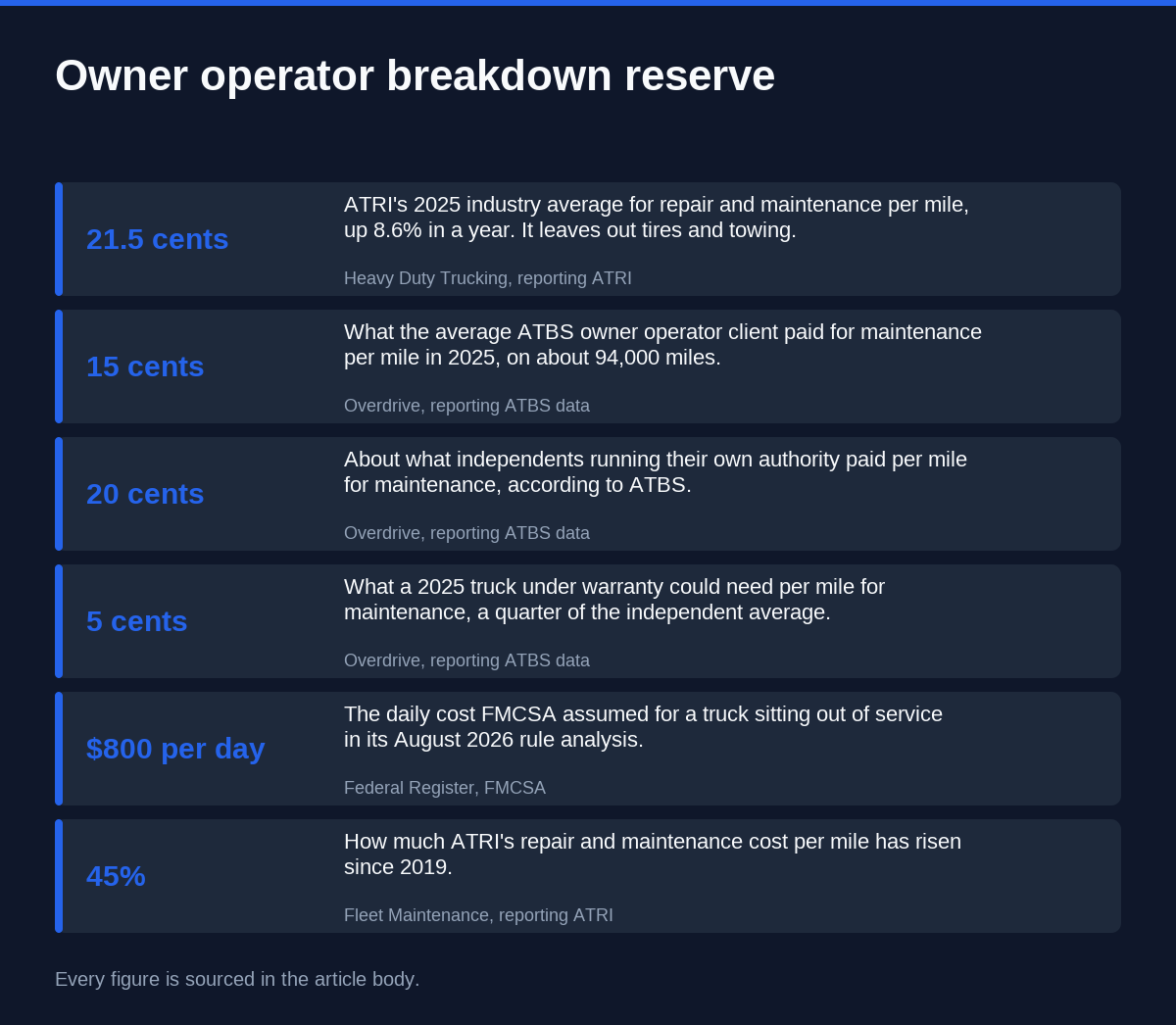
- → 21.5 cents per mile ATRI's 2025 industry average for repair and maintenance per mile, up 8.6% in a year. It leaves out tires and towing. (Heavy Duty Trucking, reporting ATRI, 2025)
- → 15 cents per mile What the average ATBS owner operator client paid for maintenance per mile in 2025, on about 94,000 miles. (Overdrive, reporting ATBS data, 2025)
- → 20 cents per mile About what independents running their own authority paid per mile for maintenance, according to ATBS. (Overdrive, reporting ATBS data, 2025)
- → 5 cents per mile What a 2025 truck under warranty could need per mile for maintenance, a quarter of the independent average. (Overdrive, reporting ATBS data, 2025)
- → $800 per day The daily cost FMCSA assumed for a truck sitting out of service in its August 2026 proposed rule. (Federal Register, FMCSA, 2026)
- → 45% How much ATRI's repair and maintenance cost per mile has risen since 2019. (Fleet Maintenance, reporting ATRI, 2025)
Keep enough cash for one real breakdown, not just the average repair bill. For an owner operator on an older truck, that means a repair account filled at about 20 cents a mile. Add a separate cushion of $7,500 to $10,000 that you never touch for anything else. No public source publishes the average cost of one breakdown, so that cushion is a planning number I built from sourced pieces. The math is below.
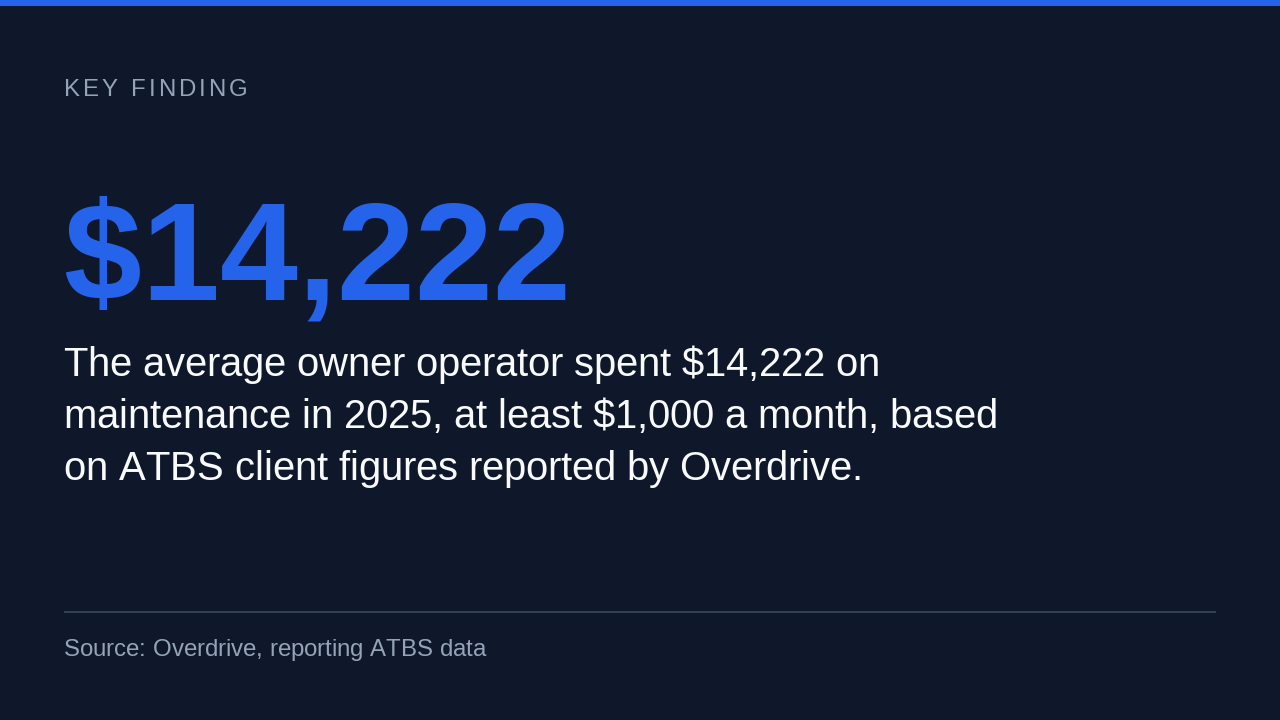
A common rule of thumb is to set aside 10 to 15 cents a mile. The average ATBS client spent more than 15 cents per mile on maintenance in 2025, which came to $14,222 for the year (Overdrive, reporting ATBS data, 2025). So the rule does not protect you from a breakdown. It matches what you spend when nothing big breaks.
I learned this on my first truck. I bought it in Houston and financed it. I paid $500 for a mechanic to inspect it first, and he missed the problems. The engine failed 8 months later and needed a short rebuild. Three months after that, the turbo and the radiator went. I let the truck go. I had planned for the payment and not for the repairs. Plan for the repairs first. The rest of this page shows you how to size that plan. My guide to hidden owner operator expenses covers the other costs that catch new drivers.
1 Does the 10 to 15 Cents a Mile Rule Actually Cover a Breakdown?
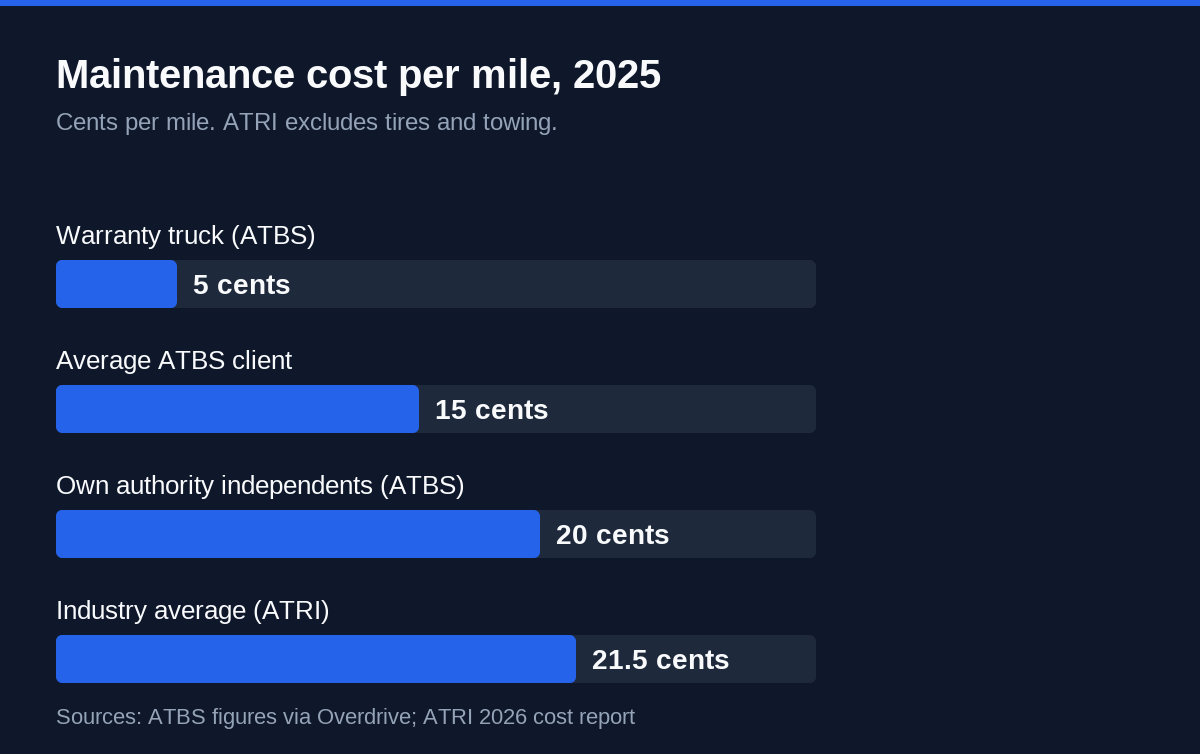
No. The average ATBS client paid more than 15 cents per mile for maintenance in 2025, so the popular rule only matches a normal year. Independents on their own authority paid 20 cents per mile, and ATRI's industry average was 21.5 cents per mile. The rule leaves nothing for the month when something big breaks.
| METRIC | VALUE | SOURCE |
|---|---|---|
| 2025 truck under warranty (ATBS) | 5 cents per mile | Overdrive, reporting ATBS data |
| Average ATBS client | 15 cents per mile | Overdrive, reporting ATBS data |
| Independents with their own authority (ATBS) | 20 cents per mile | Overdrive, reporting ATBS data |
| Industry average, repair and maintenance (ATRI) | 21.5 cents per mile | Heavy Duty Trucking, reporting ATRI |
Here is the problem with the rule. At about 94,000 miles a year, 15 cents a mile comes to about $14,100. That is almost exactly the $14,222 the average ATBS client spent. An average is what you spend when the year goes normally. A reserve has to sit on top of that, because the year you lose an engine is the year the average does not help you.
Here is the weekly math at about 94,000 miles a year. A rate of 10 cents a mile is about $181 a week. At 15 cents it is about $271. At 20 cents it is about $362, and at 21.5 cents it is about $389. The gap between the bottom of the popular rule and the industry average is more than $200 a week. That gap is what pays for the bad month.
A newer truck changes the picture for a while. ATBS says a 2025 truck under warranty could need as little as 5 cents per mile (Overdrive, reporting ATBS data, 2025). That is real money saved, but the warranty ends. Build your account around the truck you will own in year three, not year one. My list of the most reliable semi trucks for owner operators shows which models tend to keep that number down. If you are weighing a newer truck against an older one, my guide to leasing or buying a truck lays out the trade.
2 What Does the ATRI Repair Number Leave Out?
Tires and towing. ATRI's 21.5 cents per mile covers parts, labor and roadside service for 2025. Tires are counted separately at $0.050 per mile, and towing or recovery is left out entirely. A driver who budgets only the repair number is already short before the tow truck arrives.
| METRIC | VALUE | SOURCE |
|---|---|---|
| Repair and maintenance, 2025 | 21.5 cents per mile | Heavy Duty Trucking, reporting ATRI |
| Repair and maintenance, 2024 | 19.8 cents per mile | FreightWaves, reporting ATRI |
| Tires, 2025 | $0.050 per mile | American Transportation Research Institute |
| Rise in repair cost per mile since 2019 | 45% | Fleet Maintenance, reporting ATRI |
ATRI surveys for hire carriers of every size, so treat its number as a benchmark for what a truck costs to keep running, not as your personal bill. Your truck age, your lanes and your shop choices move the real figure up or down. The direction of travel is clear, though. Repair cost per mile rose from 19.8 cents per mile to 21.5 cents per mile in one year. Some of the cheap fixes are in your hands. A weak battery is one of the easier problems to prevent, and my guide to choosing a semi truck battery shows what to look for.
One more caution about the numbers. The ATBS average of 15 cents sits well below ATRI's 21.5 cents, and the published coverage does not say whether ATBS counts tires. ATBS has also quoted a lower figure, about 14 cents per mile, earlier in the year (FreightWaves, reporting ATBS, 2025), so read its number as a range of 14 to 15 cents. If tires sit outside that range, add about 5 cents and you land near 20 cents, which matches what independents on their own authority paid. When two sources disagree, I plan on the higher one until my own settlement sheets prove I run lower.
Add tires on top. At 94,000 miles, 5 cents a mile is about $4,700 a year. Then add towing, which no public source prices. A tow depends on distance, time of night and whether your plan covers it. Call your roadside provider before you break down, and check what your policy pays. My semi truck insurance cost guide explains what coverage you are paying for.
3 What Does One Day of Downtime Cost an Owner Operator?
FMCSA's August 2026 proposed rule cites industry downtime estimates of $448 and $760 per day, then rounds up to $800 per day. The agency says the figures generally include lost revenue, fixed costs and delay costs. Your own cash cost per day is smaller, and you should know that number before you need it.
| METRIC | VALUE | SOURCE |
|---|---|---|
| Downtime cost range cited by industry sources | $448 and $760 per day | Federal Register, FMCSA |
| Downtime cost FMCSA used | $800 per day | Federal Register, FMCSA |
| Truck and trailer procurement, per mile | $0.404 per mile | American Transportation Research Institute |
| Liability and cargo insurance, per mile | $0.106 per mile | American Transportation Research Institute |
| Miles per truck, 2025 | 85,991 miles | American Transportation Research Institute |
I split a day down into two parts. Lost revenue is money you did not earn. Fixed cost is money you still pay. A reserve has to cover the second part, plus your bills at home. ATRI puts truck and trailer procurement at $0.404 per mile and insurance at $0.106 per mile. Together that is $0.510 a mile. Across 85,991 miles, that comes to about $43,855 a year, or about $120 a day. That is my math from ATRI's averages.
Treat $120 as a floor. It leaves out permits, electronic logging fees, parking and your own household bills, and it assumes you still make payments on the truck. If your truck is paid off, the number drops, but your insurance and your life do not stop. Most owner operators already feel the squeeze between delivery and pay, and a breakdown stretches it. My look at the owner operator fuel cash flow gap shows how thin that window can get.
On the first day down, do three things. Get the shop's estimate in writing before work starts. Ask the shop what caused the failure and what else is likely to fail soon. Keep every receipt, including the tow and the motel, because those costs belong in your real cost per mile. A written estimate also tells you how much of your cushion the bill will eat before you commit.
4 How Much Cash Should You Hold Before the Next Breakdown?
Hold two accounts. First, a maintenance account filled by the mile at 15 to 21.5 cents, which is about $271 to $389 a week at 94,000 miles. Second, a one time breakdown cushion of $7,500 to $10,000 that covers the bill, the tow and a week or more down.
| PLANNING CASE | CASH NEEDED | ASSUMPTIONS |
|---|---|---|
| Small: sensor, hose or air system | $2,140 | $1,500 bill, $400 tow, 2 days down at $120 |
| Medium: turbo, radiator or aftertreatment | $7,540 | $6,000 bill, $700 tow, 7 days down at $120 |
| Large: engine or transmission | $21,520 | $18,000 bill, $1,000 tow, 21 days down at $120 |
The formula is simple. Cash needed equals the repair bill, plus the tow, plus the days down times your daily fixed cost. No public source gives an average shop bill or tow bill for one breakdown, so these three cases are my planning assumptions, not published averages. Swap in quotes from your own shop and your own tow provider. My cushion of $7,500 to $10,000 is built on the medium case, because that is the breakdown most drivers will meet. I round up so a slow parts delivery does not sink me.
The large case is why a cushion alone is not enough. A bill near $21,500 is more than the cushion covers. Your maintenance account has to keep growing, and you should know before the day arrives what credit you could use. Talk to your accountant about how to set the accounts up for your tax situation.
Run the two accounts as separate savings accounts at your bank, with names you will recognize. Move the maintenance money on the day your settlement lands, so it never sits in your main account where it looks like spending money. Touch the cushion only for repairs, tows and the days you are stuck. After you use it, refill the cushion before you put money toward anything else. That order protects you from the second breakdown, which tends to come when you are still short from the first.
Here is how I would size it for different drivers. On a newer truck under warranty, fill the account at 5 cents a mile and hold a cushion near the small to medium cases. Raise both before the warranty ends. On an older truck running your own authority, plan on 20 cents a mile or more, plus the full cushion. I run a 2009 Freightliner Columbia with a Detroit engine, so I plan on the older truck number. If you lease on, read your agreement closely for who pays for repairs and downtime. My guide to lease on carrier terms shows the clauses to check.
Two things would change my answer. If your engine has high miles, raise the monthly rate, because every figure above is an average across all trucks. If you are still paying off the truck, count the payment in your daily fixed cost, which is already in the $120 above. If you are still shopping, my breakdown of how much a semi truck costs helps you size the payment side. To see what your own rate does to your break even, put it in the repair line of the cost per mile calculator.
5 Do Breakdowns Really Cause Most Owner Operator Failures?
Overdrive calls breakdowns and downtime the leading cause of owner operator business failure, but it names no study behind that claim, so treat it as commonly cited, not proven. The data does show that repair costs are rising and that a thin cash cushion makes every bill harder to absorb.
| METRIC | VALUE | SOURCE |
|---|---|---|
| Leading cause of failure, as reported | Big breakdowns and related downtime (commonly cited; no primary source traceable) | Overdrive |
| Maintenance spend, average owner operator, 2025 | $14,222 | Overdrive, reporting ATBS data |
| Rise in repair cost per mile since 2019 | 45% | Fleet Maintenance, reporting ATRI |
I cannot rank the causes of failure for you from public data, and I will not pretend to. What I can say from my own first truck is that the repair bills arrived faster than my cash did. If you want the failure numbers I could source, read my breakdown of how many owner operators go out of business each year.
The reserve comes out of your take home, so it belongs in your plan from the first load. My piece on owner operator salary after expenses shows how much is left once the costs are paid. The $14,222 spent on maintenance in 2025 is a good line to check against your own settlement sheets.
Explore every figure in this article
Methodology
Every cost figure comes from a named, dated source: ATRI's 2026 operational cost report covering 2025 data, ATBS client figures as reported by Overdrive, and the FMCSA rule analysis published in the Federal Register in August 2026. The daily fixed cost of about $120 and the weekly reserve amounts are my own arithmetic from those published figures. The three breakdown cases are planning assumptions, because no public source reports an average shop bill, tow bill or downtime cost for a single breakdown.
- Sources consulted: 10
- Sources cited: 10
- Data freshness: current year: 9, last year: 0, older: 0
- Data range: 2019 to 2026-11-20
- Research date: 2026-11-20
- Update schedule: Reviewed when ATRI or ATBS publish new figures
- Limitations: ATRI figures cover carriers of every size, not only owner operators. ATBS figures cover ATBS clients, who may not match every owner operator. No public source gives an average shop bill, tow bill or downtime cost for a single owner operator breakdown, so the reserve examples in this article use stated assumptions, not averages.
Frequently Asked Questions
How much should an owner operator set aside per mile for repairs?
The average ATBS client paid more than 15 cents a mile for maintenance in 2025, and independents with their own authority paid about 20 cents. ATRI's industry average was 21.5 cents. If you run an older truck on your own authority, plan on 20 cents, not 10. (Overdrive, reporting ATBS data, 2025)
How much does one day of downtime cost an owner operator?
FMCSA's August 2026 proposed rule cites industry estimates of $448 to $760 a day for a truck out of service, then rounds up to $800 a day. The agency says the figures generally include lost revenue, fixed costs and delay costs, so your own cash cost per day will be lower. (Federal Register, FMCSA, 2026)
Does ATRI's repair and maintenance number include tires and towing?
No. ATRI's 21.5 cents per mile covers parts, labor and roadside service for 2025. Tires are counted separately at $0.050 per mile, and towing or recovery is left out of the figure entirely. Budget for both on top of the repair rate. (Heavy Duty Trucking, reporting ATRI, 2025)
Does a newer truck really cost less to maintain?
ATBS says a 2025 truck under warranty could need as little as 5 cents a mile, against about 20 cents for the average independent. The gap shows up when the warranty ends. Plan your reserve around the truck you will own in year three, not year one. (Overdrive, reporting ATBS data, 2025)
What does $14,222 a year in maintenance mean per week?
ATBS clients spent $14,222 on maintenance in 2025, reported as at least $1,000 a month. Spread across 52 weeks, that is about $274 a week going into a repair account before you count tires, towing or the days the truck sits. (Overdrive, reporting ATBS data, 2025)
How fast are repair costs rising?
ATRI's repair and maintenance cost per mile rose 8.6% in 2025, from 19.8 cents to 21.5 cents, and is up 45% since 2019. A reserve rate you set in 2022 is likely too low now. (Fleet Maintenance, reporting ATRI, 2025)
Sources & References
- American Transportation Research Institute. "Analysis of the Operational Costs of Trucking: 2026 Update." truckingresearch.org/2026/07/analysis-of-the-operational-costs-of-trucking-2026-. Accessed 2026-11-20.
- Heavy Duty Trucking, reporting ATRI. "Trucking fleets faced record operating costs during third year of freight recession." truckinginfo.com/news/trucking-fleets-faced-record-operating-costs-during-third-. Accessed 2026-11-20.
- FreightWaves, reporting ATRI. "Trucking costs outpaced consumer inflation in 2025: ATRI." freightwaves.com/news/trucking-costs-outpaced-consumer-inflation-in-25-atri. Accessed 2026-11-20.
- Fleet Maintenance, reporting ATRI. "M&R cost per mile rose nearly 9% in 2025: ATRI study." fleetmaintenance.com/shop-operations/data-and-telematics/article/55396219/americ. Accessed 2026-11-20.
- FleetOwner, reporting ATRI. "Trucking operating expenses hit record high, ATRI analysis finds." fleetowner.com/news/news/55391195/atri-releases-2026-trucking-operational-cost-r. Accessed 2026-11-20.
- Overdrive, reporting ATRI. "Trucking's 2025 operating costs hit all-time high." overdriveonline.com/business/article/15830180/2025-trucking-costs-surge-to-allti. Accessed 2026-11-20.
- Overdrive, reporting ATBS data. "Owner op income up, with capacity driven trucking recovery ongoing, fuel cost wildcard." overdriveonline.com/partners-in-business/article/15820459/ownerop-income-up-with. Accessed 2026-11-20.
- Overdrive, reporting ATBS data. "Just how high has owner ops' truck trailer maintenance cost moved?." overdriveonline.com/15822598. Accessed 2026-11-20.
- Federal Register, FMCSA. "English Language Proficiency; Out of Service Criteria (proposed rule)." federalregister.gov/documents/2026/08/10/2026-16288/english-language-proficiency. Accessed 2026-11-20.
- FreightWaves, reporting ATBS. "ATBS: average truck driver earnings in 2025 held mostly stable from '24." freightwaves.com/news/atbs-average-truck-driver-earnings-in-2025-held-mostly-sta. Accessed 2026-11-20.
Last updated: