How Many Owner Operators Go Out of Business Each Year: Three Counts, No Single Answer (2026)
KEY TAKEAWAYS
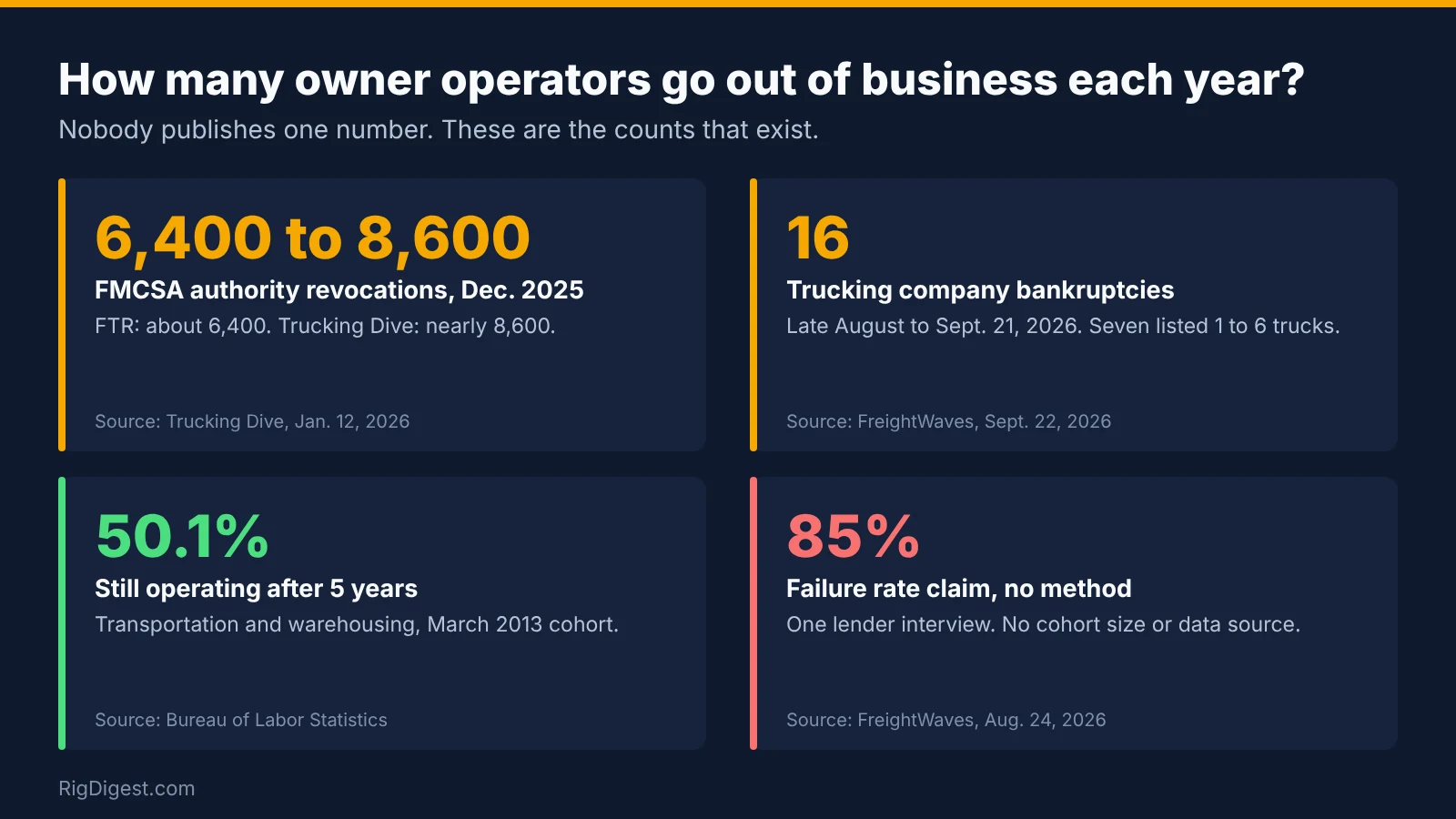
- → 16 Trucking, delivery and transportation companies that filed Chapter 7 or Chapter 11 from late August to Sept. 21, 2026. The list ran from small owner operators to fleets of dozens of trucks. (FreightWaves, 2026)
- → 7 Filers on that list that reported 1 to 6 trucks. (FreightWaves, 2026)
- → 50.1% Share of transportation and warehousing establishments opened in March 2013 that were still operating 5 years later, against 79.4% after 1 year. This is the closest official survival data, but it counts establishments in the whole sector, not trucking carriers. (Bureau of Labor Statistics, 2018)
- → 50% Share of 2024 carrier exits that involved carriers older than 3 years, up from 37% in 2023, so exits are not only first year failures. (Motive, 2024)
- → 2,000 Net operating authority additions per week in August and September 2026, a 5 year high, according to FreightWaves SONAR. (FreightWaves SONAR, 2026)
- → May 19 Date FMCSA launched Motus, its new registration system. Carriers reported access lockouts, technical glitches and wrong records, and FMCSA paused USDOT number inactivations for carriers behind on biennial updates. (Overdrive, 2026)
- → 85% Average 3 year failure rate for carriers with under 2 years of experience and their own authority, quoted from one equipment lender executive with no cohort size, data source or method given. (FreightWaves, 2026)

Nobody publishes how many owner operators go out of business each year. That is the straight answer, and you should know it before you trust a number from a video or a forum thread. What exists is three different counts that each measure a different kind of exit, plus a few failure rates that never had a source.
I went through the Federal Motor Carrier Safety Administration (FMCSA) authority counts reported by the trade press. I also read the newest bankruptcy tallies and the Bureau of Labor Statistics (BLS) survival tables. Then I traced where the famous failure rates came from. I have 11+ years over the road (OTR), so I read these numbers as a driver first. A count only helps if you know what it counts.
1 How Many Operating Authorities Does FMCSA Revoke in a Month?
FMCSA revoked about 6,400 operating authorities in December 2025 by FTR's count, and nearly 8,600 by Trucking Dive's count of the same agency data (Trucking Dive, 2025). Same agency, same month, two answers. Filters change the total, so treat any single revocation number as a range.
| METRIC | VALUE | SOURCE |
|---|---|---|
| FMCSA authority revocations, December 2025, FTR count | 6,400 | Trucking Dive |
| FMCSA authority revocations, December 2025, Trucking Dive count | 8,600 | Trucking Dive |
| Authorities revoked in 2023, one published estimate | 88,000 | IFA Commercial Factor |
| Net decline in motor carriers, first half of 2024 | 10,000 | IFA Commercial Factor |
| More for hire firms than before the pandemic, per FTR | 86,000 | Trucking Dive |
| Last quarter with revocations as low as Q1 2026 | Q4 2021 | Trucking Dive |
Operating authority is the federal permission to haul freight for hire under your own MC number. FTR is a freight forecasting firm, and Trucking Dive is a trade news site. Trucking Dive dates a revocation by its final effective date, and its count shifts with the filters an analyst applies.
Trucking Dive calls authority counts an imperfect but timely measure, because one authority can cover any number of trucks. It also counts reinstatements, which are authorities that come back after a revocation. For all of 2025, it found the for hire carrier population largely unchanged from the year before.
The older figures in the table are second hand. The International Factoring Association's magazine cites the 88,000 for 2023 to another publisher's estimate, and the 10,000 net decline in early 2024 to a TruckInfo.net analysis of FMCSA data. Use them as rough size markers, not exact counts.
A revocation is also not the same as going out of business. Carriers must keep insurance and process agent filings on record with FMCSA to avoid revocation proceedings (FMCSA, 2026). A lapse in semi truck insurance can end your trucking authority, and the authority can later come back, so counting every revocation as an exit overstates failures.
2 How Many Trucking Companies File for Bankruptcy in a Month?
FreightWaves counted at least 16 trucking, delivery and transportation companies that filed for bankruptcy from late August to Sept. 21, 2026, and 7 of them reported 1 to 6 trucks (FreightWaves, 2026). FOX Business counted at least 8 transportation related Chapter 11 filings in September. The windows and lists differ, so do not add the two.
| METRIC | VALUE | SOURCE |
|---|---|---|
| Trucking and transportation bankruptcy filings, late August to Sept. 21, 2026 | 16 | FreightWaves |
| Filers that reported 1 to 6 trucks | 7 | FreightWaves |
| Transportation related Chapter 11 filings in September 2026, FOX Business count | at least eight | FOX Business |
| Globemaster Inc. reported liabilities, Sept. 15, 2026 filing | $3.26 million | FOX Business |
| Diesel at one Flying J in Orange, Texas, per The Wall Street Journal | $6.26 | FOX Business |
Chapter 7 means a company shuts down and sells what it owns. Chapter 11 means it tries to reorganize and keep running. The FreightWaves list split about evenly between the two, with 8 Chapter 11 filings, 7 Chapter 7 filings and 1 that did not say.
Globemaster Inc. filed Chapter 11 on Sept. 15, 2026, reporting $3.26 million in liabilities against about $1.1 million in assets. Filings like that show what happens when a company's debts outgrow what it owns. Before you take on debt for buying a truck, know your break even number.
FOX Business, citing The Wall Street Journal, reported diesel at $6.26 a gallon at one Flying J in Orange, Texas. That is one station, not a national average, but it shows the squeeze. When fuel climbs, what an owner operator keeps falls fast, as the math in owner operator salary after expenses shows.
Revocations run in the thousands a month and bankruptcies in the dozens, so most exits happen without a courtroom.
3 What Are the Real Survival Odds in the First Five Years?
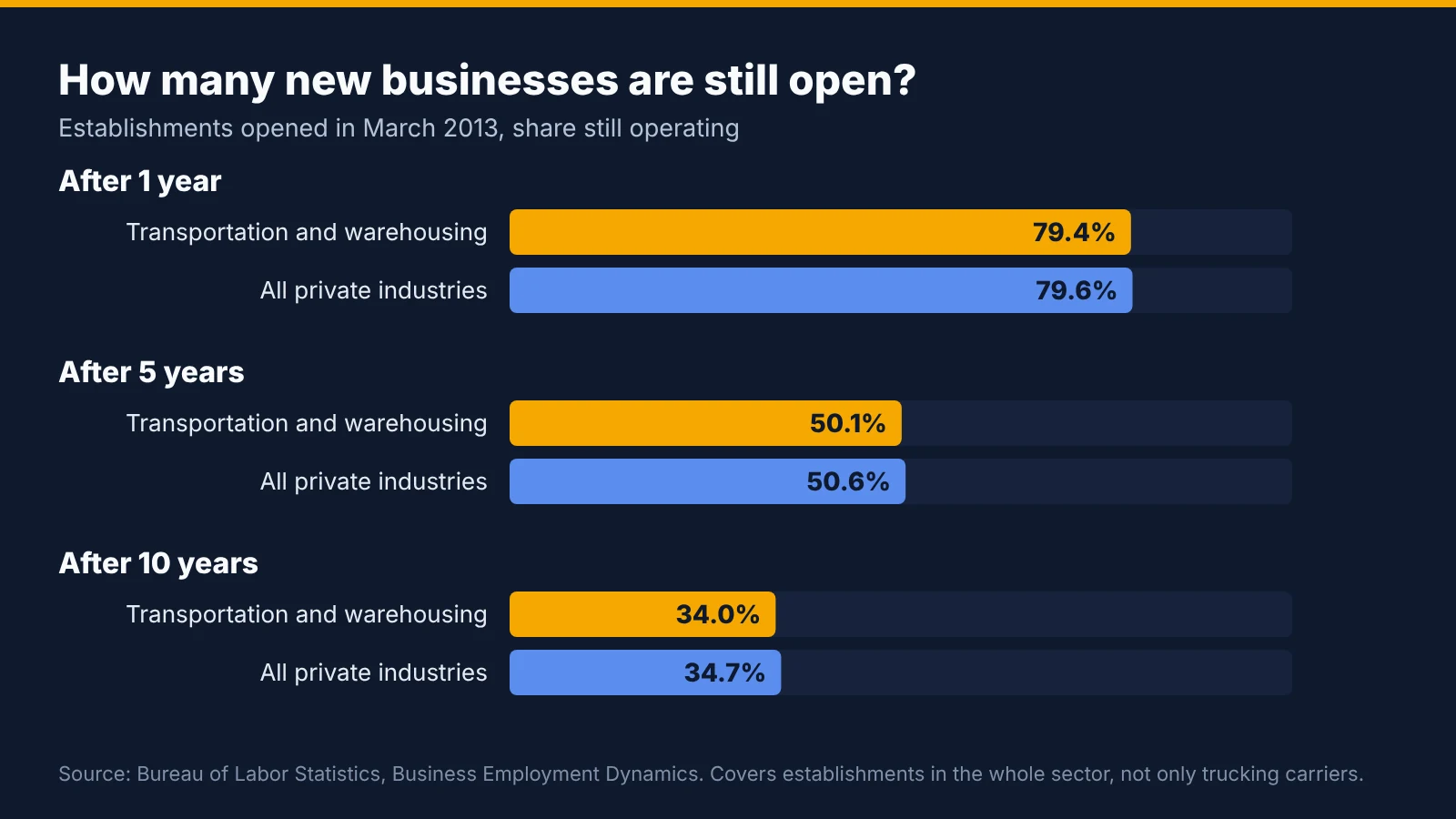
The closest official data comes from the Bureau of Labor Statistics. It says 79.4% of transportation and warehousing establishments opened in March 2013 were still operating after 1 year, and 50.1% after 5 (Bureau of Labor Statistics, 2018). That covers a whole sector, not just trucking carriers, so use it as a benchmark.
| METRIC | VALUE | SOURCE |
|---|---|---|
| Transportation and warehousing still operating after 1 year | 79.4% | Bureau of Labor Statistics |
| Transportation and warehousing still operating after 5 years | 50.1% | Bureau of Labor Statistics |
| Transportation and warehousing still operating after 10 years | 34.0% | Bureau of Labor Statistics |
| All private industries still operating after 5 years | 50.6% | Bureau of Labor Statistics |
| Share of 2023 carrier exits involving carriers older than 3 years | 37% | Motive |
| Share of 2024 carrier exits involving carriers older than 3 years | 50% | Motive |
| Average age of carriers leaving the market, August 2024 | 3 years | Motive |
BLS dates a business from the first time it reports employees on payroll, and its tables follow establishments, not trucking authorities (Bureau of Labor Statistics, 2024). Transportation and warehousing also includes warehouses, couriers and other freight businesses, so trucking carriers are only part of the number.
So read it as a benchmark. About half of new businesses in a sector that includes trucking were gone within 5 years. That does not match the claim that 8 or 9 in 10 new carriers fail, though the two measure different things.
Motive, a fleet management software company, adds another angle in its freight report. It says 50% of 2024 carrier exits involved carriers older than 3 years, up from 37% in 2023. It also put the average age of a carrier leaving the market at 3 years in August 2024.
The report calls that figure an average in its text and a median in a chart caption, and it does not name its data source. Treat it as a trend signal. The lesson holds anyway: exits are not only a first year problem. If you are weighing starting a trucking company with one truck, plan for the later years as hard as the first.
4 Do 80 to 85 Percent of New Trucking Companies Really Fail?
No published study backs that. The 85% (commonly cited; no primary source traceable) figure comes from one equipment lender executive's interview, with no cohort size, data source or method (FreightWaves, 2026). The 80% (commonly cited; no primary source traceable) figure is a forum comment. The projection that between 6,000 and 10,000 (commonly cited; no primary source traceable) carriers could exit in 2026 names no source.
| CLAIM | VALUE | SOURCE |
|---|---|---|
| 3 year failure rate for carriers with under 2 years of experience (one lender interview) | 85% (commonly cited; no primary source traceable) | FreightWaves |
| Failure rate for new trucking companies (Reddit comment, Sept. 19, 2026) | 80% (commonly cited; no primary source traceable) | Reddit, r/OwnerOperators |
| Carriers projected to exit in 2026 if diesel stays high (social media post, no source) | 6,000 and 10,000 (commonly cited; no primary source traceable) | FOX Business on Facebook |
| For comparison: transportation and warehousing still operating after 5 years | 50.1% | Bureau of Labor Statistics |
Start with the 85% (commonly cited; no primary source traceable) number. FreightWaves quoted Kirk Mann, an executive at equipment lender Mitsubishi HC Capital America. He gave it as the average 3 year failure rate for carriers with under 2 years of experience and their own authority. The article names no data source and no method.
Mann's own explanation points to the 2021 and 2022 truck price bubble. Carriers who bought trucks at inflated prices were underwater as soon as rates fell. That is a story about bad debt in one downturn.
The 80% (commonly cited; no primary source traceable) figure appears in a Reddit comment from Sept. 19, 2026, which says the industry has an 80 percent failure rate and gives no source. The projection that between 6,000 and 10,000 (commonly cited; no primary source traceable) carriers could exit in 2026 appears in a FOX Business social media post as an estimate that varies widely. The FOX Business article behind that post contains no such projection and names no source for it.
Compare these claims with the BLS benchmark: 50.1% still operating after 5 years means about half were gone, not most of them. The sectors differ, so this does not prove the claims wrong. It is a reason to ask for the cohort before you repeat a number, and to ask who gains when it sounds scary.
5 Are More Carriers Entering or Leaving Trucking in 2026?
By authority counts, more are entering. By trucks, the fleet is shrinking. FreightWaves SONAR, a freight market data platform, reported net authority additions above 2,000 a week in August and September 2026 (FreightWaves SONAR, 2026), yet total for hire tractors fell about 51,000 in August alone. More companies can mean fewer trucks.
| METRIC | VALUE | SOURCE |
|---|---|---|
| Net authority additions per week, August and September 2026 | 2,000 | FreightWaves SONAR |
| Estimated new authority grants, percent below the first quarter | 17% | FreightWaves SONAR |
| Monthly fall in total for hire tractors, August 2026 | 51,000 | FreightWaves SONAR |
| Tractors in new for hire fleets, August 2026 | 19,520 | FreightWaves SONAR |
| Tractors in new for hire fleets, mid 2022 peak | 47,000 | FreightWaves SONAR |
| Growth in total authorities, 2019 to 2022 | 51% | FreightWaves SONAR |
| New interstate registrants buying liability insurance, 2026 | two in three | FreightWaves SONAR |
| Net revocations turned negative for the first time since at least | 2019 | FreightWaves SONAR |
Trucking Dive reported a net influx of carriers in Q1 2026, with revocations at their lowest of any quarter since Q4 2021. Its text gives no counts, so I am not printing one. SONAR adds that net revocations turned negative for the first time since at least 2019. FMCSA changed systems in May, so treat that last point with care.
The entry side looks different from 2022. New for hire fleets held 19,520 tractors in August 2026 against about 47,000 at the mid 2022 peak. SONAR also found new authority grants running 17% below the first quarter. It found only two in three of new interstate registrants now buy liability insurance, down from more than 9 in 10 in 2019.
SONAR's argument is that authority counts show permission to haul, not trucks on the road, and it expects a tight market through early 2027. Total authorities rose 51% from 2019 to 2022 while for hire tractors rose just 12%. Whether that tightens freight is a rates question, and our loads and rates pages cover that side.
6 Why Are the 2026 FMCSA Numbers Hard to Trust?
FMCSA retired its legacy registration systems on May 14 and launched Motus, its new registration system, on May 19, 2026. Carriers reported lockouts and wrong records, and FMCSA paused USDOT number inactivations for carriers that missed biennial updates since June 1 (Overdrive, 2026). Treat any count from after launch as unsettled.
| METRIC | VALUE | SOURCE |
|---|---|---|
| Date FMCSA retired its legacy registration systems | May 14 | Danaco Group |
| Date FMCSA launched Motus | May 19 | Overdrive |
| Newly registered USDOT numbers, May 18 through June 9, 2026 | 12,711 | Central Analysis Bureau, republishing Overdrive |
| Newly granted MC numbers, May 18 through June 9, 2026 | 4,337 | Central Analysis Bureau, republishing Overdrive |
| Authorities FMCSA normally approves in a month | 5,000 | Central Analysis Bureau, republishing Overdrive |
| USDOT inactivations paused for missed biennial updates since | June 1 | Overdrive |
| Active for hire fleets with 1 to 6 power units, October 2025 | 181,577 | FreightWaves SONAR via idispatchhub |
An MC number is the number FMCSA issues with your operating authority. A claim spread after launch that Motus had registered zero new carriers. Overdrive and the Central Analysis Bureau found that was almost certainly wrong, with 12,711 new USDOT numbers and 4,337 new MC numbers between May 18 and June 9.
FMCSA was changing the data daily during that window. Overdrive's report on the paused inactivations describes access lockouts, technical glitches and wrong records. One owner operator was told his insurance was not active when his agent said otherwise, and his authority stayed inactive for nearly a month. The report gives no count of affected carriers.
There is also a hole no software fix closes. Owner operators leased onto a carrier hold no authority of their own, so when they quit, no revocation or bankruptcy record exists. I was leased on with Landstar Ranger as a BCO (Business Capacity Owner), and I ran under Landstar's authority, not my own. FMCSA's revocation count would never have shown me leaving.
Read the lease on carrier terms before you sign, because that is where your real exit conditions live. Small fleets are the nearest signal. Active for hire fleets with 1 to 6 power units numbered 181,577 in October 2025, down roughly 2,400 from the start of that year (FreightWaves SONAR via idispatchhub, 2025).
My verdict: no count will tell you whether your truck survives. Your own numbers will. If you run your own authority or plan to, find your break even number with the cost per mile calculator before you sign a lease or buy a truck.
Explore every figure in this article
Methodology
I wrote this page on October 15, 2026 after reviewing 24 sources and citing the 17 that matter most. No agency publishes a count of owner operators who leave trucking, so every figure here measures something narrower: authority revocations, bankruptcy filings or business survival. For each figure I went back to the original article or table and checked the number, the date and the wording before using it. The authority counts come from published analyses of FMCSA data by Trucking Dive, FTR and FreightWaves SONAR. A few of those figures sit in charts whose values the articles do not print, so I left them out. The BLS survival tables cover all transportation and warehousing establishments, not trucking carriers alone. The 2023 revocation estimate and the 2024 net decline are second hand, cited by an industry magazine from other publishers. The 85 percent, 80 percent and 6,000 to 10,000 claims have no traceable primary source, so they appear here as contested. I also went through the past month of news, forum threads and video for anything newer. FMCSA launched Motus on May 19, 2026, which makes recent counts unsettled, so I will update this page monthly as the data settles.
- Sources consulted: 24
- Sources cited: 17
- Data freshness: current year: 13, last year: 1, older: 3
- Data range: 2023-01-01 to 2026-10-15
- Research date: 2026-10-15
- Update schedule: Monthly while FMCSA data settles after the Motus launch
Frequently Asked Questions
How many owner operators go out of business each year?
No one publishes that number. FMCSA authority revocations ran about 6,400 by FTR's count and nearly 8,600 by Trucking Dive's count for December 2025 alone. Revocations include paperwork lapses, and owner operators leased onto a carrier hold no authority of their own, so they never show up in the count. (Trucking Dive, 2025)
Do 80 to 85 percent of new trucking companies fail?
That is not supported by a published study. The 85 percent figure comes from one equipment lender executive's interview with no cohort size, data source or method. For comparison, the Bureau of Labor Statistics found 79.4 percent of transportation and warehousing establishments opened in March 2013 were still operating after 1 year, and 50.1 percent after 5. (Bureau of Labor Statistics, 2018)
How many trucking companies went bankrupt in September 2026?
FreightWaves counted at least 16 trucking, delivery and transportation companies that filed Chapter 7 or Chapter 11 from late August through Sept. 21, 2026, and 7 of them reported 1 to 6 trucks. FOX Business counted at least 8 transportation related Chapter 11 filings in September. The windows and lists differ, so do not add the two counts. (FreightWaves, 2026)
Does an FMCSA revocation mean a trucking company went out of business?
Not always. Carriers must keep insurance and agent filings on record with FMCSA to avoid revocation proceedings, so a lapse can end an authority that later comes back. Trucking Dive counts reinstatements alongside grants and calls authority counts an imperfect measure of how many trucks are really running. (FMCSA, 2026)
Are more carriers entering or leaving trucking in 2026?
The signals conflict. FreightWaves SONAR reported net authority additions above 2,000 a week in August and September 2026, and Trucking Dive found a net influx of carriers in Q1 2026. SONAR also reported total for hire tractors fell about 51,000 in August 2026, so more companies can mean fewer trucks. (FreightWaves SONAR, 2026)
Why are the 2026 FMCSA numbers hard to trust?
FMCSA launched its Motus registration system on May 19, 2026, and carriers reported access lockouts, technical glitches and wrong records. FMCSA then paused USDOT number inactivations for carriers behind on biennial updates since June 1. New authority counts also changed daily in the weeks after launch, according to the Central Analysis Bureau. (Overdrive, 2026)
Sources & References
- FreightWaves. "16 trucking companies hit bankruptcy court in less than a month." freightwaves.com/news/16-trucking-companies-hit-bankruptcy-court-in-less-than-a-. Accessed 2026-10-15.
- FOX Business. "Trucking industry hit by string of bankruptcy filings as diesel costs surge." foxbusiness.com/lifestyle/trucking-industry-hit-string-bankruptcy-filings-diesel. Accessed 2026-10-15.
- Trucking Dive. "Carrier attrition eases in 2025." truckingdive.com/news/fmcsa-grants-reinstatements-revocations-operating-authorit. Accessed 2026-10-15.
- Trucking Dive. "Carrier population shifts back toward growth, quarterly FMCSA data shows." truckingdive.com/news/carrier-population-shifts-back-toward-growth-quarterly-fmc. Accessed 2026-10-15.
- FreightWaves SONAR. "Is Trucking Capacity Coming Back? Why New Capacity Isn't Entering the 2026 Freight Market." freightwaves.com/news/is-trucking-capacity-coming-back-why-new-capacity-isnt-ent. Accessed 2026-10-15.
- FreightWaves. "Trucking Downturn: Why 85% of New Carriers Didn't Survive." freightwaves.com/news/trucking-downturn-why-85-of-new-carriers-didnt-survive. Accessed 2026-10-15.
- Bureau of Labor Statistics. "34.7 percent of business establishments born in 2013 were still operating in 2023." bls.gov/opub/ted/2024/34-7-percent-of-business-establishments-born-in-2013-were-. Accessed 2026-10-15.
- Bureau of Labor Statistics. "Business Employment Dynamics: establishment age and survival FAQ." bls.gov/bdm/bdagefaq.htm. Accessed 2026-10-15.
- Motive. "State of freight 2024 and 2025." gomotive.com/blog/state-of-freight-2024-25/. Accessed 2026-10-15.
- Central Analysis Bureau, republishing Overdrive. "FMCSA's new authority counts fall to zero after Motus? Not quite." cabadvantage.com/fmcsas-new-authority-counts-fall-to-zero-after-motus-not-quite/. Accessed 2026-10-15.
- Overdrive. "FMCSA suspends USDOT deactivations as Motus issues mount for carriers." overdriveonline.com/regulations/article/15828482/fmcsa-suspends-usdot-deactivati. Accessed 2026-10-15.
- IFA Commercial Factor. "Carrier & Broker Failures in 2024 and 2025 and Why 2026 May Bring One Last Wave." magazine.factoring.org/magazine-articles/carrier-amp-broker-failures-in-20242025. Accessed 2026-10-15.
- Danaco Group. "Insurance Filed but MC Authority Still Pending?." danacogroup.com/insurance-filed-mc-authority-still-pending/. Accessed 2026-10-15.
- FMCSA. "Insurance Filing Requirements." fmcsa.dot.gov/registration/insurance-filing-requirements. Accessed 2026-10-15.
- FreightWaves SONAR via idispatchhub. "Small Fleets with 1 to 6 Trucks Continue to Decline Through 2025." datawrapper.dwcdn.net/7Adxc/1/. Accessed 2026-10-15.
- Reddit, r/OwnerOperators. "How on earth do people manage to have a trucking company but no experience." reddit.com/r/OwnerOperators/comments/1wk909r/how_on_earth_do_people_manage_to_ha. Accessed 2026-10-15.
- FOX Business on Facebook. "A growing number of trucking companies are filing for bankruptcy as soaring diesel costs." facebook.com/FoxBusiness/posts/a-growing-number-of-trucking-companies-are-filing. Accessed 2026-10-15.
Last updated: