Highest Paying Hazmat Freight and Lanes: Where Hazmat Truck Drivers Earn the Most
By Emeka Ogbonna, owner operator with 11+ years over the road and a hazmat endorsement on his CDL.
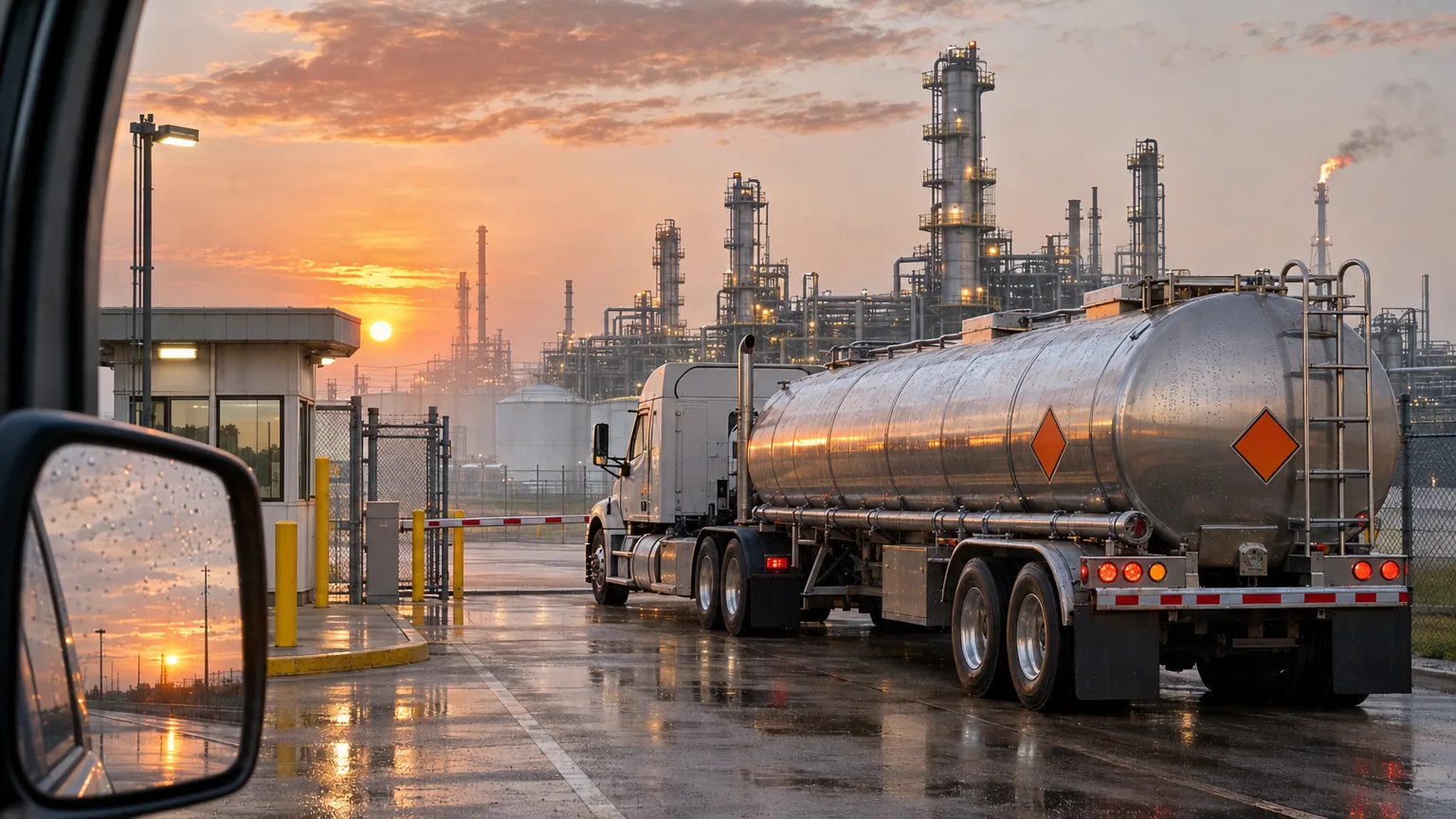
The highest paying hazmat freight is likely the freight that few trucks are allowed to haul. That means loads that need a federal safety permit, loads that carry $5,000,000 in required liability coverage, and loads that cannot sit alone on a street. The lanes that feed this freight run through Texas and Louisiana, which hold about half of US refining capacity.
As far as I know, no federal agency publishes pay by hazmat class. So this page ranks hazmat loads by how hard they are to haul legally, then shows you how to turn any pay offer into weekly dollars. Rules and figures are as of November 2026. This is general information, not legal or tax advice, so confirm any rule with FMCSA or your insurance agent before you act on it.
For base pay numbers and endorsement costs, start with hazmat truck driver pay. This page picks up where that one stops: which loads and lanes to chase.
Highest paying hazmat freight, ranked by how hard it is to haul
Pay tends to follow scarcity. The fewer carriers that can legally take a load, the more room a carrier has to pay for it. The table runs from the most rules to the fewest. It is my read of the federal rules, not a pay table.
| Hazmat freight | Extra rules | Required liability coverage |
|---|---|---|
| Radioactive, highway route controlled quantity (Class 7) | Safety permit, security plan | $5,000,000 |
| Explosives, Division 1.1 to 1.3 | Safety permit over 25 kg, attended at all times, security plan for any amount | $5,000,000 in bulk |
| Poison inhalation, Hazard Zone A and B | Safety permit (Zone A over 1 liter per package, Zone B in bulk), security plan for any amount | $5,000,000 in bulk for Zone A |
| Gases in bulk (Division 2.1 and 2.2) | Security plan for large bulk flammable gas | $5,000,000 |
| Hazardous substances in bulk cargo tanks (many chemicals) | Security plan for large bulk toxic (Division 6.1) loads | $5,000,000 if the product is a listed hazardous substance |
| Flammable liquids and oil (Class 3) | Security plan for large bulk Packing Group I or II loads | $1,000,000 for oil, $5,000,000 if the product is a listed hazardous substance in bulk |
| Packaged placarded freight (corrosives, paint, aerosols, mixed loads) | Placards, shipping papers | $1,000,000 |
The top rows are likely small markets. The 2022 Commodity Flow Survey found that Class 3 flammable liquids and Class 2 gases made up the vast majority of hazardous materials shipped, across all modes of transport including pipelines. The gas and flammable liquid rows hold most of the volume, so more trucks compete for that freight and the premium is likely modest.
The coverage tiers come from 49 CFR 387.9: $750,000 for non hazardous for hire freight, $1,000,000 for oil and most other hazmat, and $5,000,000 for the bulk and highest risk loads above. Whether a given chemical counts as a hazardous substance is a question for your carrier or your insurer. For what that coverage costs an owner operator, see semi truck insurance cost.
The safety permit list is short and specific. It covers highway route controlled Class 7 loads, more than 25 kg of Division 1.1 to 1.3 explosives, certain poison inhalation loads, and large bulk loads of liquefied natural gas, per FMCSA's hazmat compliance guide. If a load needs the permit, only carriers that hold it can run it.
Why the attendance rule matters for explosives freight
Under 49 CFR 397.5, Division 1.1 to 1.3 explosives must be attended at all times by the driver or a qualified representative of the carrier. Attended means the person is on the vehicle and awake but not in the sleeper berth, or within 100 feet with a clear view of it.
The rule has exceptions. The load can sit on carrier, shipper or consignee property, or in a safe haven, if the person responsible for it knows what it is and the emergency steps, and either has it in clear view or has parked it in the safe haven. Outside those places, a solo driver cannot rest in the berth with the load parked on the street. That is a reason this work can lean on teams, and a reason a carrier may pay more to keep it covered.
Other hazmat on a public street or shoulder must also be attended by its driver, except while the driver does duties tied to operating the vehicle. Plan your stops before you accept the load, not after.
Hazmat lanes: where the loads start
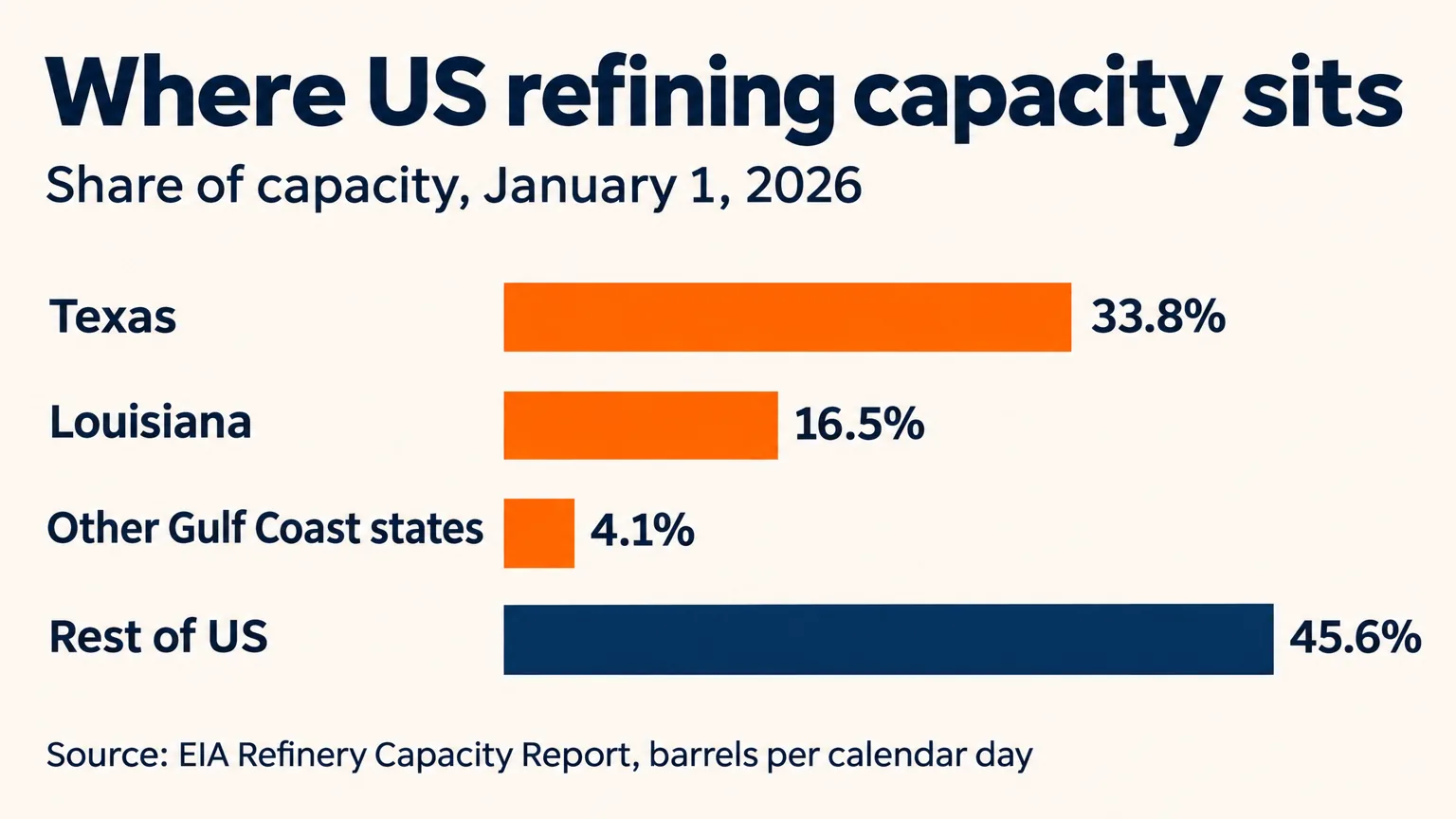
Many hazmat lanes start at plants. Texas and Louisiana together hold 50.3% of US refining capacity, about 9.1 million of 18.2 million barrels per calendar day, as of January 1, 2026. Texas has 34 refineries and Louisiana has 15. The wider Gulf Coast region that EIA tracks holds about 54%, based on the agency's refinery capacity table.
Crude oil starts in different places. In 2025 the Permian region produced 48% of US crude, and the Eagle Ford and the Bakken produced 9% each, according to EIA's review of 2025 crude oil production. Tank loads of crude and other oil can start in those regions.
Why does density matter for pay? Deadhead, which is miles you drive empty. A 10 cent premium on loaded miles means little if you run 250 empty miles to reach the next placarded pickup. Plants close together mean shorter empties and more loaded miles in your week, and Pinnacle's premium, for one, applies only to loaded miles.
These figures show where product starts. They do not show what any carrier pays on a lane, or how much of the product moves by truck.
Two ways carriers pay the hazmat premium
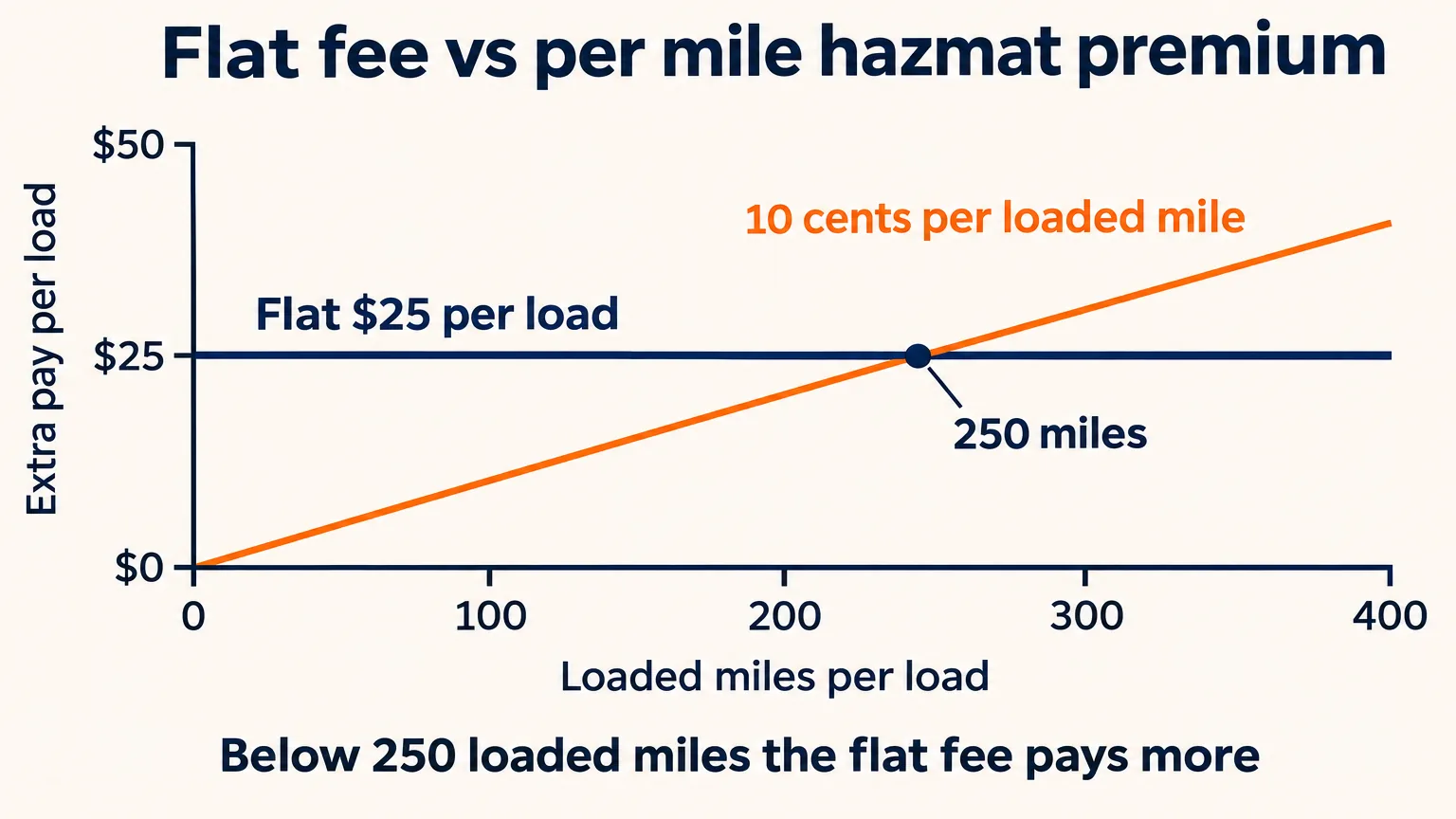
Pinnacle Trucking starts placarded loads at $0.75 per mile against its $0.65 standard starting rate. That is $0.10 more per loaded mile, according to FleetOwner's September 28, 2026 report on Pinnacle's Placard Pay.
Averitt went the other way. It dropped separate hazmat mileage rates and now pays a flat $25 per hazmat load, with regional top pay at 66 cents per mile from August 9, 2026.
The two premiums pay the same at 250 loaded miles per load, because $25 divided by $0.10 is 250. Under 250 loaded miles, the flat fee pays more. Over 250, the per mile premium pays more.
Here is a worked example with two made up offers. It is not a quote from any carrier. The week is 2,100 total miles, 1,800 loaded and 300 empty.
- Offer A: 65 cents on all miles, plus 10 cents per loaded hazmat mile.
- Offer B: 66 cents on all miles, plus $25 per hazmat load.
| Your week | Offer A | Offer B |
|---|---|---|
| 3 long loads, 600 loaded miles each | $1,545 ($0.74 per total mile) | $1,461 ($0.70 per total mile) |
| 8 short loads, 225 loaded miles each | $1,545 ($0.74 per total mile) | $1,586 ($0.76 per total mile) |
Because the base rates differ by one cent, the totals cross at about 283 loaded miles per load, not 250. Same truck, same miles, same freight. The better offer flips with the length of your hauls. That is why you compare weekly dollars, not the number on a recruiting page.
Also ask which miles the premium covers, because a premium that pays only on loaded miles is worth less to a driver who runs a lot of empties.
What changes if you own the truck
A hazmat owner operator carries more insurance and more paperwork than a dry van owner operator. If you run your own authority, your required coverage moves up from $750,000 to $1,000,000 or $5,000,000. PHMSA registration can also come out of your pocket when it applies to you, and I walk through those fees in the hazmat pay guide.
Price a hazmat load the same way as any load: revenue per total mile minus cost per mile. If the premium does not beat the extra insurance and downtime, skip the load. How to calculate rate per mile walks through the math, and owner operator salary after expenses shows what is left when the bills are paid.
A premium also does nothing for a truck that sits. The engine on my first truck, bought in Houston, failed 8 months after I bought it. The turbo and radiator failed 3 months after that. Plan for repairs before you plan for the premium.
Verdict: who should chase hazmat freight
If you want the highest paying hazmat loads, the permit freight at the top of the table is where carriers have the most room to pay. It can also take a team or a carrier with safe havens, and the work is limited.
For most drivers, steady tank or packaged loads in a dense region are likely to pay better in a real week, because you should run loaded more often. A Gulf Coast or basin carrier that pays a clear premium on every loaded mile is a better bet than a high number that applies to a few miles.
Skip hazmat if the premium covers only some miles and the carrier sends you empty to far pickups. The math can also flip if you take a flat fee plan and run many short loads, as the example shows.
Take any offer, work out weekly dollars, then run it through the cost per mile calculator with your own numbers.
References
- Commodity Flow Survey 2022 Data Released, Bureau of Transportation Statistics (June 26, 2025)
- 49 CFR 387.9, Financial responsibility, minimum levels, eCFR
- How to Comply with Federal Hazardous Materials Regulations, FMCSA
- 49 CFR 397.5, Attendance and surveillance of motor vehicles, eCFR
- Refinery Capacity Report, Table 1, as of January 1, 2026, EIA
- U.S. crude oil production rose in 2025, setting new record, EIA Today in Energy (March 31, 2026)
- Pinnacle Trucking adds hazmat pay premium for OTR drivers, FleetOwner (September 28, 2026)
- Averitt boosts regional and LTL driver pay, FleetOwner (July 31, 2026)
Want more RigDigest in your Google results? Add us as a preferred source, then check the box next to rigdigest.com.
Make me a preferred source on Google