Driver Qualification File Checklist: What Auditors Check
What is on a driver qualification file checklist? The application, state driving records, past employer safety history, road test proof, medical certification and a yearly review, all required by 49 CFR 391.51 and related rules.
Key takeaways
- Every motor carrier must keep a file for each driver it employs, and an owner operator on his own authority is both the carrier and the driver.
- Two clocks start on a new driver's first day: 30 days to put the state driving record in the file and 30 days to finish the past employer safety history.
- Most items stay for as long as the driver works for you plus 3 years. Yearly items and medical proof can come out 3 years after their date.
- FMCSA says files must be produced on demand, and handing them over after the review does not cure the violation.
- Failing to keep the file, the driving record inquiries or the medical certificate is listed as a critical violation.
- Since June 23, 2025, proof of medical certification for CDL holders is the state driving record. A paper copy counts only under a short term FMCSA waiver.
- Clearinghouse query results stay with FMCSA, but past employer drug and alcohol violation information you collect must go in the file.
In a compliance review, a driver file gets tested against a short list, and a missing item can be cited. This page gives you the list, the clocks that start on hire day, and how an owner operator keeps the file clean. Rules are as of November 2026.
What is a driver qualification file and who has to keep one?
A driver qualification file, also called a DQ file or DQF, is the folder of records that proves a driver was allowed to drive a commercial truck for you. 49 CFR 391.51 says each motor carrier must keep one for every driver it employs. It can be combined with the personnel file.
That includes you. FMCSA's safety planner says the employment application is required for every driver, owner operators included. Part 391 also says a person who is both the motor carrier and the driver must follow the rules for both.
My own path shows the split. I have driven for Averitt, National Carriers and J.B. Hunt. I leased on and ran under Landstar's authority, and now I run my own. On my own authority I am the carrier and the driver, so the file is my job.
If you are still choosing a path, the lease on guide and the trucking authority guide show what each one hands you.
What do auditors check first in a DQ file?
Auditors ask for the files. FMCSA guidance from 1997 says driver qualification files must be produced on demand. Producing them after the review is over does not cure a violation of 391.51.
Then each file is compared against the list in 391.51. Three file items are on FMCSA's critical list in Part 385, Appendix B:
- Failing to keep a file on each driver you employ, under 391.51(a).
- Failing to keep the driving record inquiries, under 391.51(b)(2).
- Failing to keep the medical examiner's certificate, under 391.51(b)(6).
Those three are the ones to double check first. A missing file, a missing driving record inquiry or missing medical proof is a critical violation by itself.
Roadside checks are a different event, but the same paperwork habits help. See the roadside paperwork costs article for what drivers get caught on there.
What goes on the driver qualification file checklist?
Use this table as your checklist, as of November 2026. The rule column tells you where each item comes from, so you can read the exact wording yourself.
| Item | Rule | When | Keep it for |
|---|---|---|---|
| Employment application | 391.21 | Before the driver drives | Employment plus 3 years |
| Driving record from each state that issued a license in the past 3 years | 391.23(a)(1) | Within 30 days of the start date | Employment plus 3 years |
| Past employer safety history, or proof you tried to get it | 391.23(d) and (e) | Within 30 days of the start date | Employment plus 3 years |
| Road test certificate, or an accepted equivalent | 391.31 and 391.33 | Before the driver drives | Employment plus 3 years |
| Yearly driving record | 391.25(a) | Every 12 months | 3 years from the date |
| Written note of the yearly review, with the reviewer's name and the date | 391.25(c)(2) | Every 12 months | 3 years from the date |
| Proof of medical certification: the state driving record for CDL holders, a copy of the certificate for drivers without a CDL | 391.51(b)(6) | Before driving, then at each renewal | 3 years from the date |
| Medical variance, Skill Performance Evaluation certificate or federal exemption letter, if the driver has one | 391.49 and part 381 | When issued | 3 years from the date |
| Note that the medical examiner is on the National Registry, for drivers without a CDL | 391.23(m)(1) | Before the driver drives | 3 years from the date |
Clearinghouse query results are not part of the file, because FMCSA keeps them. But FMCSA's checklist says any past employer drug and alcohol violation information you collect to fill in the gaps must be kept in the file. You still have to run the queries. The Clearinghouse guide for owner operators covers the setup.
What starts the 30 day clock for a new driver?
Two clocks start on the first day. Here is the starter list for each new hire under 391.23:
- Request the driving record from every state that issued the driver a license in the past 3 years, and put a copy in the file within 30 days. If a state does not answer, document your good faith effort.
- Investigate the driver's safety history with DOT regulated employers from the past 3 years. Log every contact and every non response within 30 days.
- Run the required Clearinghouse queries. If the driver refuses consent, that driver cannot operate a commercial motor vehicle for you.
- Tell the driver in writing about the right to review the information, ask for corrections and add a rebuttal.
The application has its own long list under 391.21. It covers every address from the past 3 years, employers from the past 3 years, commercial truck employers from the 7 years before that, accidents, moving violations and a signed certification.
Past employers have 30 days to answer your request, even when they have nothing to report. Once a driver asks in writing, you have 5 business days to hand over the investigation records.
How long do you keep each item?
The base rule in 391.51(c) is simple. Keep the file for as long as the driver works for you and for 3 years after. Paragraph (d) lets you remove some items 3 years after their date: the yearly driving record, the review note, the medical proof, any variance or exemption papers, and the National Registry note.
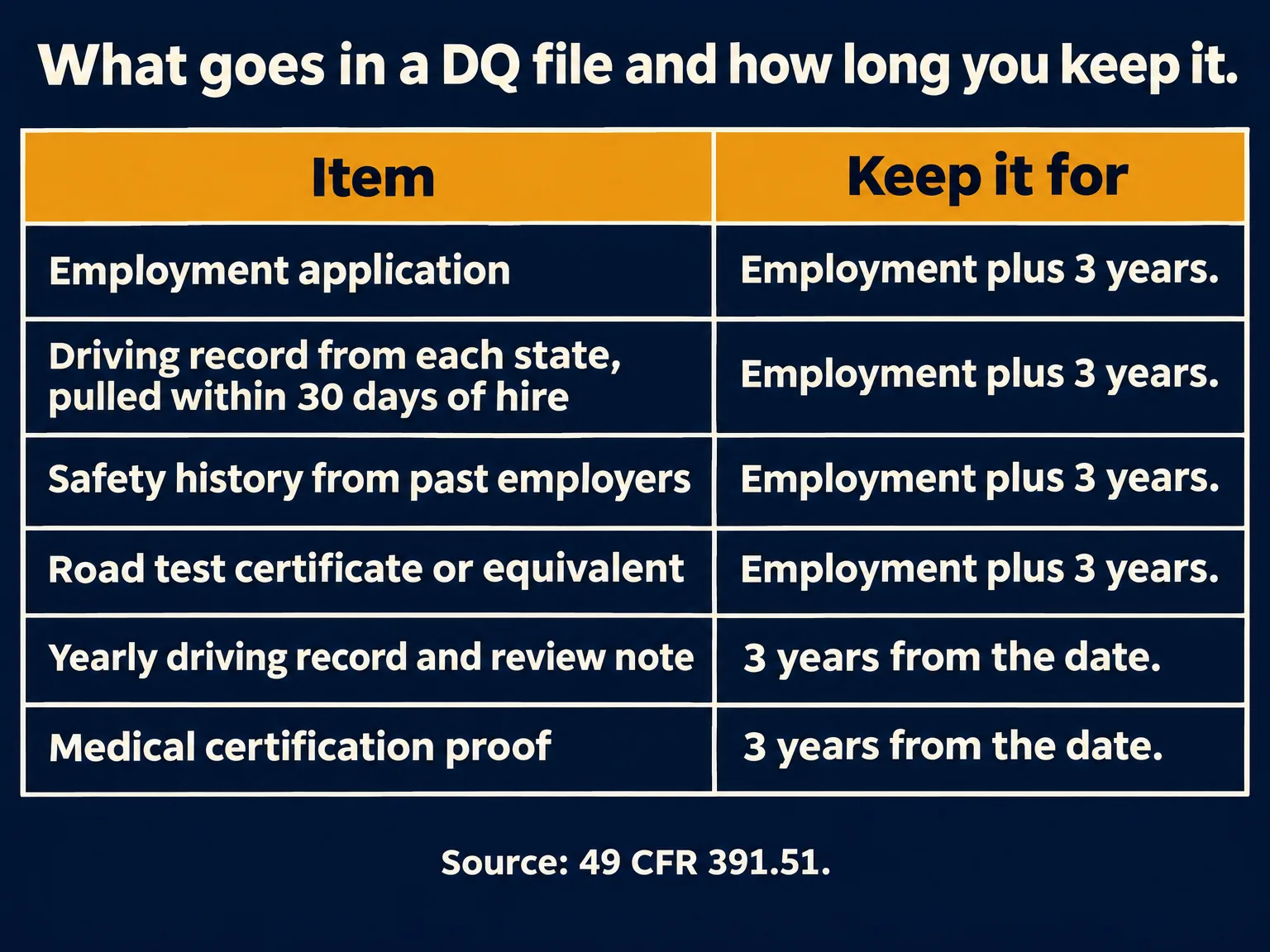
In practice, use one folder per driver and date every yearly item the day you add it. Clear out yearly items older than 3 years. Leave the application, the first driving record, the safety history and the road test certificate alone for as long as the driver is with you.
What changed for medical certification proof?
Since June 23, 2025, medical examiners no longer have to give CDL holders a paper certificate. CDL holders no longer send paper to their state. FMCSA passes the exam results to the state, and the state posts them on the driver's record.
For a CDL holder, the carrier now uses the driving record from the current licensing state as proof, and notes in the file that the driver is certified. That comes from the FMCSA National Registry driver brochure. Drivers without a CDL still get the paper certificate, and that has not changed.
Short term waivers have let carriers and drivers lean on a paper copy for up to 60 days. The January 2026 waiver ended April 10, 2026, so check the National Registry page for the latest FMCSA waiver and whether a newer one applies before you drop the paper copy. The paper medical card article explains how the change reached drivers.
My advice: after every medical exam, pull your own state driving record and confirm it shows certified before the old certificate runs out.
What does an owner operator on their own authority need to do?
You wear both hats, so build a file for yourself before your first load. Here is the order I would do it in:
- Fill out the employment application and keep it in the file.
- Pull your driving record from each state that issued you a license in the past 3 years.
- Document your road test equivalent. A driver who is also the motor carrier cannot give his own road test under 391.31. Under 391.33, a copy of a valid CDL can stand in when the state issued it after a road test in the type of truck you will run. Read the exact conditions in 391.33, which carve out the double, triple and tank endorsements.
- Add proof of medical certification, which for a CDL holder is your state driving record.
- Pull your driving record again every 12 months and write a dated review note with your name on it.
Hiring a driver? Then the full 30 day list applies to each person. Your authority paperwork sits next to this file, so see the MC number guide and the UCR registration guide too.
If you lease on, the carrier you run under is usually the one that keeps your file, and it will ask you for these items. Keep your own copies of your CDL, driving record and medical proof so you can answer fast. The lease on carrier terms article shows what else those contracts ask of you.
Which mistakes get a DQ file flagged?
These are the gaps the rules and FMCSA's enforcement records point to:
- No state driving record by day 30. Fix: request it on the first day and write down every attempt if the state is slow.
- A past employer inquiry with nothing on paper. Fix: log each contact and each non response.
- An incomplete application. Fix: check it against the list in 391.21 before the driver drives.
- Stale medical proof. Fix: set a reminder 60 days before each renewal.
- A driving record pulled but no review note. Fix: write and date the review the same day.
- Files scattered across email and a truck cab. Fix: one folder, one place, ready to hand over on demand.
Who should build a full file now, and who can wait?
If you run your own authority or you hire drivers, build the file before your first load. A missing file, driving record inquiry or medical proof is a critical violation, which is a bad trade for some paperwork.
If you are leased on, you do not keep the carrier's file, but you should hold your own copies. If you are a company driver, your employer keeps it, so just check that your medical status shows on your state record.
Two things can change this. Drivers who stay inside one state may follow a state version of these rules, so check your state agency. And the medical proof rules are still shifting, so confirm the current waiver before you rely on any paper copy.
This is general information as of November 2026, not legal advice. Confirm your situation with FMCSA or a qualified compliance professional.
Frequently asked questions
What is a driver qualification file?
It is the folder of records that proves a driver was qualified to drive a commercial truck for a motor carrier. 49 CFR 391.51 requires each carrier to keep one for every driver it employs, and it may be combined with the personnel file.
How long do I keep a driver qualification file after a driver leaves?
Keep the file for as long as the driver works for you and for 3 years after. Yearly items such as the annual driving record, the review note and the medical proof may be removed 3 years after the date they were created.
Does an owner operator need a driver qualification file for themselves?
Yes, when you run under your own authority. FMCSA says the employment application is required for every driver, owner operators included, and a person who is both the carrier and the driver has to follow both sets of rules.
How soon must I get a new driver's state driving record?
Within 30 days of the date the driver starts. The record must be placed in the file in that same window, and if a state does not answer, you must document your good faith effort to get it.
Do Clearinghouse results go in the driver qualification file?
No. FMCSA's checklist says Clearinghouse query results do not need to be kept in the file because FMCSA keeps them. You still have to run the required queries, and any past employer drug and alcohol violation information you collect must be kept in the file.
What happens if I cannot produce the file during a review?
FMCSA guidance says files must be produced on demand, and handing them over after the review ends does not cure the violation.
Do CDL holders still need a paper medical card in the file?
For drivers with a CDL, the main proof is the state driving record that shows a certified medical status. Short term FMCSA waivers have allowed a paper copy for up to 60 days in some cases, so check the National Registry page for the waiver that applies today.
Is the National Registry note still required?
For drivers without a CDL, yes. For CDL holders, the note was required only through June 22, 2025.
Pricing your own authority?
The DQ file is one line in the startup bill. Run your own numbers in the owner operator startup cost calculator before you commit.
Want more RigDigest in your Google results? Add us as a preferred source, then check the box next to rigdigest.com.
Make me a preferred source on Google