How to Decide Whether to Lease or Buy a Truck in Your First Year as an Owner Operator
By Emeka Ogbonna, 11+ years OTR, hazmat endorsed CDL holder and owner operator on his own authority. Published and last updated .
Buy a used truck with a loan if you can cover about 15% down plus 3 months of repair money. If you cannot, wait and save rather than stretch into any deal. Treat a carrier lease purchase in year one as a rental until the contract proves otherwise.
Much of the advice on this topic skips the real problem: you are making two choices, not one. People blur them together. Pull them apart, and the answer gets plain.
What are you actually deciding when you lease or buy?
Choice 1 is whose authority you run under. Leasing on to a carrier puts your truck under the carrier's DOT number. I cover how that pay works in the lease on pay guide.
Choice 2 is how you pay for the truck. That is what this article is about, and there are 3 ways to do it.
Table 1. The 3 ways to get a truck in year one
| Buy with a loan | Third party lease | Carrier lease purchase | |
|---|---|---|---|
| Who holds title during the term | You, with the lender holding a lien | The leasing company | The carrier or its finance partner |
| Who sets your freight and pay | You | You | In the programs the task force targeted, the carrier |
| Cash up front | Down payment, 10% to 20% at most lenders for good credit | Varies by deal | Check deposits and escrow before you sign |
| Biggest risk | Payment plus repairs on your own cash | Buyout and return terms | Default, escrow and early exit terms |
| Best fit | A driver with cash and a clean truck inspection | A driver who wants a newer truck under warranty | A driver who read every page and still sees a fair price |
Lease purchase is the minority path. Overdrive's most recent Truck Purchase & Lease Survey, published in early 2022, found only 5% of owner operators got their latest equipment that way, whether through a carrier or a third party company. Do not treat it as the default.
What does buying a used truck cost in year one?
ACT Research put the average used Class 8 retail price at $64,367 in August 2026, as covered in the RigDigest truck price guide. Take an $80,000 truck with 15% down and a $68,000 loan over 60 months.
Table 2. Payment on a $68,000 loan, 60 months, 9,000 miles a month
| APR | Monthly | Weekly | Per mile | Total interest |
|---|---|---|---|---|
| 8% | $1,379 | $318 | $0.15 | $14,728 |
| 12% | $1,513 | $349 | $0.17 | $22,757 |
| 18% | $1,727 | $398 | $0.19 | $35,605 |
The same truck costs $20,877 more in interest at 18% than at 8%. Shop the APR before you shop the truck.
A May 2026 FreightWaves report puts commercial truck loan rates at roughly 6% to 35% APR. At most specialty lenders, a credit score under 680 adds 2 to 5 percentage points. Ask for the APR, not the interest rate, because APR includes origination and documentation fees.
The payment is only half of it. The American Transportation Research Institute put truck procurement at $0.28 per mile in 2025, and repair and maintenance at $0.22 per mile, up 8.6% in a year. Those are fleet averages from its 2025 cost report. At 85,991 miles, the average annual figure in that report, they come to $24,077 and $18,918 a year.
Fleet trucks in that report averaged 3.6 years old. A first truck is usually older. That is my read, not an ATRI finding, but it means you should plan for repairs at or above $0.22 per mile.
Can you afford to buy a truck in your first year?
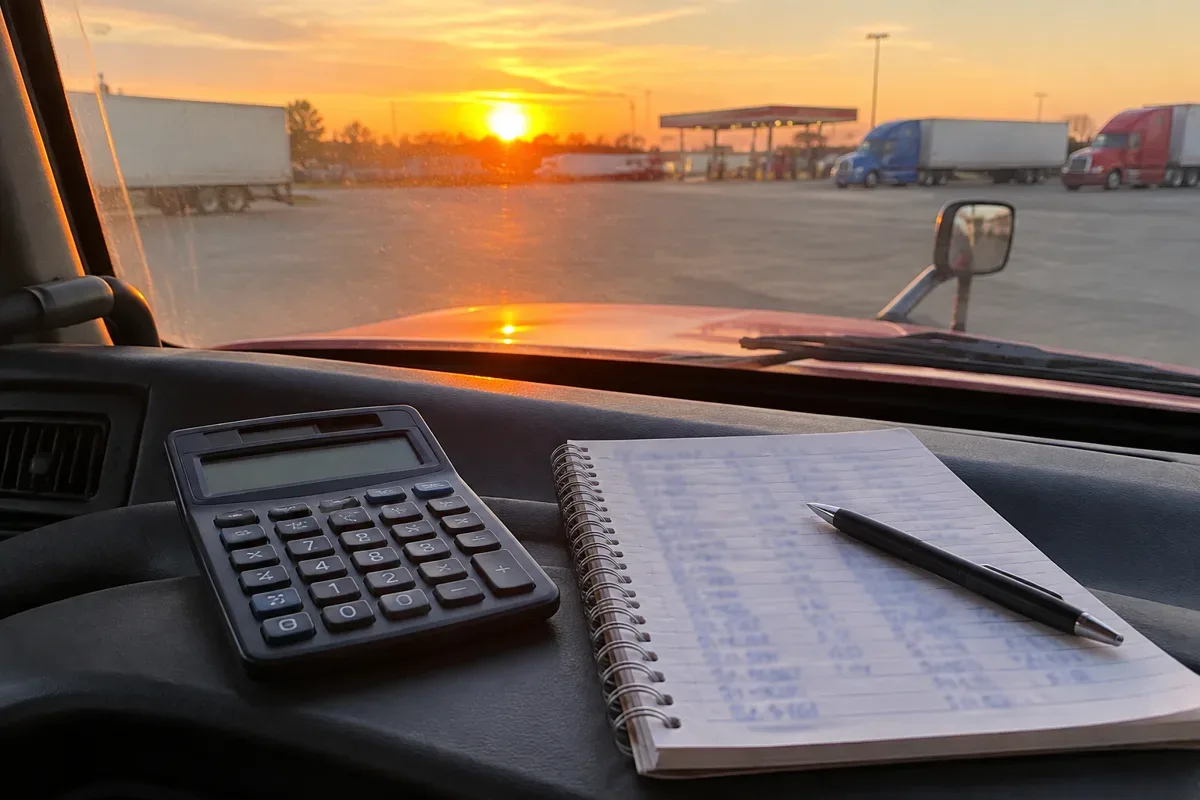
Before you open one truck listing, run 2 tests.
Test 1: cash before the first load. On the truck above, the 15% down payment is $12,000. Add $300 for your own authority, $55 for UCR for the 2027 registration year and up to $550 a year for the heavy vehicle use tax. The $550 cap applies to trucks over 75,000 pounds. That is $12,905 before insurance.
Test 2: the repair reserve. At $0.22 per mile and 9,000 miles, repairs run $1,980 a month. Three months is $5,940. That money sits in the bank and does not get spent on anything else. Fuel and insurance come on top, and you pay those whether you buy or lease.
Fail either test and you have your answer. A truck you can buy but cannot fix is not an asset. It is a payment.
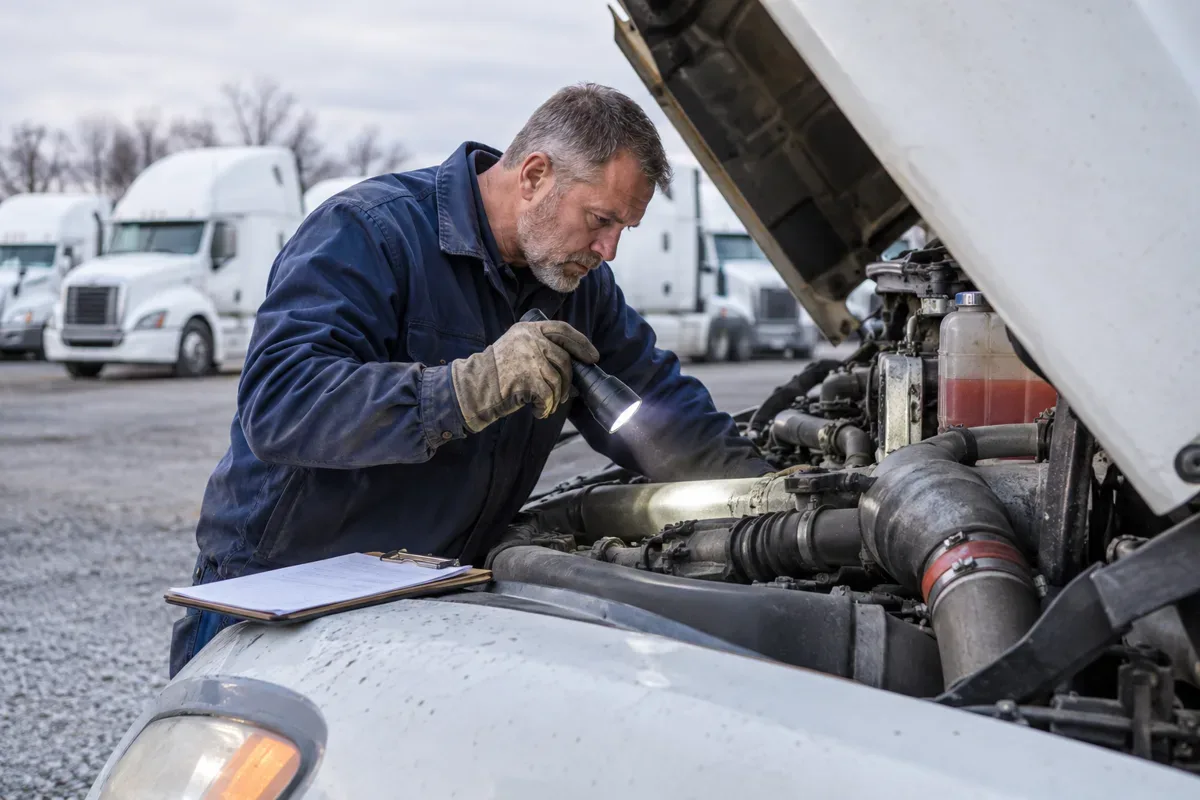
I learned that the hard way. My first truck was a financed buy out of Houston, and I paid $500 for a pre purchase inspection that missed the problems. The engine failed 8 months later and needed a short engine rebuild. The turbo and radiator went 3 months after that, and I let the truck go. I had planned for the payment. I had not planned for the repairs.
What do carrier lease purchase contracts hide?
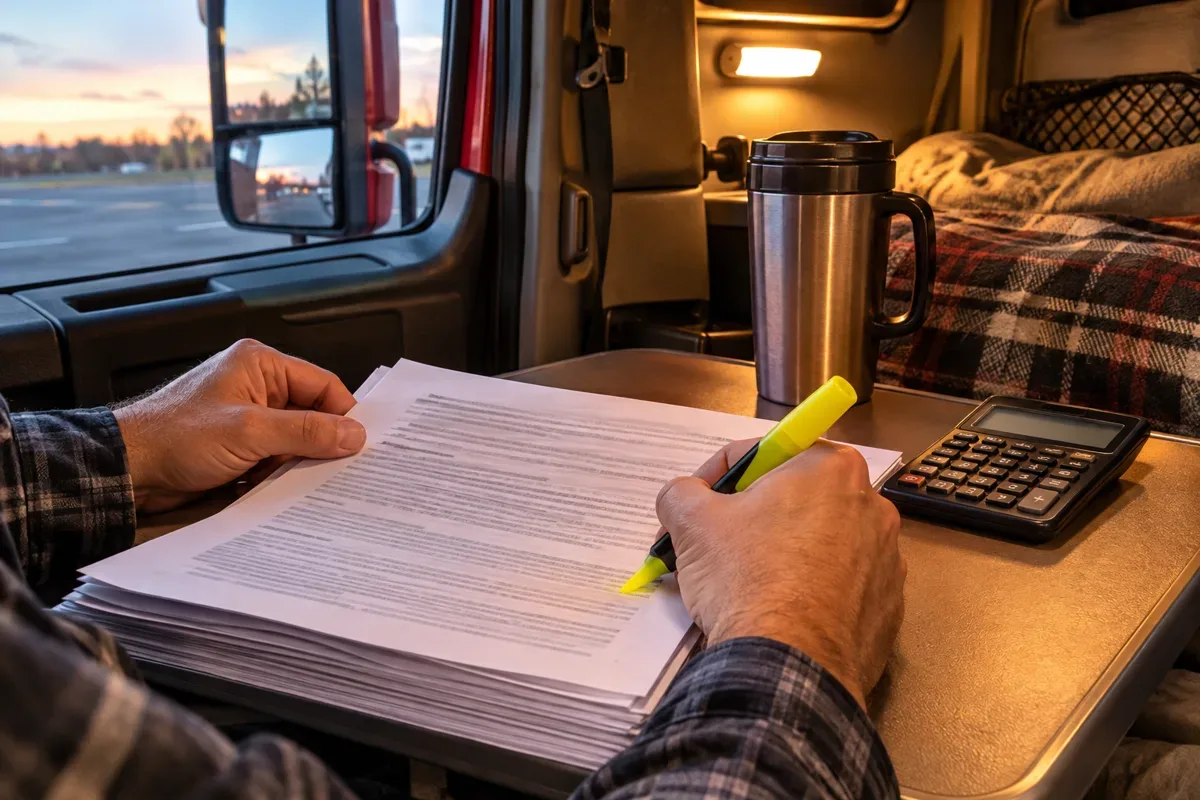
The Truck Leasing Task Force sent Congress its January 2025 findings on lease purchase programs. Its core ask: ban programs where the carrier controls your work, pay and debts. The report says "very few drivers make it to the end" of the agreement. It also found drivers often learn they built no equity, and that contracts come take it or leave it, with drivers typically not allowed to take them home to review before signing.
A CFPB staff report prepared for the task force gives one example. One lease let the finance company keep the full maintenance escrow balance if the driver failed to meet the lease terms, and it added a $5,000 early termination fee.
To be fair, not everyone agrees. Overdrive reported that Todd Amen of ATBS thinks the task force told only the downside. He says to read a carrier lease purchase as a truck rental with an option to buy. Some drivers do well that way. Glen Horack, a longtime Prime lease driver, took 3 year leases to the end and swapped for new equipment. He gave his reason in one line: "by the time I get it paid for, it's wore out."
Here are the 6 questions I would put to any carrier before signing:
- What is the total price of the truck, and what would a dealer charge for the same one?
- Can I take the contract home and have someone read it?
- What happens to my maintenance escrow if I leave early?
- What is the early termination fee?
- Who picks the repair shop, and can I turn down a load?
- Do I own the truck at the end, and what do I pay to do it?
If the answer to any of them is "it depends" or "we will get back to you," do not sign that day.
Why does your first year change the math?
A new carrier is monitored for 18 months under the new entrant safety rules, and a safety audit is expected in that window. Buying your own truck and running your own authority puts all of that on you.
That is a good reason to get your new authority insurance quote in writing before you buy. It decides whether your payment fits your first year. It also explains why some drivers lease on first: the carrier carries the authority, and you carry the lease terms instead.
Buying and leasing can also be treated differently at tax time. Ask a CPA before you sign, and have an attorney read any lease. Rules and fees in this article are current as of November 2026. This is general information, not tax or legal advice.
Which option fits you?
Table 3. Who should do what
| If this is you | Do this |
|---|---|
| 15% down, a repair reserve and a mechanic who checked the truck | Buy used with a loan and compare lenders by APR |
| Your best loan offer sits near 18% | Price the deal against waiting, since that rate adds $20,877 over 8% |
| You run high miles and want a warranty | A lease you take to term and swap, like Horack's, can fit if the terms hold up |
| Short on cash | Do not sign. Drive for a company and build the reserve first |
Put your own payment, repair reserve and first load cash into the owner operator startup cost calculator before you talk to a lender or a carrier.