Fuel Cards for Trucking: How Owner Operators Pick One
A card ad says 50 cents off a gallon. Then you check your lanes and only 4 of your 10 fuel stops take it. That gap is where a fuel card for trucking stops paying for itself.
The direct answer: pick the card with the best net discount at the stops you really use, then confirm you can get approved for it. This guide gives you a comparison table by card type, what a new authority can realistically get, a worked monthly savings example, a hidden cost checklist and the IFTA record rules.

What Is a Fuel Card for Trucking?
A trucking fuel card is a payment card for diesel that gives you a discount at participating stops and records every fill. Three things decide its value: the net discount per gallon after fees, how many of your regular stops accept it, and whether you can get approved on terms your cash flow can carry.
Net means what you keep after transaction fees, monthly fees and out of network charges.
How a Fuel Card for Trucking Saves You Money
Fuel cards use four discount models. Many cards mix two of them.
- Retail minus: you pay the posted pump price, and the card takes cents off at the pump or sends a rebate later. Heavy Duty Trucking describes it as a cents off discount from the retail price.
- Cost plus: you pay what the truck stop pays for the fuel, plus a set amount. Your price follows wholesale, not the sign on the pole.
- Better of: some programs price each fill at the lower of retail minus and cost plus. The same Heavy Duty Trucking piece says some deals pick the better price automatically, mostly for larger carriers.
- Rewards and rebates: points or credits back at a chain, paid after the fill. My Love's vs TA vs Pilot comparison covers how the big three chains handle rewards.
Here is the part card ads skip. Neither retail minus nor cost plus wins everywhere.
Example: on a $5.00 posted price, a 10 cent retail minus card gets you $4.90. A cost plus card prices the same fill from the stop's own cost, so it can land above or below $4.90 depending on that day's markup.
Ask which formula your card uses, and read the stop list before you read the discount.
Fuel Card Types Compared
Use this table to match a card type to your situation. Fees and terms change, so treat the figures as examples and get the fee schedule in writing.
| Card type | Discount model | Typical fees | Credit check | Network reach | New authority approval |
|---|---|---|---|---|---|
| Truck stop chain cards and apps (Pilot Flying J Axle, Love's, TA Petro) | Retail minus cents off, plus loyalty points | Terms vary by program, so ask for them in writing | Pilot's Axle is a credit program, so expect a credit review | One chain and its partner network | Confirm with the chain before you apply |
| Fleet and universal cards (Comdata, WEX and EFS, Fuelman, BP) | Retail minus, cost plus or better of | Setup $50 to $75 and monthly $8 to $10 per card (Comdata), $39 to $99 per account (Fuelman), out of network up to $2 (BP) or $3 (Fuelman) per swipe | Credit lines get a review, and Fuelman says to assume a personal guaranty. Comdata Connect is prefunded with no credit check | Widest: Comdata lists 8,000+ in network truck stops, EFS 12,000+, Fuelman 60,000+ stations | Hard on a credit line without history, easier on a prefunded card |
| Cash secured discount cards (TCS Fuel is one example) | Cents off at in network stops | TCS advertises $0 activation, monthly, annual and in network fees | None, you fund the card in advance | TCS advertises 2,300+ discount stops and 12,000+ accepted at no more than cash price | Easy, no credit line |
| Prepaid fuel cards (AtoB Unlimited is one example) | Varies: some list no fuel discount, and AtoB says diesel averages about 40 cents at select stops | $35 setup and $3 per active card each month on AtoB Unlimited, no per transaction fee | None, you preload funds | Mastercard acceptance, with discounts at partner stops | Easy |
| Factoring tied fuel credit (OTR Solutions is one example) | Cents off at in network stops, advertised average 50 cents | $0 in network transaction fees advertised, advances cost extra, plus the factoring agreement | Advertised as no personal or business credit check | 3,000+ in network stops and 8,000+ stations accepted, per its own page | Advertised as open to new authorities |
| Business credit card with fuel rewards | Percent back, no per gallon price | Annual fee on some cards | Yes, often personal credit too | Anywhere the card is accepted | Hard with no history |
A brand name tells you the network, not the deal, because one issuer can sell a prepaid card, a credit card and a fleet plan with different fees.
The TCS and OTR figures are the issuers' own advertised numbers, so treat them as claims, not guarantees. The Comdata, Fuelman and BP fee figures come from FreightWaves card reviews updated in February 2026. FreightWaves also reported on the factoring tied card.
What a New Authority Carrier Can Realistically Get Approved For
Credit based fleet cards run a credit review, and a new authority has no history to show. FreightWaves lists new trucking businesses without credit history as a fit for no credit check cards, which are often prepaid or deposit secured. The same page warns that they may lack detailed reporting and some list no fuel discounts at all.
Here is the realistic order, from most likely to least likely:
- A cash secured or prepaid card. Approval is the most likely, but you load money before you fuel.
- A truck stop chain app and rewards program. Savings and approval rules vary by chain, so ask before you rely on it.
- Fuel credit tied to a factoring company. Some advertise credit without a hard credit check, but you are tied to that factoring deal.
- A credit based fleet card. Expect a decline or a low limit until you have months of authority history, and assume a personal guaranty may apply. Issuers do not publish a minimum authority age, so ask each one how many months of history it requires before you apply.
A common mistake is loading a card with cash and then finding the discount stops sit far off your lane. Check the stop list against your last 10 fills before you fund anything.
Plan the cash too. One RigDigest worked example put the extra cash needed to cover five weeks of fuel at about $5,300 for one truck at $6.29 diesel. Read the owner operator fuel cash flow gap story before you pick a funding method.
Worked Example: What a Fuel Card Saves in a Month
These are labeled example numbers, not quotes from any card. The truck runs 9,000 miles a month at 6.0 MPG, so it burns 1,500 gallons. The posted price is an example $5.00 a gallon, and the truck makes 10 fills of 150 gallons each.
With no card, the month costs $7,500, or about 83 cents a mile. Put 9,000 miles, 6.0 MPG and $5.00 into the fuel cost calculator to check that math, then swap in your own numbers.
| Line (example numbers) | Card A: big discount, thin network | Card B: modest discount, wide network | Card C: good discount, small fees |
|---|---|---|---|
| Advertised discount per gallon | 50 cents | 25 cents | 30 cents |
| Stops that accept the card, out of 10 | 4 | 9 | 9 |
| Gallons discounted | 600 | 1,350 | 1,350 |
| Gross discount | $300.00 | $337.50 | $405.00 |
| Out of network fees | $12.00 (6 stops at $2) | $2.00 (1 stop at $2) | $0.00 |
| Per swipe fees | $0.00 | $0.00 | $15.00 (10 swipes at $1.50) |
| Monthly or weekly fees | $10.00 monthly | $0.00 | $24.00 (4 weeks at $6) |
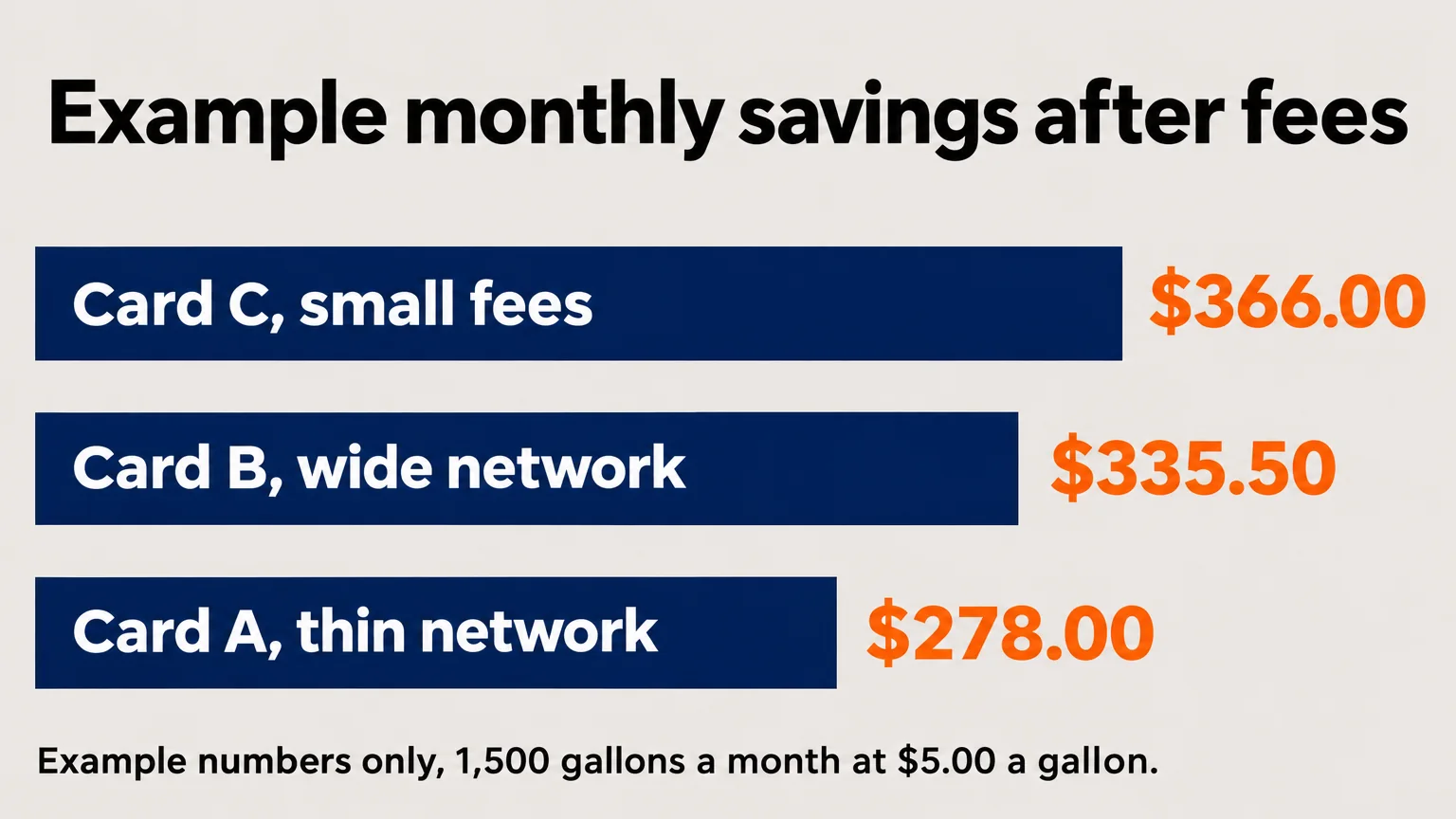
| Net savings for the month | $278.00 | $335.50 | $366.00 |
| Net cents off per gallon | 18.5 | 22.4 | 24.4 |
| Monthly fuel cost | $7,222.00 | $7,164.50 | $7,134.00 |
| Net savings for the year | $3,336 | $4,026 | $4,392 |
Rank them by the ad and Card A wins with 50 cents. Rank them by net savings and Card A finishes last. The gap between the best and worst card is $1,056 a year on one truck.
Card A needs 5 of your 10 stops in its network to pass Card B. At 5 stops it nets $355 a month, and at 4 stops it nets $278. The stop list decides the winner, not the headline discount.
Want the fee checks and fuel math in your inbox as cards and prices change? Join the RigDigest weekly email.
Hidden Cost Checklist Before You Sign
Ask for the full fee schedule in writing, and check each settlement after you start. Overdrive gives the same advice. Then go down this list:
- Transaction fees: look for per swipe fees and out of network fees. The BP Mastercard charges up to $2 per out of network transaction, and Fuelman lists $3 at select non preferred sites. If all 10 fills in a month pay a $2 fee, that is $20.
- Weekly or monthly fees: Comdata lists a $50 setup fee per account and $8 a month per card. Fuelman plan fees run $39 to $99 a month per account. Divide the monthly fee by your discount per gallon, in dollars, to find the gallons you need just to break even. At $8 a month and 8 cents off, that is 100 gallons.
- Late fees: Comdata Fleet and Mastercard accounts list the greater of $150 or 13.99 percent of the past due amount. Fuelman lists the greater of $99 or 17.99 percent of the new balance. Turn on autopay if the card bills weekly.
- Minimum volume and caps: ask whether the card charges a minimum usage fee when your spend stays under a set amount, and whether any cap limits how many gallons get the discount.
- Setup, replacement and rush shipping fees: ask about each one, since they show up on the first statement.
If a card has a fee you cannot explain in one sentence, skip that card.
Fuel Cards and IFTA: Keep the Receipts and State Records
Your fuel card report helps with IFTA, but only if it carries the right detail. Washington State and Iowa both say to keep IFTA records for four years. The clock runs from the return due date or the filing date, whichever is later.
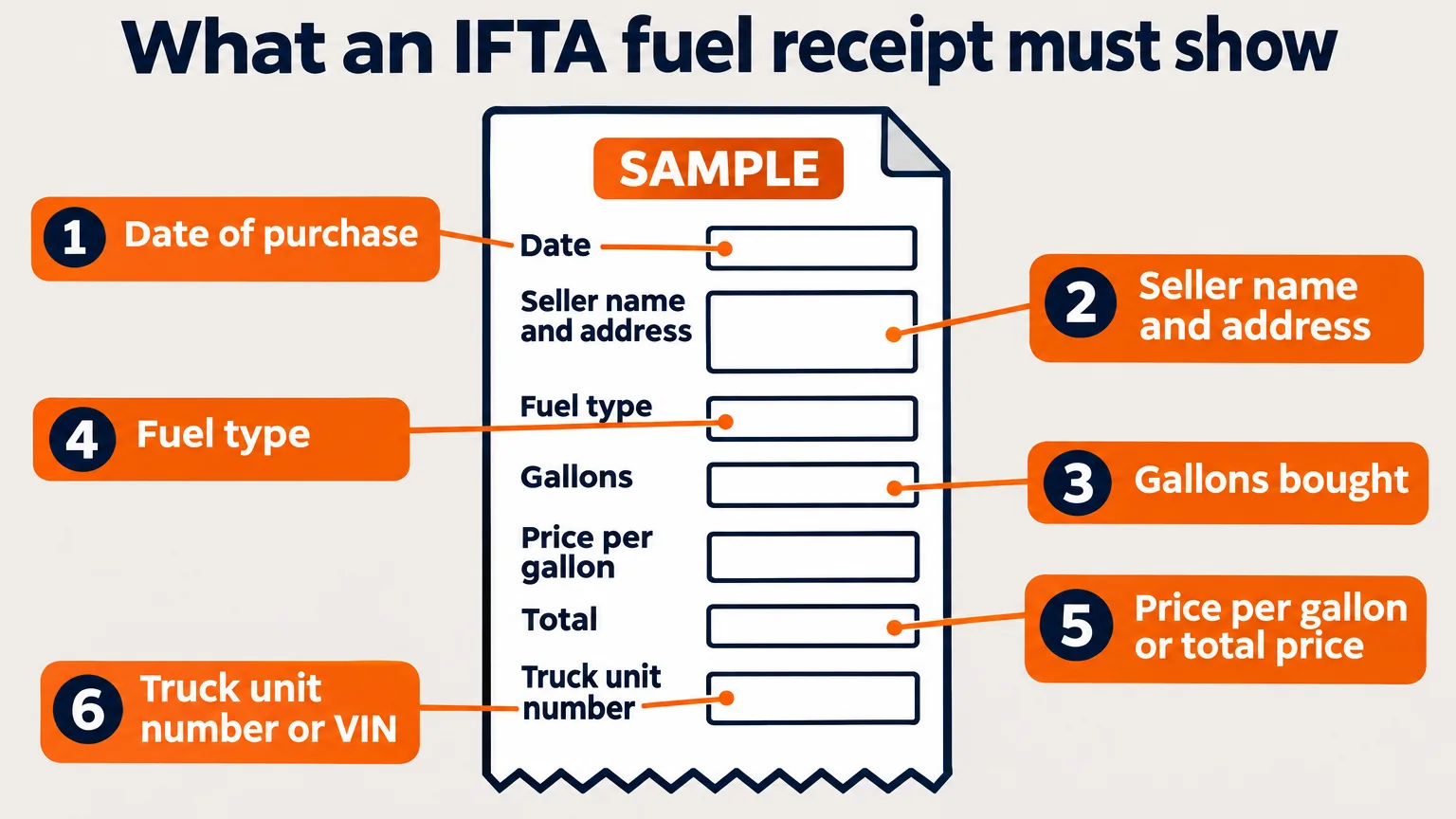
Iowa says a receipt, invoice or transaction listing used for tax paid credit must show:
- The date of purchase
- The seller name and address
- The gallons bought
- The fuel type
- The price per gallon or the total price
- The truck that got the fuel, by unit number or VIN
Iowa also says prepaid receipts and card statements without itemized purchase detail do not count. So a monthly card balance is not enough, but an itemized transaction listing from the card issuer can be. Washington's list adds whether tax was paid, so check that your card report shows it.
Here is the routine that keeps you safe:
- Download the card's transaction report every quarter, and check that each fill shows gallons, fuel type and the right truck.
- Keep the pump receipt for any fill where the report is missing a field.
- Keep miles by state from your trip records, since IFTA uses miles and gallons together.
Your base jurisdiction sets the final rules, so check its page too. Then run your quarter through the IFTA calculator.
What I Have Seen With Fuel Cards
In my Love's vs TA vs Pilot comparison I wrote that my Love's Express card and app save about 35 cents a gallon. That is my own figure, and your savings depend on your lanes.
Fuel Card FAQ
How much does a fuel card cost?
Some cards cost nothing to hold. Others charge $8 a month per card or $39 to $99 a month per account, plus $35 to $75 to set up. Per swipe and late fees add more, so judge a card by net cents per gallon, not the sticker.
Can I get a gas card with my EIN number?
Yes, fuel cards are issued to businesses, and an EIN identifies yours. An EIN alone will not get a credit line, because those cards review credit, but prepaid and cash secured cards skip the credit check and work for a new LLC. Expect to load money before you fuel.
Are DCI cards worth it?
For US trucking, no. DCI is a fuel card network run by Radius and used mainly in Ireland, Northern Ireland and the UK, not a US truck stop network. If a US seller pitches a card called DCI, ask who issues it and for the full stop list before you pay.
What is the easiest fuel card to get approved for?
Prepaid and cash secured cards are the easiest, because they usually skip the credit check and you fund them in advance. Factoring tied fuel credit is the next easiest for some new authorities. The tradeoff is that they may offer fewer reporting tools, and some prepaid cards list no fuel discount.
Pick the Card That Fits Your Lanes
The best fuel card for trucking is the one with the highest net discount on the stops you actually use, at fees you can predict. List your last 10 fills, then check each card's stop list against them. Run your numbers through the fuel cost calculator, then get the next fee check in the RigDigest weekly email.
Want more RigDigest in your Google results? Add us as a preferred source, then check the box next to rigdigest.com.
Make me a preferred source on Google