Diesel Prices Are Finally Falling: What It Means for Your Rate Per Mile
Diesel is down 35.0 cents from the record, but your rate per mile depends on your surcharge and on what brokers offer.

Key takeaways
- The U.S. Energy Information Administration (EIA) weekly diesel average fell from a record $6.529 on September 21 to $6.179 on October 12, a decline of 35.0 cents.
- That price is still $2.514 above a year ago, and the EIA's October outlook has retail prices staying above $4 a gallon through 2027.
- Surcharges tied to the EIA price fall with it, so a 35 cent decline trims a dry van surcharge by about 6 cents a mile.
- Your own fuel cost falls 5.0 to 6.4 cents a mile at 7.0 to 5.5 miles per gallon (mpg). A driver who is paid a surcharge comes out about even.
- Spot rates did not follow diesel down. DAT Freight and Analytics reported that van linehaul rose 5 cents a mile in the week of October 4 to 10.
- In September, DAT's van spot rate rose 12 cents to $3.01 a mile, but linehaul fell 2 cents to $2.17, so the whole gain was fuel.
- If a broker reduces your all in rate by more than your fuel savings per mile, you have taken a pay cut.
How far have diesel prices fallen?
The EIA national average for on highway diesel peaked at $6.529 a gallon for the week of September 21, 2026. By October 12 it was $6.179, a decline of 35.0 cents or 5.4%, according to the U.S. Energy Information Administration weekly diesel price history.
The decline came quickly and then slowed, and the latest week fell only 2.0 cents. The next EIA weekly price is due October 20.
| Week of | Price | Change from prior week |
|---|---|---|
| September 7 | $5.967 | Up 36.8 cents |
| September 14 | $6.285 | Up 31.8 cents |
| September 21 | $6.529 | Up 24.4 cents |
| September 28 | $6.382 | Down 14.7 cents |
| October 5 | $6.199 | Down 18.3 cents |
| October 12 | $6.179 | Down 2.0 cents |
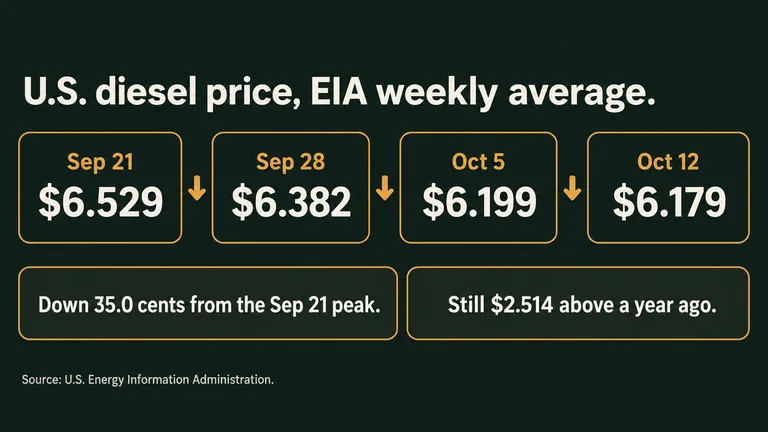
Diesel is still $2.514 above the $3.665 it cost on October 13, 2025, which is 68.6% higher. A 35 cent decline has given back only about 12% of that climb, so the relief is small compared with the increase.
Why are diesel prices falling, and will it last?
Global diesel prices have eased from September highs above $200 a barrel, according to the International Energy Agency's October 2026 oil market report. The report says diesel benchmarks are still nearly double the price of crude oil. It also expects tight supplies of middle distillates, the fuel family that includes diesel, to last well into 2027.
The EIA's October Short Term Energy Outlook points the same way. It forecasts that retail distillate prices, the category that includes diesel, will stay above $6 a gallon in October and then come down gradually. It also expects retail prices to remain above $4 a gallon through 2027.
My take: plan for slow relief, build your cost per mile on today's price, and treat any further drop as a bonus. The October 5 red dyed diesel order is a separate tax story, which I cover in the red dyed diesel guide.
How does falling diesel change your fuel surcharge?
A fuel surcharge is additional money the shipper pays to cover the cost of diesel. Overdrive explains the common truckload fuel surcharge formula. You take the EIA price, subtract a baseline price, and divide the result by the fuel mileage the contract assumes.
Overdrive says the baseline is commonly $1.25 a gallon and the assumed mileage is often 6 mpg, with some newer examples at 7. Many surcharges reset weekly after the EIA posts its new price, so yours may trail the pump by about a week. Your contract specifies the exact week.
| Equipment | Assumed mpg | At $6.529 | At $6.179 | Change |
|---|---|---|---|---|
| Dry van | 6.0 | 88.0 cents | 82.2 cents | Down 5.8 cents |
| Reefer | 5.5 | 96.0 cents | 89.6 cents | Down 6.4 cents |
| Flatbed | 5.0 | $1.056 | 98.6 cents | Down 7.0 cents |
These inputs reproduce the record September surcharges in the DAT monthly report. Those averages were 84 cents for a van, 92 cents for a reefer and $1.01 for a flatbed.
The DAT weekly report for October 4 to 10 shows the same effect. A 14.7 cent drop in the EIA price took about 2 cents a mile off the national van surcharge and 3 cents off reefer and flatbed surcharges. The same report shows the lag: it used the September 28 price of $6.382, and it says the October 5 price of $6.199 will reach the surcharge in the next report.
Did September's higher spot rate pay you more?
No. In September, DAT's average van spot rate rose 12 cents to $3.01 a mile. The linehaul part of that rate, which is the rate before fuel, fell 2 cents to $2.17.
DAT does not see a separate surcharge on spot loads. It estimates the fuel part of each rate, and that estimate hit a record 84 cents a mile for vans in September. The old high was 75 cents in June 2022. The math is simple: $3.01 minus $2.17 leaves 84 cents. The fuel part rose 14 cents and linehaul fell 2 cents, which adds up to the 12 cent gain.
Dean Croke, DAT's principal industry analyst, said in the September report that what matters for carriers is "whether the rates they negotiate can cover their higher fuel bills." He also said rates usually take three to four weeks to catch up with rising diesel prices.
Drivers feel the pressure. The American Transportation Research Institute (ATRI) surveyed nearly 3,100 industry stakeholders for its 2026 Top Industry Issues report, released October 18. Truck drivers, including owner operators and company drivers, ranked fuel prices as their top concern. Motor carriers ranked it second, behind lawsuit abuse reform.
The wider economy shows the same strain. The Bureau of Labor Statistics reported that consumer prices rose 3.7% over the 12 months ending in September 2026, while energy prices rose 20.4%.
My take: compare linehaul, not the all in total, when you look at a load. If the linehaul is lower than what you took last month, the higher total is your own fuel money coming back. Your numbers decide it. The cost per mile calculator shows your break even, the trucking fuel cost calculator shows what each gallon costs per mile, and the load profit calculator tests a single load.
Does a lower diesel price raise your rate per mile?
No. On a load with a separate surcharge, falling diesel reduces the surcharge line on your rate confirmation. On a spot load quoted as one all in number, it gives the broker a reason to offer you less.
The market has not supported that argument yet. In the week of October 4 to 10, the DAT average van spot rate rose 3 cents to $3.12 a mile. Van linehaul, which is the rate before fuel, rose 5 cents to $2.26. Flatbed all in fell 2 cents, and DAT said lower diesel pulled it down.
Van linehaul is also up 35% from a year ago, and DAT's 35 day forecast expects only a small decline to $2.23 by mid November. My loads and rates guide tracks the weekly figures if you want to follow the trend.
DAT analyst Dean Croke said in the September report that spot rates usually take three to four weeks to catch up with rising diesel. Carriers pay for fuel in the meantime. A rising price hurts you first, while a falling price benefits you only if your rate holds.
How much do you really save when diesel falls?
Your fuel savings per mile equal the price decline divided by your real fuel economy. This table applies that calculation to the 35 cent decline from the peak, with a weekly total for 2,500 miles.
| Your mpg | At $6.529 | At $6.179 | Saved per mile | Saved in 2,500 miles |
|---|---|---|---|---|
| 5.5 | $1.187 | $1.123 | 6.4 cents | $159 |
| 6.0 | $1.088 | $1.030 | 5.8 cents | $146 |
| 6.5 | $1.004 | $0.951 | 5.4 cents | $135 |
| 7.0 | $0.933 | $0.883 | 5.0 cents | $125 |
Take an example truck that gets 6.5 mpg and runs 2,500 paid miles a week. Its fuel cost declines from $1.004 to $0.951 a mile, which saves $135 a week.
If your surcharge assumes 6.0 mpg, it declines 5.8 cents a mile, or $146 a week. You end up about $11 a week behind, which is close to a wash, and a truck under 6.0 mpg comes out slightly ahead. Either way, the difference is under a penny a mile.
DAT's September report used a truck that runs 500 miles a day at 6 mpg, which means it burns 83.3 gallons of diesel every day. At $6.529 the fuel costs $544 a day. At $6.179 it costs $515, so the decline saves about $29 a day or $146 over a five day week.
That same report put fuel at $524 a day for September, up $214 a day from February. A 35 cent decline gives back only a small part of that increase.
Who gains when diesel falls, and who should not count on it?
| Driver type | What changes | What to check |
|---|---|---|
| Leased on, surcharge passed through | Your fuel bill falls now. Your surcharge can fall about a week later. | Your carrier's pass through share. My lease on carrier terms guide compares nine carriers. |
| Own authority, contract freight | Same pattern, set by your rate agreement. | The baseline price, the mpg and the EIA week in the contract. |
| Own authority, spot freight | No surcharge line. Brokers may cite cheaper diesel to lower offers. | Any cut compared with your savings per mile in the table above. |
| Company driver paid by the mile | Nothing in your pay changes. The carrier pays for fuel. | Whether your carrier ties a bonus to fuel use. |
My verdict: falling diesel is a cost reduction for your truck and a wash on your rate. It benefits you most when your rate holds while your fuel expense declines. It benefits you least when you accept a rate reduction because of it.
Two developments would change that verdict. If diesel declines faster than 35 cents a month, brokers will push harder to reduce rates, so have your break even figure ready. That is the lowest rate that still covers every cost of running your truck. If diesel rebounds, your surcharge can rise a week later while you pay the higher pump price first.
This is general information about fuel costs. Your lease and your rate confirmations decide what you are paid.
What should you do this week?
- Locate the fuel surcharge line on your last settlement or rate confirmation, and note which EIA week it uses.
- Divide today's diesel price by your real mpg to get your fuel cost per mile. The trucking fuel cost calculator does it by trip.
- Find the fuel part of your rate. On a spot load, that is the all in rate minus linehaul, as I show in how to calculate rate per mile.
- Before you accept a lower offer that blames diesel, subtract the reduction from your savings per mile in the table above.
- Check the new EIA price on Tuesday, October 20, and repeat the calculation.
Frequently asked questions
Are diesel prices going down?
Yes, slowly. The EIA national average fell from $6.529 on September 21 to $6.179 on October 12, a decline of 35.0 cents. It is still $2.514 above a year ago.
Does falling diesel lower my fuel surcharge?
Yes, when your surcharge follows the EIA price. A 35 cent drop cuts a van surcharge by about 5.8 cents a mile, and the reduction can show up about a week after the EIA posts the lower price.
How is a fuel surcharge calculated?
Take the EIA diesel price, subtract the baseline price, and divide by miles per gallon. At $6.179, a $1.25 baseline and 6.0 mpg, the surcharge is about 82 cents a mile. Your contract sets the real baseline, mpg and EIA week.
Will diesel fall below $6 a gallon soon?
The EIA's October outlook has retail distillate prices, which include diesel, above $6 for October and then coming down gradually. It gives no date for a lower price, and it expects retail prices to stay above $4 a gallon through 2027.
Do spot rates drop when diesel drops?
Not right away, because DAT van linehaul rose 5 cents a mile to $2.26 in the week of October 4 to 10 while diesel fell. Compare any offer with your own cost per mile before you accept it.
What if a broker cuts my rate because diesel fell?
Work out your fuel savings per mile by dividing the price decline by your mpg. A 35 cent decline saves about 5.4 cents a mile at 6.5 mpg. A reduction larger than that lowers your profit, so counter the offer or pass.