7 Quick Ways to Locate the Closest Truck Stop and Avoid Costly Delays

The fastest way to find the closest truck stop is to use two sources together. Use the exit signs for what is ahead of you. Use a trucker app to confirm the stop is open, has parking and fits your rig. Start your search with three hours of drive time left, not when the clock is almost out.
Closest on the map and closest for you are not always the same stop. A stop 3 miles away that is full, closed or too tight for your trailer is farther than one 12 miles away with an open space.
Nobody warns you that parking can be harder to find than the load. I had 30 minutes left outside Houston, and the rest area was full and the next stop was closed. I shut down in a dark lot, slept badly, and lost about $200 in time and a bonus. My rule now is to look for parking when I have three hours left, not one.
This is a real problem, not a driver complaint. In the Federal Highway Administration's 2019 Jason's Law survey, 98 percent of drivers who responded reported problems finding safe parking. The American Transportation Research Institute (ATRI) put the gap in plain numbers in its 2025 research on public truck parking: just one truck parking space nationally for every 11 truck drivers, and an average of 19 truck spaces at a rest area. Since you are paid by the mile, every hour you spend searching is an hour you are not earning. Here is how to calculate your rate per mile if you want to see it on one of your loads.
Here are 7 ways to cut that time down.
1. Read the exit signs before you reach them
The blue Gas, Food and Lodging signs on the interstate list the businesses at the next exit. Read them early, while you still have time to pick your exit and get in the right lane, instead of deciding at the ramp.
A logo on that sign only tells you the business signed up to be listed. It does not tell you the lot has diesel lanes, a space for a 53 foot trailer or any parking left. Treat the sign as a lead, then check it.
2. Use a trucker app instead of a car map
A car map knows where fuel is, but it cannot tell you the lot is small, the entrance is tight or the diesel lanes are around back. Trucker apps such as Trucker Path are built around truck parking, fuel and truck stop details.
Check three things before you exit: how recent the last report is, whether diesel is listed and how big the lot is. Parking counts in these apps can be out of date by the time you arrive, so a "lots of spots" tag is a guess, not a promise.
3. Use your fuel chain's app and your fuel card's network
Your fuel card decides which stop is really the closest. A stop that will not take your card costs you a second stop.
If the chain you fuel with has an app, check what it shows for the stop ahead before you exit.
I use the Love's Express card with the Love's Connect app. Together they save me about 35 cents a gallon on diesel. I now plan my fuel and parking stops around Love's, but I won't go far out of my way for a discount.
Do the math before you chase a cheaper pump. Say you fill 100 gallons and the far stop saves 10 cents a gallon. That is $10. If your cost per mile is $2.00 (use your own number), a 12 mile round trip detour costs $24. The cheap stop lost. You can test your own trip in the fuel cost calculator.
4. Watch for state truck parking systems
Some states now show you how many parking spaces are open before you reach the lot. Washington launched one on Interstate 5 in September 2025. It covers rest areas and weigh stations, shows spaces open up ahead and predicts availability up to four hours out, through in cab displays and phone apps.
Other states have received federal money to build their own. The FMCSA grant list for 2018 to 2024 includes truck parking information systems in Connecticut, Montana and South Dakota. Funding does not mean a system is live on your route, so check the state's traveler site and your trucker app before you count on one.
5. Plan the stop backward from your hours of service clock
The nearest stop only counts if you can reach it before your clock ends. The Federal Motor Carrier Safety Administration's hours of service summary sets the limits for property carrying drivers, as of October 2026:
- 11 hours of driving after 10 hours off duty.
- No driving after the 14th hour from coming on duty.
- A 30 minute break once you have driven 8 hours without a 30 minute interruption.
That break can be any 30 straight minutes of non driving time, including on duty not driving, off duty or sleeper berth. It does not have to be a nap, so a fuel stop can cover it if you stay out of driving for the full 30 minutes.
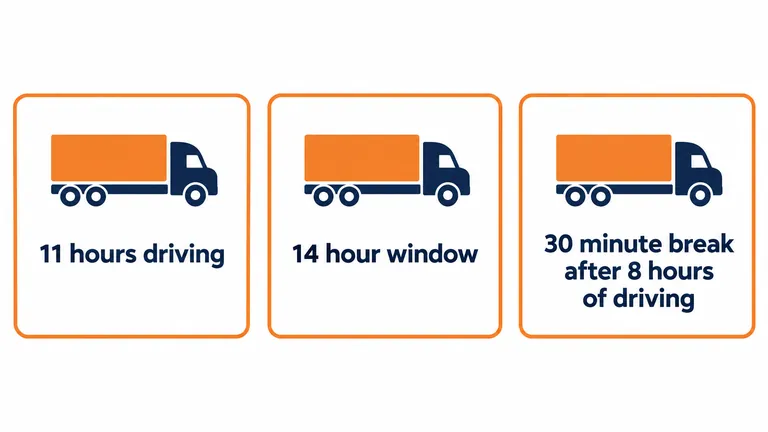
At the start of each day, mark your 8 hour break point and your 11 hour limit. Choose your stops so they land well ahead of both. Use your three hour rule as the cushion, so you are looking for a space long before the clock forces your hand. The cushion matters for safety too. In its first Jason's Law report, the Federal Highway Administration warns that when drivers cannot find a space, tired truck drivers may continue to drive or park at unsafe locations such as the shoulder of the road, exit ramps or vacant lots.
6. Check the lot before you commit
Take 60 seconds and look at three things.
First, open the satellite view to see the entrance, the lot shape and whether a long trailer will fit. Second, check the hours and whether the diesel lanes are separate from the car pumps. Third, check the diesel price in your fuel app, because a map listing may show the regular gas price instead.
The stop that burned me was the Love's in Gallup, NM. It looked fine on the map, with fuel, food, and a pin that said truck parking. But the layout has a bad reputation among drivers, and I found out why. There's little room to turn around, so trucks end up doing U turns while others keep pulling in behind them.
7. Pick a backup before you need one
Never plan around one stop. Pick a first choice and a backup before you leave the last town. If the first lot is full, you already know the next exit and you do not spend 20 minutes searching with your hours running down.
Plan your evening stop earlier than you think you need to. A full lot late in your day leaves you the fewest options.
If you haul hazmat, the closest stop may not be allowed
Federal rule 49 CFR 397.7 limits where you can park a vehicle with hazardous materials. If you haul explosives (Division 1.1, 1.2 or 1.3), you cannot park on or within 5 feet of the traveled part of a public road. You cannot park on private property, including a fueling or eating facility, unless the person in charge of the property knows you are there and knows what you are hauling. You also cannot park within 300 feet of a bridge, tunnel, dwelling or a place where people work, gather or assemble, except for a brief period when the operation requires it and no other place is practical. For other hazmat loads, the rule is narrower: do not park on or within 5 feet of the traveled part of a public road, except for a brief period when the operation requires it and no other place is practical.
Ask the stop before you commit, and check your carrier's own rules, which can be stricter.
On a placarded load, I park away from the road, keep the truck in view, and keep my stops short. I plan the stop early because a full lot leaves me fewer options. For explosives, I tell the manager what I'm hauling before I park.
Which method should you use first?
If you do only three things, read the exit signs, confirm in one trucker app and pick a backup. That is enough for lanes you know well.
If you run new lanes, add the hours of service plan. That is where the money is lost, because a full lot at the end of your clock costs you miles you cannot drive. If you have never worked out what a lost hour costs you, run your own numbers in the cost per mile calculator.
This article is general information. Rules reviewed in October 2026. Confirm hours of service and hazmat rules with the FMCSA or your carrier.
Written by Emeka Ogbonna, an owner operator with 11+ years over the road, from company driver to running on his own authority.